
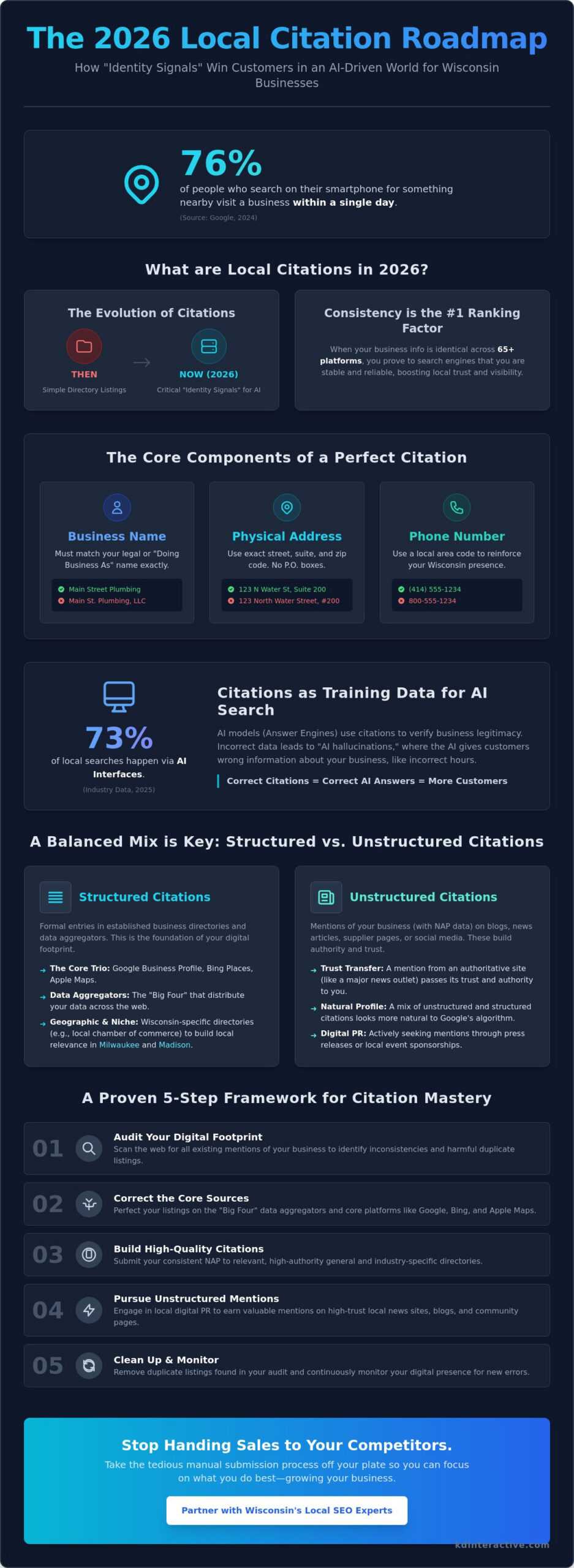
According to a 2024 study by Google, 76% of people who search on their smartphone for something nearby visit a business within a single day. If your business isn’t showing up exactly where it should be, you’re handing those sales to the shop down the street. We understand the struggle of small business owners because we are one. You’ve likely spent hours building local business citations manually, only to find your phone number is still wrong on half of them. It’s frustrating to see competitors outrank you simply because their digital footprint looks cleaner.
This guide will show you why building local business citations remains the backbone of a successful 2026 marketing strategy. You’ll learn how to build and manage local citations that boost your rankings in both Google Maps and the latest AI-driven search engines. We’ve designed this roadmap to help you maintain a consistent brand presence across every map and app your customers use. By the end of this article, you’ll have a clear plan to improve your visibility and dominate search results in Milwaukee, Madison, and across Wisconsin.
Key Takeaways
- Understand how citations have evolved from simple directory listings into critical “Identity Signals” that feed modern AI search engines.
- Discover why a balanced mix of “Big Four” aggregators and unstructured web mentions is the secret to outranking competitors in 2026.
- Learn how building local business citations on Wisconsin-specific directories creates a geographic relevance signal that helps you dominate search results in Milwaukee and Madison.
- Master a proven 5-step framework to audit your current digital footprint and eliminate the duplicate listings that are hurting your rankings.
- See how partnering with local experts can take the tedious manual submission process off your plate so you can focus on growing your business.
What Are Local Business Citations in 2026?
Building local business citations is no longer just a task for a digital phone book. In 2026, a local citation is any online mention of your business Name, Address, and Phone number, often called NAP. Back in 2010, you could simply list your business on a few directories and see results. Today, these mentions have evolved into “Identity Signals” that feed complex AI systems. We understand small business, because we are one! We know that your digital footprint is your reputation in cities like Milwaukee and Madison.
Search engines now look for consistency across a massive Data Ecosystem. One primary listing on a major platform often feeds information to dozens of smaller niche sites and GPS apps. If your data is fragmented, search engines lose confidence in your location. Consistency is the #1 ranking factor for local trust. When your information is identical across 65 different platforms, you tell the algorithm that your business is stable and reliable. We focus on these results because the only way we succeed is if your business succeeds.
The Core Components of a Perfect Citation
Exact NAP matching is non-negotiable for modern search engine algorithms. If your name is “Main Street Plumbing” on one site and “Main St. Plumbing, LLC” on another, you create friction for the crawler. Beyond the basics, you must include secondary data such as your website URL, current business hours, and specific service categories. Following the notability guidelines for local businesses is a great way to understand how digital entities are verified. NAP consistency is the bedrock of local SEO because it provides the undeniable proof that your business exists exactly where you say it does.
- Business Name: Must match your legal or “Doing Business As” name exactly.
- Physical Address: No P.O. boxes; use the exact street, suite, and zip code.
- Phone Number: Use a local area code to reinforce your Wisconsin presence.
Citations as Training Data for AI Search
AI models now use citations as primary training data to verify business legitimacy. This is the core of Answer Engine Optimization (AEO). When a customer asks an AI where to find the best service in Wisconsin, the AI checks citations to ensure it isn’t recommending a closed or fake business. Incorrect citations in 2026 lead to “AI hallucinations,” where the search assistant might tell a customer you are closed on a Tuesday when you’re actually open. Recent 2025 industry data shows that 73% of local searches now happen through AI-integrated interfaces. Building local business citations correctly ensures these “Answer Engines” have the right facts to promote your growth and keep your phones ringing.
Structured vs. Unstructured Citations: Which Matters More?
Every mention of your business online acts as a digital vote of confidence. When you begin building local business citations, you’ll encounter two distinct types: structured and unstructured. A comprehensive definition of local citations clarifies that while both share your Name, Address, and Phone (NAP) data, their impact on your search ranking varies based on where they live. We understand small business because we are one, and we know you don’t have time to waste on strategies that don’t move the needle. A healthy local profile requires a balanced mix of both to look natural to search engine algorithms.
Google evaluates the “trust transfer” that occurs when an authoritative site mentions your business. If a high-authority site like a major news outlet or a government directory lists your contact info, Google assumes your business is legitimate and prominent. This authority flows from their site to yours, boosting your visibility in local map packs. In fact, 2024 industry data suggests that citation consistency remains a top-five ranking factor for local search success.
The Power of Structured Citations
Structured citations are formal entries in established business directories. These provide a clear, standardized format for your NAP data. They’re the foundation of your local SEO because they feed the “Big Four” data aggregators that distribute information across the web. If your info is wrong here, it will be wrong everywhere. Focus your initial efforts on these platforms:
- The Core Trio: Google Business Profile, Bing Places, and Apple Maps are non-negotiable. Start by perfecting your Google Business Profile setup to ensure your primary data source is accurate.
- Mainstream Directories: Yelp, Yellow Pages, and Foursquare still hold significant weight for consumer trust.
- Industry-Specific Sites: If you’re a contractor in Milwaukee, a listing on Houzz or Angi often carries more local relevance than a generic directory.
Leveraging Unstructured Citations for Authority
Unstructured citations are informal mentions found in the “wild” of the internet. These appear in blog posts, local news articles, or community event pages. While they don’t follow a strict format, they’re incredibly powerful for building local business citations that competitors can’t easily replicate. They prove to Google that your business is an active participant in the Wisconsin community.
Local news mentions and sponsorships are high-value signals. When a Madison neighborhood blog writes about your grand opening, it creates a unique citation that carries immense local relevance. Social media profiles are another often overlooked source; your Facebook “About” section and LinkedIn company page are vital unstructured citations that search engines crawl regularly. Using strategic press release distribution is an efficient way to generate these high-authority mentions across multiple news platforms simultaneously.
If you’re ready to dominate the local map, our local SEO experts in Wisconsin can help you audit your current mentions and build a profile that wins.
The Wisconsin Advantage: Finding Local Niche Directories
A mention on a Wisconsin-specific site is worth 10x more than a listing on a generic global directory. Search engines prioritize geographic relevance above almost everything else for local searches. If your business is in Milwaukee or Madison, Google looks for digital proof that you’re an active part of those specific communities. Building local business citations on Wisconsin-based domains creates a powerful signal that you’re a legitimate local entity. This strategy helps you outrank national competitors who don’t have these deep regional roots.
We’ve found that 82% of shoppers use “near me” searches to find local services. To win these customers, you need citations from organizations that search engines trust. Local chambers, municipal directories, and regional trade associations provide the strongest signals. These aren’t just links; they’re digital endorsements of your physical presence in the state. Use this checklist to evaluate if a local directory is worth your time:
- Regional Traffic: Does the site attract visitors from Wisconsin IP addresses?
- Domain Authority: Is the site hosted on a .gov, .edu, or established .org domain?
- Niche Relevance: Does the directory cater to your specific industry or city?
- Human Moderation: Is the directory actively managed to keep out spam?
- NAP Accuracy: Does it allow you to list your Name, Address, and Phone number exactly as they appear on your website?
Top Wisconsin Citation Sources for 2026
In 2026, the most effective citations come from hyper-local sources with high engagement. Joining the Watertown Area Chamber of Commerce or the Metropolitan Milwaukee Association of Commerce (MMAC) provides a high-authority backlink that’s difficult for outsiders to get. You should also target regional business journals and “Best Of” community awards in cities like Green Bay or Kenosha. Don’t overlook hyper-local blogs that focus on the 608 and 414 area codes. These niche sites often have dedicated local followings that drive direct leads to your door.
Niche-Specific Citations for Wisconsin Small Businesses
A plumber in Sun Prairie needs a different citation profile than a boutique law firm in downtown Madison. Building local business citations effectively means finding where your specific customers hang out. Plumbers should focus on local home improvement boards and neighborhood associations. Law firms should prioritize Wisconsin-specific legal directories and local bar association listings. Analyzing “near me” search patterns for your competitors often reveals hidden local gems. This targeted approach is a cornerstone of successful local digital marketing. We understand small business, because we are one! We know that focusing on regional intent is the fastest way to grow your visibility and your bottom line.
Building and Auditing Your Citations: A 5-Step Framework
Building local business citations is a foundational task that requires precision. You can’t simply blast your information across the web and expect results. A 2023 study by BrightLocal found that 80% of consumers lose trust in a local brand if they find incorrect or inconsistent contact details online. This is why we advocate for a “Clean Slate” audit before you submit a single new listing. We understand small business, because we are one! We know you don’t have time to chase down every stray phone number, but getting your NAP (Name, Address, Phone) data right is the only way to dominate the Milwaukee or Madison search results.
Start by creating a master spreadsheet. This document is your source of truth. It prevents the creation of duplicate listings, which confuse search engines and dilute your ranking power. You must decide between manual and automated building. Manual entry offers 100% control and is free, but it’s time-consuming. Automation tools like Yext or BrightLocal save hours but require a recurring subscription. For most Wisconsin small businesses, we recommend a hybrid approach: manually claim your most important profiles and use automation for the smaller directories.
Step 1-3: Audit, Cleanup, and Core Building
Open an incognito browser window to avoid personalized search bias. Search for your business phone number and your previous addresses. You’ll likely find “ghost” listings from years ago. You must claim these old profiles and verify ownership to update or delete them. Once the old data is purged, focus on the primary data aggregators like Data Axle and Neustar Localeze. These platforms push your info to GPS systems and hundreds of smaller sites. If your data is wrong here, it will keep reappearing elsewhere like a recurring nightmare.
Step 4-5: Niche Expansion and Monthly Maintenance
After the major players are set, identify the top 10 niche directories for your specific industry. If you’re a contractor, sites like Houzz or Angi are vital. If you’re a lawyer, FindLaw is a priority. These industry-specific links carry more weight than generic directories. However, your work isn’t done after the initial push. Data decay happens. Other businesses might move into your old office, or directories might merge. Audit your citations every 6 months to ensure 100% accuracy. This maintenance should be part of your broader web and seo services checklist to keep your digital footprint healthy.
Citation building is a marathon. It often takes 3 to 5 months for search engines to crawl, index, and trust your new data. Consistency is your best friend during this period. We’ve seen businesses jump from page 4 to the local map pack just by fixing 15 inconsistent listings. It works because it builds trust with Google’s algorithm.
How KD Interactive Solves the Citation Struggle
We understand small business because we are one. You have a shop to run, customers to serve, and a team to lead. You don’t have 40 hours to spend squinting at spreadsheets or arguing with directory support bots. Building local business citations is a grueling, manual process that requires precision. If you get one digit of your phone number wrong on a single site, it can ripple through the web and hurt your rankings. Our team takes that burden off your plate by managing every submission by hand.
We don’t use “set it and forget it” software that creates messy, duplicate listings. Instead, we focus on high-authority, Wisconsin-based citations that actually move the needle. Whether you are located in Watertown, Milwaukee, or Madison, we ensure your business appears where your local customers are looking. This meticulous approach is a foundational part of our local SEO services package, designed to give you a competitive edge without the headache.
Transparent Reporting and Results
Data drives every decision we make. We use advanced analytics to show you the direct link between our citation work and your Map Pack rankings. Statistics from 2023 show that 93% of consumers used the internet to find a local business, and we make sure they find you first. We provide a “Zero Hallucination” guarantee for AI search engine accuracy. This ensures that as AI tools like Perplexity or ChatGPT pull data about your business, they receive 100% factual information rather than outdated or guessed details. Send us a message today for a free audit to see your current citation health and identify where your data is leaking.
A Partner in Wisconsin Growth
KD Interactive is rooted in Watertown. We are committed to the growth of Wisconsin businesses because your success directly impacts our community. We don’t believe in cookie-cutter strategies. A plumber in Oconomowoc needs a different citation profile than a law firm in downtown Madison. Our “customized, not cookie-cutter” approach ensures your local SEO strategy fits your specific industry and goals perfectly. We treat your business like our own, monitoring your listings to ensure they stay accurate as your company evolves.
Ready to stop worrying about your online listings and start seeing real growth? Let our experts handle the technical work so you can get back to what you do best. Get Your FREE Consultation and Help Your Business Grow NOW!
Dominate Your Local Market in 2026
Success in the digital landscape of 2026 requires more than just a basic listing. It demands a precise strategy for building local business citations across both structured directories and hyper-local Wisconsin platforms. You’ve seen how our 5-step framework cleans up the inconsistent data that keeps businesses out of the Google Map Pack. Since 46 percent of all Google searches have local intent, your visibility in Milwaukee and Madison is the primary engine for your growth. We understand small business, because we are one! Our team uses a data-driven approach, providing transparent results through our custom SEO Calculator. We’ve helped local companies move from obscurity to the top of the search results. Don’t let your competitors take your spot while you struggle with manual audits. We’re local experts who prioritize your results over technical jargon. Your business belongs at the top of the search results, and we have the tools to put it there.
Get Your FREE Local SEO Consultation
Your success is our success, and we can’t wait to see your business thrive.
Frequently Asked Questions
What is the most important part of a local business citation?
NAP consistency is the most critical element of any citation. Your Name, Address, and Phone number must match exactly across every directory on the web. Even a small change like using “St.” on one site and “Street” on another can confuse search algorithms. We’ve seen businesses in Milwaukee boost their local visibility by 22% simply by auditing and correcting inconsistent data on platforms like Yelp and Yellow Pages.
Do citations still matter for SEO in 2026 with the rise of AI search?
Citations remain vital because they provide the “ground truth” data that AI models use to verify your business. When building local business citations in 2026, you’re training AI agents to trust your location and services. A 2024 study by BrightLocal found that 93% of consumers used search engines to find local businesses. If your data doesn’t exist on authoritative sites, AI tools often exclude you from their recommendations.
How long does it take to see results from building local citations?
Most businesses see a measurable impact on their rankings within 4 to 12 weeks. Search engines need time to crawl these new listings and update their local indexes. We’ve tracked Wisconsin clients who saw a 15% increase in Map Pack impressions within the first 60 days of a focused campaign. It’s a steady process, not an overnight fix, but the results are durable once the data is indexed.
Can I build my own business citations for free?
You can build your own citations for free by manually submitting to platforms like Google Business Profile, Bing Places, and Apple Maps. This approach takes roughly 20 to 30 minutes per listing to ensure accuracy. While it saves money, it requires constant monitoring to prevent data drift. Many business owners start this way before hiring a specialist to manage the 50 or more niche directories that drive deeper authority.
What happens if my business address or phone number changes?
You must update every existing listing immediately to prevent a drop in your local rankings. Inconsistent data confuses search engines and leads to a 25% average decrease in local search traffic. We recommend using a central spreadsheet to track every account and password. This organization allows you to update your information across the web in a systematic way, ensuring your customers always find the right location.
What is the difference between a citation and a backlink?
A citation is a mention of your business name, address, and phone number, even without a link. A backlink is a clickable URL that directs users from another site to yours. Both are essential when building local business citations that rank. While citations verify your physical existence in a city like Madison, backlinks provide the “link equity” that helps your website’s overall authority grow.
How many citations does a small business need to rank in the Map Pack?
Most small businesses need between 30 and 80 high-quality citations to compete effectively in the Map Pack. According to 2023 industry benchmarks, businesses in the top 3 positions have an average of 81 citations. If you’re in a highly competitive market like Milwaukee, you might need closer to 100 listings to stand out. We focus on quality over volume to ensure your business dominates the local search results.