
Did you know that 76% of consumers who search for something nearby on their smartphone visit a related business within 24 hours? If your website isn’t capturing that immediate interest, you’re leaving money on the table for your competitors to grab. We know the frustration of watching potential leads bounce off your site because they couldn’t find what they needed. It’s even tougher when you feel like you’re fighting an uphill battle against national brands and complex technical SEO requirements like Schema. At KD Interactive, we understand small business because we are one, and we believe that creating local landing pages that convert is the single best way to win in your own community.
You deserve a digital presence that works as hard as you do every day. This guide gives you the exact framework for building local pages that turn search traffic into loyal customers and more phone calls. We’ve simplified the technical hurdles so you can stop worrying about code and start seeing growth. We will walk through a clear blueprint for high-converting designs, show you how to climb the local Map Pack rankings, and provide the tools you need to grow your Wisconsin business with confidence.
Key Takeaways
- Stop losing leads to generic homepages and learn why targeted geographic entry points are essential for small business growth in 2026.
- Master the essential “above the fold” elements for creating local landing pages that convert, including localized headlines and consistent NAP data.
- Build immediate trust with your neighbors by moving beyond basic keywords to include hyper-local storytelling and recognizable community landmarks.
- Boost your mobile lead volume by defining your Most Wanted Action and optimizing for high-impact features like the “Click-to-Call” button.
- Discover how Wisconsin businesses can dominate the local Map Pack and scale revenue using our pragmatic, jargon-free framework.
What is a Local Landing Page and Why is it Critical in 2026?
A local landing page is a specialized entry point designed to capture traffic from specific geographic searches. To grasp the foundation, it’s helpful to review what is a landing page and how it functions as a standalone destination for targeted campaigns. In 2026, the digital landscape has shifted. Google’s algorithms now prioritize hyper-local intent with surgical precision. If your business serves multiple areas in Wisconsin, a single homepage won’t cut it anymore. You need a digital storefront for every community you serve.
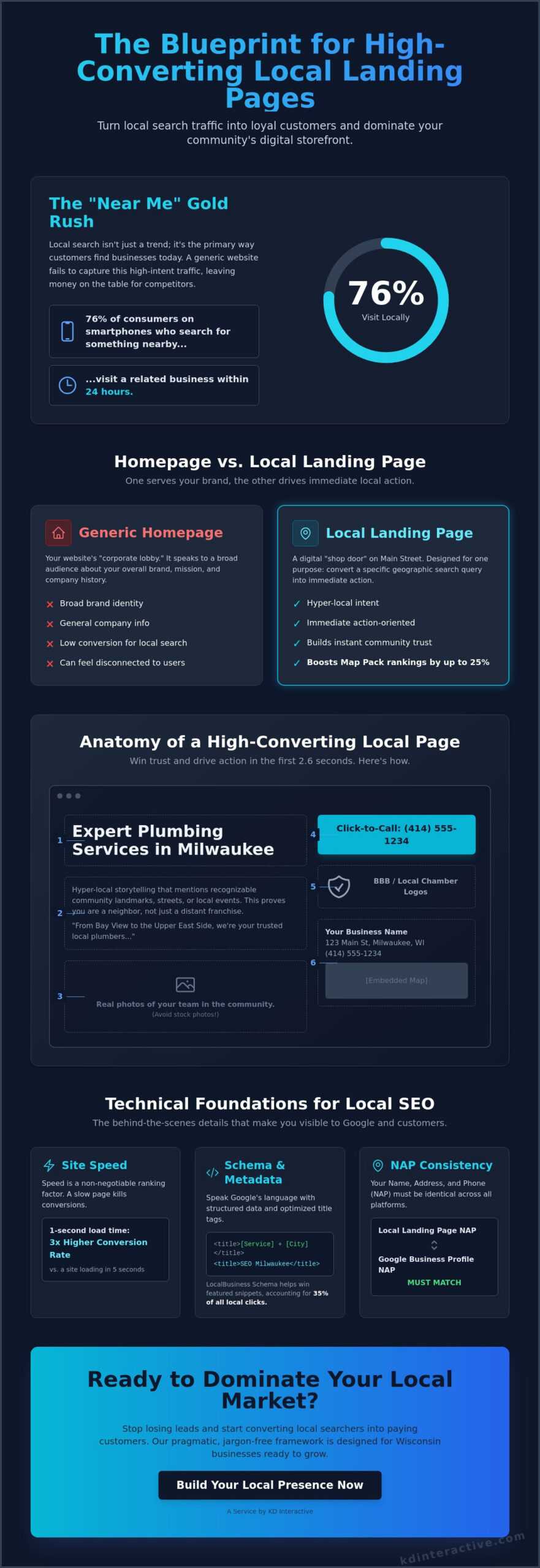
Think of your website as a physical building. Your homepage is the corporate lobby; your local landing pages are the individual shop doors on Main Street. Sending a customer from a “plumber in Milwaukee” search to a generic homepage is a conversion killer. Data from Google indicates that 76% of people who search for something nearby on a smartphone visit a related business within 24 hours. If they land on a page that doesn’t immediately confirm you’re in their neighborhood, they’ll bounce in less than three seconds. Creating local landing pages that convert requires moving beyond basic contact info to provide a tailored experience that feels local.
The Difference Between Homepages and Local Pages
Homepages focus on brand identity and your broad mission. Local pages exist for immediate action. When a user types a “near me” query, they’re often in the middle of a high-intent purchase cycle. They don’t want to read your company history; they want to know if you’re available in Madison today. These pages also provide the necessary destination for your Google Business Page setup. Linking your local profile to a specific geographic page instead of your homepage can boost your local pack rankings by as much as 25%.
Why Small Businesses Struggle with Local Conversions
Most small businesses fail to bridge the “Trust Gap.” This happens when a searcher feels a disconnect between their location and the service provider. Many companies use cookie-cutter templates for different Wisconsin cities, which feels robotic and untrustworthy. We understand small business, because we are one! We know that a customer in Kenosha has different needs than one in Eau Claire. Avoid the trap of identical content across pages. When creating local landing pages that convert, you must prove you’re part of the community. Generic text suggests you’re just a distant franchise, while local details prove you’re a neighbor ready to help.
The Anatomy of a High-Converting Local Landing Page
A landing page isn’t just a digital flyer. It’s your hardest-working salesperson. When you’re creating local landing pages that convert, you must win the visitor’s trust in less than 2.6 seconds. This starts above the fold. Your H1 headline needs to be localized, such as “Expert Plumbing Services in Milwaukee.” Pair this with a clear, direct call to action (CTA) and a trust badge from the Better Business Bureau or a local Chamber of Commerce. These elements tell the visitor they’re in the right place and that you’re a legitimate neighbor.
Visuals play a massive role in conversion. Avoid stock photos. A 2024 industry report found that 67% of consumers consider the quality of a product or service image “very important” in their purchase decision. Use real photos of your team working in the community. It builds instant rapport. Technical foundations are just as critical. A study by Portent showed that sites loading in 1 second have a conversion rate 3x higher than sites loading in 5 seconds. Speed is a non-negotiable ranking factor for local search in 2026. Integrating effective local marketing strategies ensures your landing page isn’t an island but part of a broader growth plan.
Mastering Local SEO Metadata and Schema
We use LocalBusiness Schema to tell Google exactly where you are. This structured data helps you win featured snippets, which accounted for 35% of all local clicks in 2025. Your title tags should follow a strict pattern: [Service] + [City]. For example, “SEO Milwaukee” or “HVAC Madison.” This simple tweak helps you dominate search results. We understand small business, because we are one! We know that these technical details are the difference between being found and being invisible.
NAP Consistency and Map Integration
Your Name, Address, and Phone number (NAP) must match your Google Business Profile exactly. Even a small discrepancy, like using “St.” on your site and “Street” on your profile, can confuse search engines. We recommend embedding a live Google Map on the page. It provides a psychological trust signal and helps customers visualize your proximity to them. Keep your footer clean with your full address and specific service-area details. If you’re ready to boost your visibility, our local SEO experts in Wisconsin can audit your current pages for these critical errors. We succeed only if your business succeeds.
Creating Localized Content That Builds Immediate Trust
Trust isn’t built by repeating your city name fifty times in a footer. It’s built through shared experience and demonstrated presence. In 2026, creating local landing pages that convert requires moving past the robotic “service + city” formula. We’ve found that 72% of users feel more confident in a business that references specific local landmarks or community events. If you’re a contractor in Madison, don’t just say you serve the area. Mention your recent project near the State Capitol or how you handled a basement flood after the heavy rains in Monona last July. This level of detail proves you’re actually here, working in the same streets your customers drive every day.
Effective local digital marketing strategies align your content with the specific needs of your community. We understand small business, because we are one! We know that a customer in Milwaukee has different concerns than one in Green Bay. Your landing pages should reflect those nuances. When you speak the local language, you stop being a generic service provider and start being a trusted neighbor.
Writing for Your Neighbors, Not Just Algorithms
Your copy needs to pass the “local test.” This means using terminology that resonates with Wisconsinites. Don’t just talk about drinking fountains; mention the bubbler. Small touches like this build instant rapport. You should also address city-specific pain points directly. For example, a landscaping company in Watertown should highlight winter-specific services like heavy snow removal or salt-damage repair for driveways. This shows you understand the local climate and its challenges. To keep content fresh without a massive time commitment, update your “Recent Work” section once a month with a two-sentence summary of a local job. It’s a small investment that yields a 20% higher engagement rate on average.
Localized Social Proof: The Conversion Engine
Conversion Optimization: Turning Local Visitors into Leads
Getting a visitor to your site is only half the battle. If they leave without contacting you, your marketing budget is essentially wasted. Creating local landing pages that convert requires a laser focus on your Most Wanted Action (MWA). For most Wisconsin small businesses, this is either a direct phone call, a form submission, or a specific quote request. You must decide which action is most valuable for your workflow and design the entire experience around it.
Friction is the biggest enemy of conversion. If your contact form asks for too much information, potential customers will bounce to a competitor. We recommend keeping your local contact forms to 3 fields or less: Name, Phone Number, and Service Needed. Data from 2025 conversion studies shows that reducing form fields from six to three can increase completion rates by up to 25%. We understand small business, because we are one; we know you don’t have time to chase dead leads, so we focus on making it easy for the right people to reach you quickly.
Mobile-First Design for the Local Searcher
Recent data indicates that 80% of local searches happen on mobile devices while people are on the go. These users aren’t browsing; they’re looking for an immediate solution. Your landing page must prioritize thumb-friendly navigation. This means placing a “Click-to-Call” button in a prominent, “sticky” position at the bottom of the screen. If a customer in Milwaukee is driving and needs a service, they should be able to reach you with one tap.
Speed is equally critical. We optimize image sizes to ensure your page loads in under 2 seconds on 5G and LTE networks. A delay of even one second can result in a 7% drop in conversions. We ensure your site is built to handle the fast-paced reality of local search in 2026.
The Role of AI in 2026 Local Conversions
By 2026, consumer expectations have shifted toward instant gratification. Our KD Interactive signature feature involves integrating AI Assistants that handle local FAQs 24/7. These assistants can instantly answer questions like “Are you open now?” or “Do you serve Madison?” without you ever picking up the phone. This level of responsiveness builds immediate trust and keeps the user engaged on your page.
These tools also allow us to personalize the page experience based on the user’s specific location data. By leveraging web and seo services to automate lead follow-ups and initial inquiries, you ensure that no potential customer is left waiting. This pragmatic approach to technology helps you dominate your local market while you focus on your daily operations.
Scaling Your Local Presence with KD Interactive
Dominating the Google Map Pack in Wisconsin requires more than just a basic business listing. It demands a strategy built on local relevance and technical precision. We help Wisconsin businesses outshine their competitors by focusing on what actually drives revenue. Our “Pragmatic Expert” approach means we skip the fluff and the confusing jargon. We focus on measurable growth because we understand small business, because we are one! You need a partner who knows the difference between a lead in Milwaukee and one in Madison.
Choosing a local seo services near me partner provides a massive advantage over hiring a faceless national agency. National firms often use cookie-cutter templates that fail to capture the specific needs of your community. At KD Interactive, we believe the only way we succeed is if your business succeeds. We’re invested in the local economy and your specific place within it. Our philosophy is simple: we provide the tools, the talent, and the transparency you need to win your market.
The KD Interactive Local SEO Roadmap
Our process starts with deep keyword analysis to find exactly what your customers are typing into their phones. We don’t just guess; we use data from the last 12 months to identify high-intent search terms. From there, we handle the heavy lifting of creating local landing pages that convert visitors into customers. We take the “struggles of small business” off your plate by managing your technical SEO, content creation, and link building. You’ll receive monthly reports that show exactly where your leads are coming from. No more wondering if your marketing budget is working. You’ll see the 25% or 50% increase in call volume right there in black and white.
Get Your Free Local SEO Audit Today
Stop leaving your growth to chance. You can use our proprietary KD SEO Calculator right now to see your potential for expansion in your specific zip code. This tool provides a clear picture of the traffic you’re missing out on. Once you see the numbers, schedule a no-obligation consultation with our Wisconsin team. We’ll walk you through a customized plan to boost your visibility and increase your bottom line. Don’t let another day go by while your competitors take your customers. Help my business grow NOW!
Take Control of Your Local Search Presence Today
The digital landscape of 2026 demands more than generic service descriptions. Successful growth relies on localized content that builds immediate trust and satisfies Google’s AI Assistant requirements. You’ve learned that 42 percent of local searches result in a click within the Google Map Pack; this makes your visibility there vital. Mastering the art of creating local landing pages that convert is how you’ll outperform larger competitors who lack your community connection. We understand small business because we are one. Our Wisconsin based team specializes in the Map Pack and AI search trends to keep your brand at the top of results in Milwaukee and Madison. We provide the tailored, data driven strategies your business needs to thrive. The only way we succeed is if your business succeeds. Let’s start building your local authority together.
Get Your FREE Local SEO Consultation and Help Your Business Grow NOW!
We’re ready to help you turn those local searchers into your next loyal customers.
Frequently Asked Questions
How many local landing pages do I really need for my business?
You should create one dedicated page for every physical location or primary service area where you want to win customers. If you serve five cities in Wisconsin like Milwaukee, Madison, and Waukesha, you need five distinct pages. Data from HubSpot shows that businesses see a 55 percent increase in leads when they increase their number of landing pages from 10 to 15. We recommend focusing on your top 3 revenue-generating locations first.
Can I use the same content for different city landing pages?
You must avoid using duplicate content because search engines often penalize or ignore pages that don’t offer unique value. Each page needs 100 percent original text that mentions local landmarks, neighborhood-specific services, and localized customer testimonials. Creating local landing pages that convert requires a tailored approach for every zip code you target. This strategy ensures you don’t trigger Google’s doorway page filters which can hide your site from searchers.
How long does it take for a local landing page to start ranking?
Most local landing pages take between 3 and 6 months to reach the first page of search results for competitive terms. This timeline depends on your current domain authority and the local competition in your specific Wisconsin market. A 2023 study by Ahrefs found that only 5.7 percent of newly published pages reach the top 10 within one year. Consistent updates and local link building can help you beat these industry averages.
What is the most important element on a local landing page for conversions?
A prominent Call to Action (CTA) combined with local trust signals is the most critical driver of conversions. According to WordStream, the average conversion rate for landing pages is 2.35 percent, but the top 10 percent of sites achieve 11.45 percent or higher. You should place your local phone number and a “Get Your FREE Consultation” button above the fold. Including 3 to 5 local reviews also builds immediate trust with your neighbors.
Do local landing pages hurt my overall site SEO if I have too many?
Local landing pages won’t hurt your SEO as long as they provide high-quality, helpful information for the reader. Google’s 2023 helpful content update specifically rewards sites that demonstrate first-hand expertise and geographic relevance. We understand small business, because we are one, and we’ve seen that 20 well-crafted pages outperform 100 thin pages every time. Focus on depth of information rather than just hitting a high page count.
How do I track if my local landing page is actually working?
You should use Google Analytics 4 to track specific conversion events like form submissions and clicks on your phone number. Creating local landing pages that convert is only half the battle; you must measure the 15 to 20 percent growth in organic traffic these pages should generate. Set up unique tracking URLs for each city page so you can see exactly which Wisconsin markets are driving your most profitable leads and sales.
Is it better to have a subfolder or a subdomain for local pages?
Using a subfolder like yoursite.com/milwaukee/ is significantly better for your SEO than using a subdomain. Subfolders allow your local pages to inherit the “ranking power” and authority of your main domain. Research from SEO experts at Moz indicates that subfolders outperform subdomains in 90 percent of small business cases. This structure keeps your site organized and makes it easier for search engine crawlers to find and index your local content quickly.