
What if a nearby patient could find your dental clinic, feel confident in what they see, and take the next step toward booking? That journey is what effective dental clinic seo services are designed to support. Search visibility matters, but it’s only part of the picture. Patients also need clear, useful information to help them assess your practice.
It’s understandable to wonder what SEO work includes, how it can lead to inquiries, and whether progress is being measured clearly. A tailored strategy connects local search visibility with the patient experience, rather than focusing on rankings alone. This guide explains the core parts of SEO for a dental practice, the indicators that can help you assess performance, and what realistic progress may look like.
You’ll also see how keyword research, local listings, relevant content, reviews, and analytics can work together to attract relevant searches and track meaningful actions. KD Interactive builds customized local SEO strategies for Wisconsin businesses and keeps clients informed. Improvements may appear in 3-6 months, while full results typically take 6-12 months, so clear reporting and steady communication matter throughout.
Key Takeaways
- Dental clinic seo services can connect local searches with the information patients need to assess a practice and take the next step.
- Keyword research, content, reputation management, and other SEO activities support different stages of local discovery.
- Track rankings, traffic, visitor behavior, and inquiries as distinct indicators, rather than treating any one metric as the whole picture.
- Use a practical planning framework to prioritize your Wisconsin practice’s goals, services, locations, and existing online presence.
- KD Interactive tailors local SEO work for Wisconsin businesses and makes ongoing progress easier to understand.
What Dental Clinic SEO Services Do for a Practice’s Local Visibility
A patient searching for a dentist nearby needs more than a name in a results list. They need relevant practice information, a way to judge whether the clinic may suit their needs, and a clear next step. Dental clinic SEO services improve a practice’s visibility for relevant searches and make it easier for prospective patients to find and evaluate its information. They support discovery, but don’t guarantee patient growth.
SEO helps search engines understand a practice’s pages and when those pages may be useful to a searcher. The fundamentals of Search Engine Optimization (SEO) include improving website content and structure so it can be discovered and understood. Organic results are unpaid listings selected by search systems, while paid placements are advertising purchased for eligible search results. SEO can strengthen relevance over time, but it can’t promise a particular organic position.
How prospective patients search for dental care locally
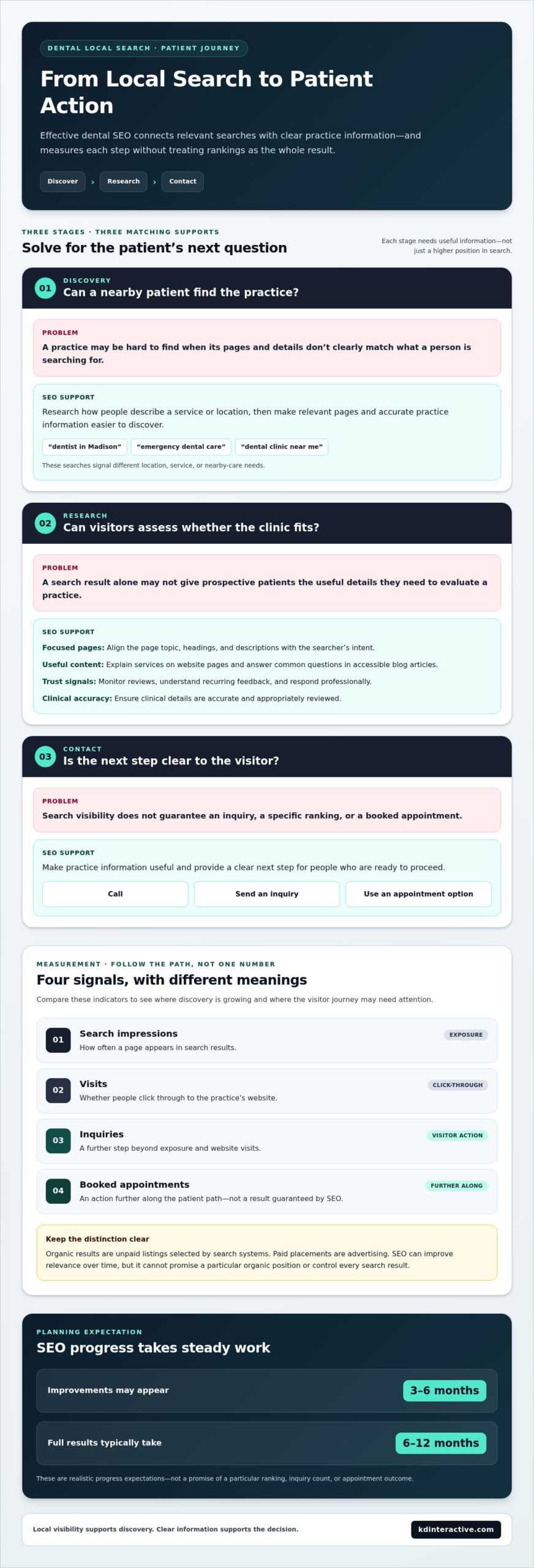
Searches often reveal both what a person needs and where they need it. Someone might search “dentist in Madison,” “emergency dental care,” or “dental clinic near me.” The first suggests a location-based search, the second names a specific service and immediate concern, and the third indicates a search for a nearby option. Results can reflect both the query and the searcher’s location, so useful local visibility depends on clear, accurate practice information.
The patient journey has distinct stages:
- Discovery: A person sees a practice while searching for a dentist, service, or nearby clinic.
- Research: They review the website and practice details to decide whether it fits their needs.
- Contact: They call, send an inquiry, or use an appointment option if they’re ready to proceed.
SEO supports this journey by helping relevant pages appear for appropriate searches and giving visitors useful information. A practice’s visibility also depends on its broader local presence. For an overview of this work for small businesses, explore this guide to local SEO services near me.
What SEO can and cannot promise a dental practice
SEO is ongoing work to improve visibility, relevance, and the quality of information available to searchers. It can help a practice become easier to find for searches related to its services and locations. It can’t control every search result or guarantee rankings, a specific number of inquiries, or booked appointments. Search engines make their own decisions, and patient actions depend on factors beyond visibility, including whether the practice’s information meets their needs.
Measure the steps separately. Search impressions show how often a page appears; visits show whether people click through. Inquiries and booked appointments are further along the path and indicate actions, not just exposure. Comparing these signals can show where discovery is growing and where the visitor journey may need attention. This is more useful than treating one ranking as proof of business growth.
What a Dental SEO Strategy Includes, from Search Terms to Patient-Focused Content
A useful dental SEO strategy connects the phrases people search with clear, relevant information about a practice. Research, pages, content, reputation, links, and measurement work together; an isolated edit rarely addresses the full path from discovery to decision. The right priorities depend on the practice’s goals, services, and Wisconsin locations.
Match search intent with useful dental practice pages
Keyword research identifies how prospective patients describe a service or location in search. A practice might need to know whether people search for a service by name, include a city, or use a broader phrase such as “dentist near me.” Those patterns help determine which pages deserve attention and what information each page should provide. A broad local SEO services guide can also explain how local intent fits into a wider visibility plan.
On-page optimization aligns each page’s topic, headings, and descriptions with the searcher’s intent. A page explaining a service should focus on that subject and make relevant practice information easy to understand. This creates a direct connection between the query and the page, rather than trying to cover several different topics on one general page.
Content extends that connection. Website pages can explain the practice and its services, while blog articles can address common questions in accessible language. Because dental information is clinical, the practice should ensure that clinical details are accurate and reviewed appropriately. SEO should organize and present information clearly, not invent treatment advice or claims.
Build trust through content, reviews, and relevant links
Content creation may include web pages, blogs, and press releases, each with a different role. A service page helps visitors understand what the practice offers; a blog post can answer a focused question; a press release can share a relevant business announcement. The aim is useful, original information, not pages created simply to repeat search phrases.
Reviews contribute to a practice’s public reputation and can influence how prospective patients assess it. Monitoring reviews helps the practice understand recurring feedback and respond professionally. Keep responses general: don’t confirm that a reviewer is a patient or disclose treatment or other personal details.
Link building supports a site’s broader presence by developing relevant connections from other websites. Focus on relevance and credibility, not a promised number of links or a specific authority score. No link guarantees a ranking.
Analytics tracking connects the work to practice goals. It can show which pages attract search visits and whether those visits lead to meaningful actions, while keeping visibility metrics distinct from inquiries and appointments. A tailored plan for dental clinic seo services should make these priorities and measures understandable. Wisconsin practices can explore KD Interactive’s local SEO approach.
How to Evaluate Dental SEO Progress Without Mistaking Rankings for Results
A ranking can show that a practice appears for a search, but it can’t tell you by itself whether the right people are visiting or contacting the clinic. A useful report connects visibility with what happens next. Review several indicators together and compare them over time, rather than judging an ongoing SEO program by one position on one day.
Which SEO metrics help explain progress?
Each metric answers a different question. Rankings indicate visibility for selected searches, while search traffic shows whether people are reaching the website. User behavior adds context about what visitors do after arriving. Conversion tracking can connect a visit to an action, such as a phone inquiry or submitted appointment request, when that action is properly measured.
Metric
What it indicates
Question to ask
Search rankings
Visibility for tracked search terms
Are relevant local searches gaining visibility?
Search traffic
Visits from organic search
Are more searchers reaching useful practice pages?
User behavior
How visitors interact with the site
Do visitors explore relevant information or leave quickly?
Conversions
Tracked inquiry actions from website visits
Are search visits leading to calls or appointment requests?
Use the metrics as a sequence, not as competing scorecards. If visibility improves but relevant traffic doesn’t, review which searches and pages are appearing. If traffic grows but inquiries don’t, examine whether landing pages answer visitors’ needs and make next steps clear. Rankings fluctuate, so they’re a visibility signal, not a substitute for inquiries, appointments, or revenue.
How to set expectations for an ongoing SEO program
KD Interactive states that businesses may see improvements in 3-6 months, with full results typically in 6-12 months. These are ranges, not guarantees. Progress can depend on factors such as competition and industry, so the same schedule shouldn’t be treated as a promise for every dental practice.
Consistent monitoring helps distinguish a lasting trend from a short-term ranking shift. Agree on the practice’s goals, the metrics being reported, and how often results will be reviewed. A clear report should explain what changed, which work relates to that movement, and what the next priorities are. This gives the practice a practical basis for decisions instead of leaving it to interpret numbers without context.
When evaluating an SEO agency, consider its communication, strategy, and reporting. With dental clinic seo services, the most useful measure is not a ranking in isolation, but whether visibility, visits, and meaningful patient inquiries are moving in the right direction.
A Practical Dental SEO Planning Framework for Wisconsin Practices
A useful SEO plan starts with the practice, not a generic checklist. A Wisconsin dental clinic may serve one community or several locations, and its priorities should reflect the services it wants to grow, the patients it hopes to reach, and what its current online presence already does well. Use this framework to turn those factors into focused dental clinic seo services.
- Set business goals. Decide what SEO should support, such as improving visibility for priority services, helping patients find a location, or increasing relevant inquiries. Clear goals make it easier to choose which work deserves attention first.
- Choose priority services. Identify the services the practice wants to emphasize. Consider the language prospective patients use to search for them, and keep website information aligned with what the clinic actually provides.
- Define the locations served. List the Wisconsin communities or areas the practice serves. For a multi-location clinic, clarify which services and information apply to each location so the plan reflects the actual structure of the business.
- Review the current starting point. Assess existing pages, search visibility, online reviews, and analytics before deciding what to change. This review can reveal whether a service page needs clearer information, a location page needs attention, or reporting needs to better connect search activity with inquiries.
- Prioritize and sequence the work. Use research findings to decide whether to focus first on on-page updates, new content, reputation work, or measurement. A tailored plan can sequence these activities around the practice’s needs without assuming every clinic should follow the same schedule.
Separate immediate questions from longer-term work. A practice may first want to make sure patients can find accurate service and location information. Building useful content around patient questions or strengthening reputation management may then become a continuing priority. This distinction helps the team understand why tasks are recommended and how they support the broader plan.
For local search, the Google Business Profile is one part of a practice’s online presence. Accurate profile details can support discoverability, while website pages and other local SEO work provide additional context. Consider profile information alongside the practice’s other local search priorities.
Keep the work plan transparent. For each priority, document the finding behind it, the action to take, and the indicator that will help assess progress. Analytics tracking can inform later decisions, such as whether to refine a page or develop content for another relevant search. KD Interactive is a Wisconsin business serving Wisconsin businesses, and its customized approach keeps clients informed as priorities evolve.
Build a plan around your practice’s goals and locations with KD Interactive’s local SEO services.
How KD Interactive Partners with Wisconsin Dental Clinics on SEO
KD Interactive is a Wisconsin business serving Wisconsin businesses. That local perspective informs its approach to dental clinic SEO: start with the practice’s goals and the communities it serves, then shape the work around its current search presence. The focus is a clear plan, relevant priorities, and communication that helps decision-makers understand what’s being done and why.
A tailored, communicative approach for Wisconsin businesses
Rather than applying a cookie-cutter package, KD Interactive develops customized SEO solutions. For a dental practice, priorities may include researching the language people use to find services, improving relevant website pages, or planning useful content around the practice’s locations. The work is shaped to the business’s needs, with clients kept informed as the strategy develops and priorities are reviewed.
The work can draw on several connected capabilities:
- Keyword research to identify relevant service and location searches.
- On-page optimization to align page topics and information with those searches.
- Content creation for website pages and ongoing blog content.
- Link building to develop relevant connections to the practice’s online presence.
- Review and reputation management to monitor public feedback and support a professional response approach.
- Analytics tracking to make search activity and progress easier to understand.
These are practical areas of work, not a promise of a particular ranking or patient outcome. They can be prioritized according to a practice’s goals, existing pages, and local search needs. A smaller clinic and a multi-location practice may need different emphasis, so the plan should reflect the structure and priorities of the business.
Client feedback also offers a view of KD Interactive’s working relationships across different industries. Named testimonials include Carl Anden of Anden Business Systems, David Alecock of Link It Call Center, and Mike Yenser of Y’s Way Flooring. These testimonials reflect feedback from clients in other sectors, not dental-practice results, and don’t replace a strategy built around a clinic’s own goals.
Start with a conversation about visibility and goals
A useful first conversation can focus on what the practice wants to achieve, which services and locations matter most, and where current search visibility feels unclear. That gives the discussion a practical starting point. From there, KD Interactive can outline how a customized local SEO strategy may connect research, page improvements, content, reputation work, and measurement for the Wisconsin practice.
The next step is a FREE Consultation. Discuss your goals and current search challenges with KD Interactive, then consider how a tailored local SEO strategy can support your practice. Schedule your FREE Consultation with KD Interactive to discuss an SEO partnership focused on your practice’s needs.
Take the Next Step Toward Stronger Local Visibility
Your next SEO decision can start with a clear conversation about what you want local search to support. A thoughtful strategy for dental clinic seo services should connect your goals with practical priorities and keep progress understandable, without promising a particular ranking or patient count.
KD Interactive brings Wisconsin-focused local knowledge and customized strategies to its work with businesses in the state. Transparent communication helps clients stay informed as plans move forward. Testimonials from Carl Anden, David Alecock, and Mike Yenser reflect feedback from clients in other industries, not dental practices, and offer perspective on those working relationships.
Use a FREE Consultation to discuss your practice’s search visibility, goals, and challenges with KD Interactive. Schedule your FREE Consultation with KD Interactive and start building a clearer path to local discovery.
Frequently Asked Questions
What do dental clinic SEO services include?
Dental clinic SEO services can include keyword research, on-page optimization, content creation, link building, review and reputation management, and analytics tracking. The emphasis should reflect the practice’s needs. For example, a clinic with clear service pages but limited educational content may prioritize useful blog topics, while another may need to improve how existing pages address its services and locations. KD Interactive tailors local SEO work to business goals rather than applying a standard package.
How long does dental SEO take to show results?
KD Interactive states that businesses may see improvements in 3-6 months, with full results typically in 6-12 months, depending on competition and industry. These are progress ranges, not guaranteed deadlines. Regular reports can help a practice understand whether search visibility is moving and whether the work is reaching its intended audience. Assess progress over time instead of drawing conclusions from a short-term change.
Can SEO help a dental clinic attract more local patients?
SEO can help a clinic become more visible to people searching for relevant dental services in the areas it serves. That gives prospective patients another way to discover the practice and learn about its offerings. Whether a search visit turns into an inquiry or appointment also depends on the information patients find and their own needs. A practical goal is to make accurate, useful practice information easier to discover, then monitor meaningful patient actions.
Is dental SEO different from general local SEO?
The local search foundations overlap, but dental SEO applies them to a clinic’s services, practice information, and patient questions. For instance, content about a clinical topic needs to be accurate and useful, while location-focused pages should clearly represent the practice’s actual services and locations. The strategy should account for those needs without making unsupported treatment claims. Local SEO principles provide the structure; the practice’s goals and subject matter shape how that structure is used.
How does a dental practice measure SEO success?
Measure success by connecting search activity to actions that matter to the practice. A report might compare whether relevant pages are receiving organic visits with whether visitors then call or submit an inquiry. Rankings can help explain visibility, but they don’t show whether a prospective patient took action. Set up reporting around the practice’s goals and review trends consistently, so the team can see what is gaining attention and where the patient journey may need improvement.
Can an SEO agency support a dental practice with multiple locations?
Yes. KD Interactive has experience optimizing websites for businesses with multiple locations. A coordinated approach can account for the distinct information and search needs associated with each practice location, while keeping the overall strategy aligned with the business’s goals. For example, a clinic can review whether each location’s website information reflects the services available there. Priorities should be based on the actual structure and needs of the practice, not a one-size-fits-all template.
Does KD Interactive offer ongoing SEO support?
Yes. KD Interactive provides ongoing SEO support through continuous optimization, monitoring, and reporting. This allows the work to respond to performance data rather than stopping after a one-time set of changes. For a dental practice, ongoing support can help keep priorities visible as the clinic’s goals or search activity evolve. Transparent reporting also gives decision-makers a clearer view of completed work, current progress, and areas that may deserve attention next.