
What if you could dominate the local search results in the next town over without ever signing a lease for a new office? Many local entrepreneurs feel invisible once they cross their immediate city limits, watching helplessly as competitors in neighboring zip codes snag all the high-value leads. If you’ve been struggling with expanding my service area on google, you probably know the frustration of being a “best-kept secret” just a few miles from your front door. It’s a common hurdle that often feels like a technical maze. You want the growth, but you’re rightfully worried about Google’s strict verification rules or the risk of profile suspension for accidental policy violations.
We understand that your business growth depends on reaching more customers in the specific regions you serve. This guide provides a pragmatic, data-driven strategy to help you scale your visibility safely. You’ll learn the exact steps to grow your digital footprint and rank in new territories without opening a physical office. We’ll explore the latest 2026 Service Area Business guidelines, including the two-hour drive-time rule and the shift to video verification. By the end, you’ll have a clear roadmap to increase your lead volume and command the local map pack across a much wider radius.
Key Takeaways
- Understand the technical difference between physical storefronts and Service Area Businesses to ensure your profile is set up for maximum visibility.
- Discover why simply changing your settings isn’t enough and how local landing pages bridge the relevance gap in new cities.
- Learn how to build geo-relevance through targeted customer reviews and local backlinks that signal your presence to Google’s algorithm.
- Master the specific steps for expanding my service area on google while avoiding common pitfalls like the virtual office trap that lead to profile suspensions.
- See how AI-driven tools and our Google Map Pack with AI Assistant can identify high-value expansion zones and automate your local growth.
The Mechanics: How to Update Your Service Area on Google
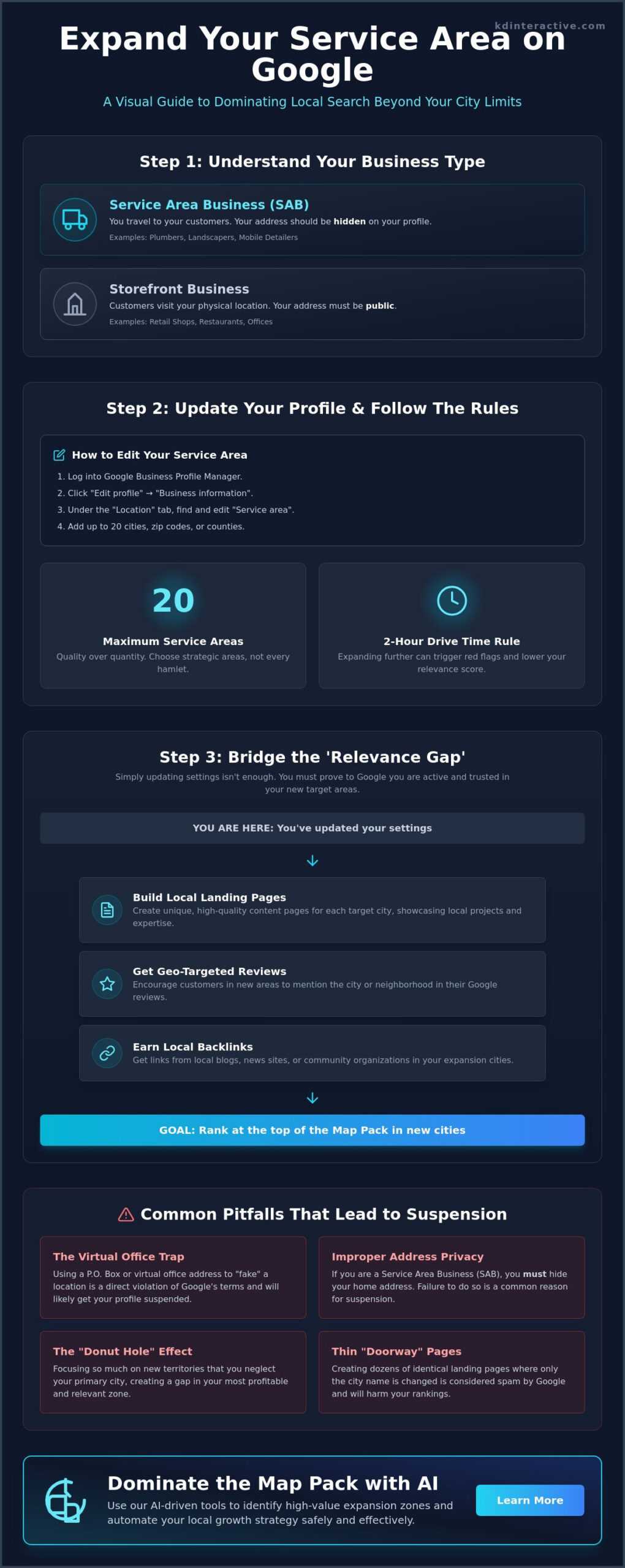
Google allows you to list up to 20 specific service areas. While it’s tempting to list every tiny hamlet in the state, quality beats quantity. Additionally, Google recommends that your service area should not extend beyond a two-hour drive from your base location. Pushing past this limit often triggers red flags in the algorithm. Why? Because Google wants to ensure you can actually fulfill the demand you’re generating. If you claim to serve a city four hours away, your relevance score drops. We’ve seen that staying within a realistic radius builds much more trust with the algorithm.
Choosing Between Zip Codes, Cities, and Counties
Precision matters. Zip codes offer the highest level of targeting, while counties provide a broad net. However, many businesses fall victim to the “Donut Hole” effect. This happens when you focus so much on new territories that you neglect your primary city, leaving a gap in your most profitable zone. Geo-precision for SABs is the strategic selection of specific geographic boundaries to signal local relevance to search engines without triggering spam filters. This strategy is a core component of Local search engine optimization (local SEO), which focuses on increasing visibility for businesses within a specific region.
Address Privacy for Home-Based Businesses
If you operate out of your garage, privacy is a priority. You must hide your physical address on your profile to comply with Google’s guidelines. Failure to do so is a leading cause of profile suspension. Don’t worry about your ranking; hiding your address doesn’t inherently penalize your visibility. The key is maintaining NAP (Name, Address, Phone) consistency across the web. Even if your address is hidden on Google, it must match exactly on your website and local directories. This methodical approach ensures you remain a trustworthy local expert in the eyes of both Google and your customers.
The Strategy: Why Settings Aren’t Enough to Rank in New Cities
Simply clicking a few buttons in your dashboard won’t magically make your business appear at the top of the Map Pack in a new city. This is the ‘Relevance Gap.’ While you’ve told Google you work in a specific zip code, your website might still suggest you only exist in your home town. Google’s algorithm prioritizes businesses that prove they are active and trusted within those specific borders. When you’re expanding my service area on google, remember that settings are just the foundation. To bridge this gap, your online presence must reflect your physical reach. Aligning your web and seo services with your geographic goals ensures the algorithm sees you as a local authority rather than a distant intruder.
The most effective strategy for ranking in new service areas involves creating high-quality, city-specific content. These Local Landing Pages serve as a beacon for Google’s crawlers, providing the context needed to rank your profile. You should also implement geo-coordinates within your website’s schema markup. Schema is essentially a digital map for search engines. By using the ‘areaServed’ property and embedding latitude and longitude data into your site’s backend code, you give search engines undeniable proof of where you operate. This technical precision is often what separates the market leaders from the businesses stuck on page two.
Building High-Converting Local Landing Pages
Don’t fall into the ‘doorway page’ trap by creating carbon-copy pages with only the city name changed. Google penalizes thin, repetitive content. Instead, make every page unique and valuable. Include local testimonials from residents in that specific town and showcase project galleries that feature recognizable neighborhood landmarks. Integrating local keywords naturally into your headers and meta descriptions helps search engines understand your intent. When every page offers genuine local value, your rankings will follow. If you need help crafting this content, our Content Creation services focus on building this exact type of geo-relevance.
Linking Your GBP to the Right Destination
Should your Google Business Profile link to your homepage or a landing page? For a single-location business expanding into several nearby towns, linking to specialized city pages often yields better conversion rates. Use UTM parameters on these links to track exactly which territories generate the most phone calls. This data-driven approach allows you to refine your local digital marketing efforts based on real-world performance. Precision wins every time. Our Google Map Pack with AI Assistant can help you automate the tedious parts of local relevance, identifying the most profitable expansion areas for your specific business model.
Building Geo-Relevance: Signals That Prove You’re Local
Google’s ranking algorithm balances three main factors: relevance, distance, and prominence. When you’re expanding my service area on google, you’re essentially fighting against the “distance” factor. You need to compensate by over-delivering on “relevance.” One of the most powerful ways to do this is through ‘Geographic Reviews.’ Instead of just asking for a general review, encourage your customers to mention the specific city where the work was performed. A review that says, “The team did a fantastic job on our HVAC repair in Madison!” carries significantly more weight for local ranking than a generic “Great job!” This specific mention helps Google associate your brand with that specific territory.
Local backlink building serves as a digital vote of confidence from the community. Securing links from local chambers of commerce or regional news outlets in your new territories proves you aren’t just a “ghost” listing. We often recommend using Press Release Distribution to officially announce your expansion. This creates a trail of high-authority mentions that Google’s crawlers can’t ignore. Managing your online reputation effectively is the final piece of the puzzle. It builds the necessary trust with prospects who may not have heard of your brand before you entered their neighborhood.
The ‘Check-In’ Strategy for Field Teams
Your field team is your best source of geo-relevance data. Every time a technician completes a job, they should take a photo of the finished work. Modern smartphones automatically embed GPS metadata, also known as EXIF data, into these images. When you upload these photos to your Google Business Profile or use them in ‘Posts’ highlighting recent jobs, Google sees the exact coordinates where you’re active. Geo-tagged images act as verifiable proof of your service area claims, helping you climb the Map Pack rankings in towns far from your home base. It’s a simple habit that pays massive dividends in visibility.
Citations and Directories for New Territories
Consistency is key, but so is local depth. Beyond the “Big Three” directories like Yelp and Yellow Pages, you should seek out niche, regional directories. For businesses operating in the Midwest, getting listed in regional Wisconsin directories reinforces your local authority and signals deep roots in the community. Local citations validate service area claims by providing consistent third-party evidence of a business’s name, address, and service regions across multiple authoritative platforms. This methodical approach ensures that Google views your expansion as legitimate and trustworthy, rather than a spammy attempt to game the system.
Common Pitfalls: Avoiding the Dreaded Google Suspension
Risking a profile suspension is the quickest way to halt your business growth. While expanding my service area on google is a powerful strategy, doing it incorrectly can lead to “suspicious activity” flags that take weeks to resolve. The most dangerous shortcut is the ‘Virtual Office’ trap. Using a P.O. Box, a UPS Store address, or a virtual office to appear local in a new city is a direct violation of Google’s guidelines. These locations are easily identified by automated filters. If you don’t serve customers at a physical location, you must hide your address and rely on service area designations instead.
Over-expansion is another common mistake that triggers manual reviews. If you list 200 cities but only operate a single service vehicle, the algorithm may flag your profile for spam. Google expects your service area to be a realistic reflection of your operational capacity. Consistency is king here. Your website’s ‘Contact’ page should clearly list the regions you serve, and these must align perfectly with your Google Business Profile. If Google’s crawlers find a discrepancy between your site and your profile, they may suspend your listing to protect the integrity of search results.
Google’s Proximity Filter vs. Service Area
Compliance Checklist for 2026
Staying compliant requires a methodical approach to your digital presence. We recommend verifying your service area through the local seo services near me framework to ensure every technical box is checked. Keep a digital folder of contracts, invoices, and job photos that prove you actually work in the areas you claim. This documentation is your lifeline if you ever need to appeal a suspension. Additionally, audit your profile weekly for ‘suggested edits’ from competitors who might try to shrink your service area through user-generated reports. Protect your business from sudden visibility drops by ensuring your expansion is fully compliant and optimized for growth.
KD Interactive: Dominating the Map Pack with AI
Successfully expanding my service area on google requires more than just technical knowledge; it demands a data-driven strategy that identifies where your next most profitable customer is hiding. At KD Interactive, we remove the guesswork by using AI-driven insights to analyze local search patterns across specific regions. Our Google Map Pack with AI Assistant is designed to automate the most tedious aspects of maintaining local relevance. From identifying geographic gaps in your current visibility to suggesting the most impactful local keywords, this tool ensures your profile remains active and authoritative without requiring hours of manual labor every week.
Every market has its own unique rhythm. We specialize in custom local SEO packages designed specifically for Wisconsin’s unique market dynamics, ensuring your business resonates with residents from Milwaukee to Madison and everywhere in between. Having a partner who deeply understands digital marketing for small business is essential for long-term growth. We don’t just set up your profile and walk away; we act as a methodical collaborator whose success is tied to your expansion. By leveraging advanced data tracking, we help you transition from being a local favorite to a regional leader.
Our Data-Driven Approach to Wisconsin Growth
We start by analyzing local search volume to prioritize which towns you should target first. Not all zip codes are created equal. Some may have higher competition but lower intent, while others represent untapped goldmines for your specific trade. Our case studies show the power of this approach; we recently helped local contractors double their service radius in 6 months by focusing on high-intent territories rather than broad, generic expansion. With our transparent reporting, you’ll see exactly which service areas are generating the most ROI, allowing you to allocate your resources with total confidence.
Ready to Expand Your Reach?
Making major changes to your Google presence carries inherent risks, as we discussed regarding profile suspensions. Professional oversight is the best way to ensure your expansion is both aggressive and compliant. We begin every partnership with a comprehensive local SEO audit to identify immediate opportunities for growth and any red flags that might be holding you back. Don’t let your competitors claim the neighboring territories that should be yours. Take the first step toward dominating your regional market. Book your consultation with KD Interactive today and let’s build a roadmap for your business’s future.
Take Command of Your Regional Market
Dominating the local map pack in 2026 requires a blend of technical precision and authentic local signaling. We’ve established that expanding my service area on google is a content and reputation strategy rather than a simple setting change. By prioritizing unique local landing pages and gathering geo-specific reviews, you build the relevance Google’s AI filters demand. You must also remain vigilant about compliance. Avoiding the virtual office trap and keeping your service radius realistic ensures your business stays safe from sudden profile suspensions while you grow.
You don’t have to navigate this digital expansion alone. KD Interactive specializes in Wisconsin small business growth, providing the data-driven keyword and geo-analysis you need to win. Our Google Map Pack with AI Assistant automates the complex parts of local SEO so you can focus on serving your new customers. It’s time to stop being a best-kept secret and start reaching the high-value leads waiting in your neighboring territories. Scale your business with KD Interactive’s Local SEO Services and secure your position as the top choice in every zip code you serve. Your next phase of growth is just a strategic update away.
Frequently Asked Questions
How many service areas can I add to my Google Business Profile?
You can specify up to 20 service areas on a single business profile. These areas can be defined by specific zip codes, cities, or entire counties. While you have 20 slots available, it’s best to prioritize the regions you can actually reach within a two-hour drive. Over-extending your list without having the operational capacity to serve those areas can lead to a drop in local trust and relevance.
Can I rank in a city if I don’t have a physical office there?
Yes, you can rank in cities where you don’t have an office by designating them as part of your service area. This is the core strategy for Service Area Businesses (SABs). However, your ranking strength is generally highest near your verified business address. To compete effectively in distant towns, you must build geo-relevance through local landing pages and city-specific customer reviews to prove your presence to the algorithm.
Will expanding my service area hurt my rankings in my home city?
Expanding your reach typically doesn’t penalize your home city rankings as long as you maintain your local signals. The primary risk is the “Donut Hole” effect, where a business neglects its primary market’s content and reviews while chasing new territories. By continuing to post updates and gather reviews from your home base, you ensure you remain the dominant local expert in your original location.
How long does it take for Google to show my business in a new service area?
Google often updates your profile information within 24 to 48 hours of an edit. However, seeing a significant ranking improvement when expanding my service area on google can take several weeks or months. This timeline depends on how quickly you build local signals like citations, project-based posts, and geo-tagged photos for that specific area. Consistent activity is the key to speeding up this process.
What is the difference between a service area and a physical location on Google?
A physical location is a brick-and-mortar storefront where customers visit you, while a service area is a geographic region where you travel to meet them. If you operate from home and meet customers at their locations, you are a Service Area Business. In this case, you must hide your home address from the public to comply with Google’s guidelines and avoid potential profile suspension.
Can I use a PO Box or virtual office to expand my service area?
No, using a P.O. Box or virtual office is a direct violation of Google’s terms of service and will likely lead to a permanent suspension. Google requires a legitimate physical address for verification, even if that address is hidden from the public. To expand your reach safely, use the service area settings and prove your local activity through real jobs and customer interactions in those new territories.
How do I prove to Google that I serve a specific area if I’m challenged?
You can prove your service area by providing documentation like business licenses, utility bills, or customer invoices that show work performed in those specific zip codes. Geo-tagged photos of your team at job sites also serve as powerful evidence during a manual review. Keeping a methodical record of your field operations ensures you’re prepared if Google ever requests proof of your service claims.
Does my website need to mention every city I list in my service area?
Yes, your website should ideally have dedicated pages or specific mentions for the major cities in your service area. Google’s algorithm cross-references your profile with your website to verify your claims of local authority. Without on-site confirmation, simply listing a city in your profile settings rarely results in a high ranking. Content that highlights local projects and landmarks helps bridge this relevance gap.