
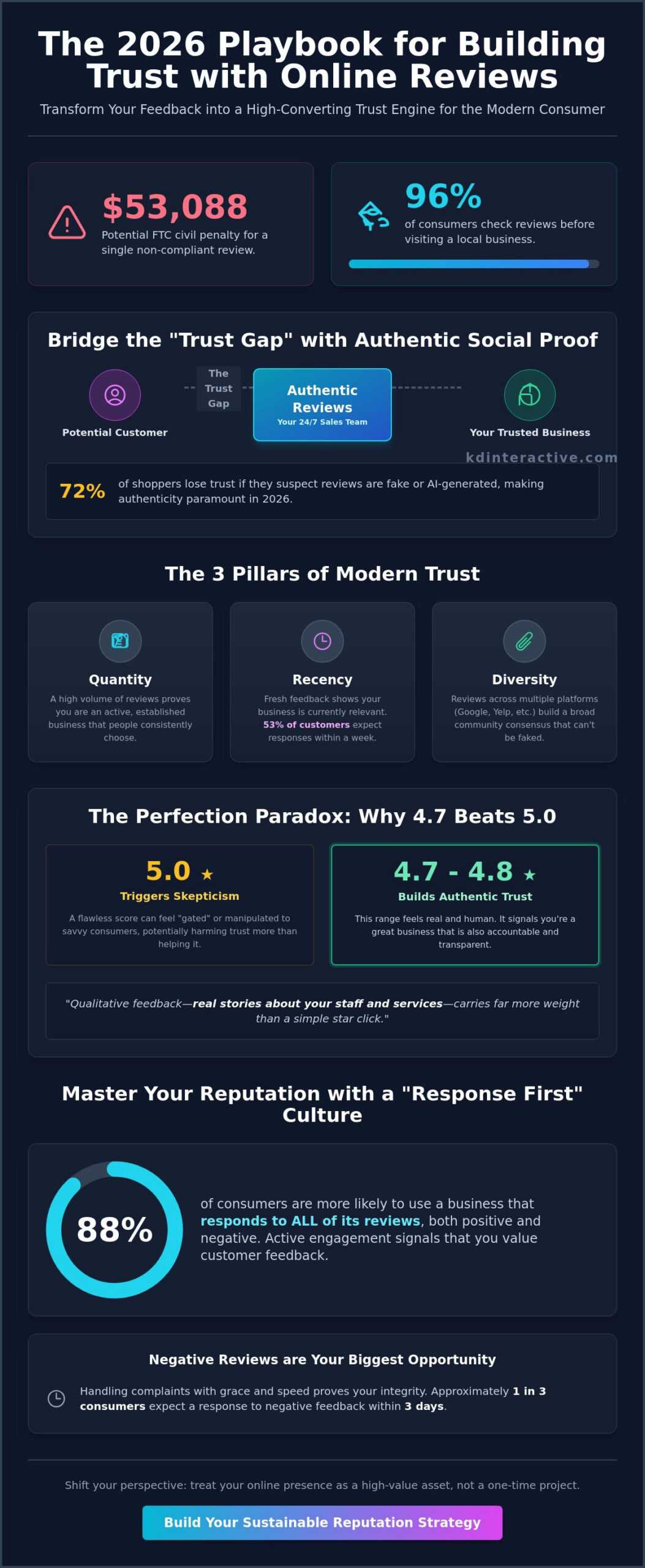
Did you know that a single non-compliant review could now cost your business up to $53,088 in FTC civil penalties? It’s a stressful reality for local entrepreneurs who want to protect their reputation while learning how to build trust with online reviews in a strict regulatory environment. Since 96% of consumers now check feedback before visiting a business, the stakes for your local presence have never been higher. You’ve likely felt the sting of an unfair negative comment or the frustration of seeing a competitor dominate the Google Map Pack. We understand these challenges because we help businesses in our community overcome them every day.
This guide shows you how to transform your feedback loop into a high-converting trust engine that wins customer loyalty. We’ll break down the latest 2026 Google and Yelp policy updates and the FTC’s Consumer Review Rule. You’ll also learn a repeatable system for generating authentic responses that convert skeptics into regulars. It’s time to stop fearing the comment section and start using it to drive measurable growth.
Key Takeaways
- Learn why a perfect 5.0 rating often triggers skepticism and how authentic feedback builds stronger social proof in 2026.
- Discover how to build trust with online reviews by implementing a “Response First” culture that addresses both positive and negative feedback professionally.
- Explore technical trust signals like Review Schema and video testimonials to increase your visibility and website conversion rates.
- Understand the impact of review velocity on your Google Map Pack rankings to ensure your business stays relevant for local search queries.
- Shift your perspective to a sustainable reputation strategy that treats your online presence as a high-value asset rather than a one-time project.
The Psychology of Social Proof: Why Reviews Build Trust
Local business success depends on what neighbors say about you when you aren’t around. This is the psychology of social proof, a concept where people look at others’ actions to decide how to behave. For an entrepreneur, understanding this mental shortcut is the first step in learning how to build trust with online reviews. Your reviews aren’t just comments; they’re a 24/7 sales team that validates your claims even when you’re off the clock. When a potential customer sees a history of satisfied neighbors, the perceived risk of doing business with you disappears.
Most small businesses face a “Trust Gap.” This is the distance between a potential customer finding your website and actually trusting you with their money. Authentic feedback bridges this gap by providing evidence of past performance. It turns a risky choice into a safe bet. Market data from January 2026 shows that 96% of consumers check reviews before considering a new business. This high percentage proves that your reputation is the most powerful conversion tool in your arsenal. It provides the reassurance that your business is a reliable partner in the community.
The 2026 Trust Landscape for Local SEO
The digital environment has shifted significantly over the last few years. With the rise of AI-generated content, consumers are more skeptical than they were in the past. Industry reports from early 2026 indicate that 72% of shoppers lose trust in a brand if they suspect reviews are fake or machine-written. This skepticism makes authentic reputation management a cornerstone of your local digital marketing strategy. To win in this high-skepticism market, you need more than just a high score. The new gold standard for trust is built on three specific pillars:
- Quantity: A high volume of reviews proves you’re an active, established business that people actually use.
- Recency: Since 53% of customers expect responses within a week, they also want to see that someone used your service in the last few days.
- Diversity: Having reviews across different platforms like Google, Yelp, and TikTok shows a broad community consensus that a single platform cannot fake.
Star Ratings vs. Qualitative Feedback
You might think a perfect 5.0 rating is the ultimate goal, but data suggests otherwise. Consumers often view a flawless score as “gated” or manipulated. A 4.7 or 4.8 rating often converts better because it feels real. It shows you’re a human-run business that handles the occasional mistake professionally. Transparency is far more valuable than perfection in the eyes of a 2026 shopper. They aren’t looking for a business that never fails; they’re looking for one that is accountable.
Qualitative feedback carries more weight than a simple star click. When a reviewer mentions a specific staff member or a particular service, it provides a vivid picture for the next customer. Social proof is the bridge between curiosity and conversion. By focusing on how to build trust with online reviews through detailed, honest stories, you create a reputation that national competitors can’t easily replicate. This localized authority is what keeps your business growing month after month.
Strategic Review Management: Turning Feedback into Conversion
Managing your reputation requires more than just collecting stars. To truly master how to build trust with online reviews, you must establish a “Response First” culture within your business. This means every single piece of feedback receives a professional answer. Data from December 2025 shows that 88% of consumers would consider using a business that responds to all reviews, both positive and negative. Silence is often interpreted as indifference; active engagement signals that you value your customers’ time and opinions.
Negative reviews often feel like a personal attack, but they are actually high-stakes opportunities to demonstrate your integrity. When you handle a complaint with grace and speed, you prove to potential customers that you are accountable. Since about a third of consumers expect a response to a negative review within three days, your speed is a direct indicator of your service quality. Adhering to FTC guidelines for online reviews ensures that your management practices remain transparent and legally compliant, protecting you from the heavy civil penalties enacted in late 2024.
The 5-Step Framework for Responding to Negative Reviews
- Step 1: Stay calm. Avoid defensive language. A pragmatic, professional tone protects your brand image.
- Step 2: Acknowledge the issue. Repeat the specific concern to show you have actually read and understood their feedback.
- Step 3: Move the conversation offline. Provide a direct phone number or email address to resolve the matter privately.
- Step 4: Offer a resolution. Explain how you will fix the problem without promising specific financial compensation in a public forum.
- Step 5: Follow through. Ensure the internal fix happens so the same complaint doesn’t surface again.
Not every negative comment is legitimate. If you encounter fraudulent or defamatory content, use the platform’s reporting tools immediately. In 2025, Yelp’s systems filtered nearly half a million AI-generated reviews, showing that platforms are becoming more aggressive in removing fake content. For local businesses in Wisconsin, these reviews provide vital data for improving operations. If multiple customers mention a long wait time at your Milwaukee storefront or a specific service delay in Madison, use that data to refine your internal processes and staffing levels.
Leveraging Positive Reviews for Marketing
Positive feedback is a powerful asset for your web and seo services strategy. The best time to ask for a review is at the “Peak of Happiness,” which is immediately after a successful service or purchase. You can transform these glowing quotes into social media graphics or featured website testimonials to reinforce your credibility. When responding to positive reviews, naturally mention the specific service provided. This helps search engines connect your business to those keywords, improving your visibility for local queries. If you want to see how your current reputation stacks up against competitors, you can request a professional assessment of your local search presence.
Advanced Trust Signals: Beyond the Star Rating
Collecting reviews is only the first step in a professional reputation strategy. To truly understand how to build trust with online reviews, you must focus on how that feedback is presented to potential customers. In a market where 74% of consumers consult at least two different platforms before making a choice, your business needs to project authority across every digital touchpoint. Moving beyond the basic star rating involves using technical tools and visual evidence to prove your claims are authentic.
Visual proof is one of the most effective ways to combat the rising skepticism surrounding AI-generated content. Integrating “Verified Purchase” badges or linking reviews to specific project photos creates a layer of transparency that generic testimonials cannot match. When a customer sees a review paired with a high-resolution image of a completed job, the “Trust Gap” narrows instantly. These signals act as a secondary layer of validation, ensuring your local brand stands out as a reliable choice.
Implementing Review Schema for Rich Snippets
Your website’s technical setup plays a massive role in how trust is perceived in search results. Review Schema, specifically the AggregateRating structured data, allows search engines to read your review scores and display them as gold stars directly in the search results. For a Milwaukee service provider, these rich snippets can significantly improve click-through rates. When your listing has visual stars and your competitor’s listing does not, you’ve already won the first moment of truth.
While many businesses use third-party widgets to display feedback, we recommend hard-coded testimonials with properly configured schema. Widgets can often slow down your page load speed, which hurts your user experience. A fast, clean landing page that features hard-coded reviews with clear schema markup provides the best balance of SEO performance and consumer trust. It tells Google exactly what your customers think of you while keeping your site lean and professional.
Case Studies: The “Deep Dive” Review
A single detailed review can be more valuable than ten generic 5-star ratings. You can transform a standout testimonial into a full customer success story. For example, if a Madison-based contractor completes a complex home renovation, they should pair the client’s quote with “before and after” photos of the specific project. This creates a “Deep Dive” review that serves as a mini case study for your local brand.
Local SEO Integration: Reviews and the Google Map Pack
Google treats your review section as a real-time data feed that informs its local ranking algorithm. While many businesses view feedback as a static reputation score, search engines use this content to determine your relevance for specific local queries. If your customers frequently use terms like “best plumber in Watertown” or “emergency repair,” Google associates those keywords with your business profile. This is a critical component of local seo services near me because it helps you appear in the “Map Pack” when neighbors search for your specific expertise.
Review velocity is another vital metric for 2026. This refers to the frequency at which you receive new feedback. A business that received 50 reviews three years ago but nothing in the last month will likely see its rankings slip. Google prioritizes active businesses that demonstrate consistent customer engagement. Maintaining a steady stream of fresh feedback is one of the most effective ways to show how to build trust with online reviews while keeping your search visibility high. If you want to dominate your local market, you can request a Google Map Pack assessment to see where your velocity currently stands.
Optimizing Your Google Business Profile with Reviews
Your strategy should go beyond simply asking for a five-star rating. Encourage your customers to mention the specific service they received and the name of the staff member who helped them. This level of detail provides Google with the qualitative data it needs to rank you for long-tail searches. Owner responses also play a significant role in the 2026 algorithm. By responding to every review, you signal to Google that your profile is managed by an attentive, active owner. This engagement is a natural extension of how to set up a google business page for maximum performance.
Geographic Signaling in Feedback
Google places a high value on geographic signaling within user reviews. When a customer mentions their specific neighborhood, such as the Third Ward in Milwaukee or a suburb like Sun Prairie, it reinforces your local authority in that territory. Reviews originating from local Wisconsin IP addresses carry more weight than generic feedback from outside the region. This authentic local consensus is impossible for national competitors to fake.
To amplify this effect, you can use Press Release Distribution to highlight your top-tier customer testimonials in local news outlets. This creates high-quality backlinks and social proof that search engines can’t ignore. Learning how to build trust with online reviews through geographic keywords ensures that you aren’t just getting found, you’re getting found by the right people in your immediate community. Mixing these organic signals with a data-driven SEO strategy is the fastest way to secure your spot at the top of the Map Pack.
Building a Sustainable Reputation Strategy with KD Interactive
Reputation management is not a one-time task you can check off a list. It’s a long-term business asset that requires consistent attention to maintain its value. At KD Interactive, we view your digital presence as the foundation of your growth. Our pragmatic, data-driven approach to local SEO ensures that your business isn’t just collecting stars but building a defensible market position. We help businesses throughout Wisconsin automate the review request process, ensuring you capture feedback at the exact moment of customer satisfaction without adding to your daily workload.
Are you curious about how your business appears to a first-time searcher? We invite you to a professional assessment of your current online presence. We’ll analyze your review velocity, sentiment, and keyword integration to identify exactly where you can improve. This isn’t about chasing a perfect score; it’s about mastering how to build trust with online reviews so that every search result works in your favor. By shifting from a reactive to a proactive strategy, you turn your reputation into a predictable engine for new leads.
Why a Local SEO Agency is Essential for Reputation
Generic software often promises “set it and forget it” solutions, but these tools lack the nuance of a bespoke strategy. Choosing the right seo agency means having a partner who understands the local Wisconsin market. We don’t just look at Google; we monitor brand mentions across the entire web to ensure your reputation remains consistent. By establishing high-quality feedback loops, we help you scale your business based on real-world data rather than guesswork. This methodical monitoring prevents small issues from turning into reputation crises.
Our team specializes in SEO Keyword Analysis and Content Creation to ensure your responses and testimonials are optimized for search engines. This approach transforms a simple thank-you note into a powerful ranking signal. When you partner with a specialist, you gain access to advanced tools like our Google Map Pack with AI Assistant. This technology helps you manage high volumes of feedback with precision and speed while maintaining the human touch that local customers expect.
Your Next Steps to Building Digital Trust
Start by auditing your current review profiles. What is the first thing a potential customer sees when they search for your name? If your most recent review is several months old, it’s time to refresh your strategy. You can immediately improve your results by setting up a simple system for your team to ask for feedback after every sale. Whether it’s a QR code on a receipt or a follow-up prompt, making the process frictionless for the customer is key to increasing your review volume. Effective reputation management requires a blend of technical expertise and genuine human engagement. By focusing on how to build trust with online reviews today, you are securing your business’s visibility for years to come. Ultimately, lasting digital trust is earned through unwavering consistency and radical transparency.
Secure Your Local Reputation and Drive Future Growth
Building a high-converting trust engine requires a blend of technical precision and consistent engagement. By implementing review schema for rich snippets and maintaining a steady review velocity, you ensure your business remains visible and credible in a high-skepticism market. Adhering to the latest FTC and platform guidelines protects your brand from significant penalties while positioning you as a transparent leader in your community. You now have the roadmap for how to build trust with online reviews using a methodical, data-driven approach.
As a specialist in Wisconsin Local SEO, KD Interactive is here to help you navigate these changes with pragmatic, results-oriented reputation management. We offer expert Google Map Pack optimization enhanced by our proprietary AI Assistant to keep your business at the top of local search results. Ready to dominate the Milwaukee Map Pack? Get your free Local SEO audit from KD Interactive today. Your reputation is your most valuable asset; let’s work together to make it work for you. We’re ready to help your local brand reach its full potential.
Frequently Asked Questions
Is it illegal to pay for online reviews in 2026?
Yes, paying for reviews is illegal and carries severe financial risks for your business. Under the FTC’s Consumer Review Rule, which took full effect in late 2024, the government actively prosecutes businesses that buy, incentivize, or disseminate fake testimonials. Violations can result in civil penalties of up to $53,088 per occurrence. Authenticity is the only legal path to long-term success in the local market.
How do I remove a fake or malicious Google review?
You can remove a fraudulent review by using Google’s official reporting tools within your Business Profile. Flag the content as “spam” or a “conflict of interest” if it violates specific policy terms. Google’s 2026 AI-powered enforcement is now more aggressive at identifying non-compliant content, but manual reporting is still necessary for targeted attacks. If the review is clearly defamatory, you may need to provide additional evidence through their legal help desk.
Should I respond to every single positive review my business gets?
Yes, you should respond to every review to demonstrate active engagement and appreciation for your customers. Acknowledging positive feedback reinforces customer loyalty and shows potential leads that you are an attentive, professional owner. This practice is a core part of how to build trust with online reviews because it humanizes your brand. Use these responses to naturally mention specific services, which helps search engines understand your expertise and improves your local visibility.
How many reviews do I need to start ranking in the Google Map Pack?
There is no single magic number for ranking, as Google prioritizes a mix of relevance, distance, and prominence. However, you generally need enough reviews to exceed the average volume of your top three local competitors. High-ranking profiles often display a combination of high volume and recent activity. Our data-driven approach focuses on improving your review velocity, ensuring you get new feedback consistently enough to signal that your business is a popular, active choice.
Can negative reviews actually help my business build trust?
Negative reviews can actually increase your credibility by proving your feedback isn’t manipulated or “gated.” A perfect 5.0 rating often triggers skepticism in 2026 shoppers, whereas a 4.7 rating feels more authentic and trustworthy. The real value lies in your response. By handling a complaint professionally and offering a resolution, you demonstrate accountability. This transparency often wins over more customers than a flawless profile because it proves you stand behind your work.
What is the best way to ask a customer for a review without being pushy?
The most effective method is asking at the “Peak of Happiness” immediately after a successful service is completed. You can send a personalized text or a follow-up email with a direct link to your profile. Avoid using on-site kiosks or tablets, as Google explicitly banned these in early 2026. Simply explain that their feedback helps your local business grow and allows you to continue providing high-quality service to the community.
Does the length of a review impact my SEO more than the star rating?
Long-form reviews that include specific keywords and service descriptions have a greater impact on your SEO than a simple star rating. When customers describe a specific job, Google uses that text to determine your relevance for local search queries. While a high star rating helps with conversion, the qualitative data within a detailed review is what helps you rank for “near me” searches. Encourage your clients to mention the specific problem you solved for them.
How often should I be getting new reviews to stay relevant to Google?
You should aim for a steady, weekly stream of new feedback to maintain a high review velocity. Google’s algorithm favors recency because it proves your business is currently operational and meeting customer needs. If your last review was several months ago, your profile may appear stagnant to both search engines and potential customers. We recommend a repeatable system that integrates review requests into your daily operations to ensure your digital presence stays fresh and competitive.