
What if your marketing spend wasn’t a monthly bill, but a strategic acquisition of digital real estate? For many small business leaders, the process of getting buy-in for an seo budget feels like asking partners to bet on “magic” instead of math. You’re right to be skeptical if you’ve been burned by low-cost experts or struggle to measure the exact ROI of a local search campaign. We understand that frustration because we’ve helped countless entrepreneurs move past it.
You’re about to learn how to transform SEO from a line-item expense into a high-ROI business case that stakeholders can’t ignore. This guide provides a clear framework to present SEO as a long-term investment, including ways to calculate potential returns based on real-world data. We’ll also explore why choosing a local specialist is the most pragmatic way to capture the 87% of consumers who use Google to evaluate local businesses. By the end, you’ll have the confidence to stop chasing clicks and start building a permanent moat around your local market share.
Key Takeaways
- Shift the perspective from marketing expenses to strategic investments by using our formula to project search-driven revenue.
- Learn how to successfully navigate the process of getting buy-in for an seo budget by connecting search performance directly to your company’s lead generation goals.
- Understand the specific competitive realities of the Wisconsin market and why “cheap” SEO packages often lead to long-term penalties rather than growth.
- Identify the “Digital Front Door” concept to show stakeholders exactly where your local customers are starting their buying journey.
- Build an “Objection Buster” framework to address skepticism about referral-based growth and the time required to build a sustainable digital moat.
The True Cost of Invisibility: Why Local SEO is a Business Requirement in 2026
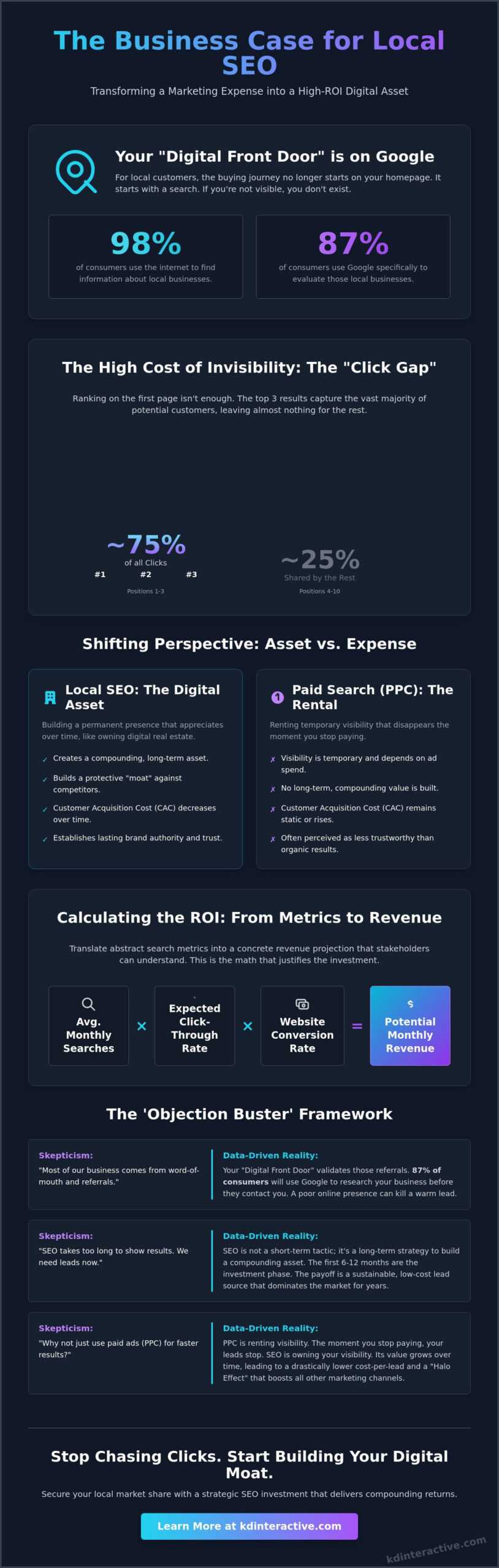
Think of your SEO budget as a strategic investment in your local market share rather than a technical fee on your balance sheet. In 2026, your website is no longer just a digital brochure; it’s your “Digital Front Door.” Research indicates that 98% of consumers use the internet to find information about local businesses, and 87% use Google specifically to evaluate them. If you aren’t visible during that initial search, your business effectively doesn’t exist to those potential customers. Most local journeys start on a search engine, not your homepage, making your presence in search results the first point of contact for your brand.
Unlike Pay-Per-Click (PPC) models where your visibility vanishes the second you stop paying, Search engine optimization (SEO) builds a permanent presence. It’s the difference between renting a billboard and owning the land it stands on. As AI-assisted search continues to evolve, maintaining accurate and authoritative local data has become even more critical. When you’re getting buy-in for an seo budget, focus on this shift: AI tools pull from the most trusted local sources. Being invisible to these tools means being left out of the AI-driven recommendations that modern shoppers rely on for quick decisions.
The Opportunity Cost of Ranking #4 or Lower
There is a massive “Click Gap” in search results that many leaders overlook. Data consistently shows that the top three results capture approximately 75% of all local traffic. If your business sits at the bottom of the first page, you aren’t just losing a few clicks; you’re handing warm leads directly to your competitors in Milwaukee or Madison. Every day you remain invisible is a day your competitors strengthen their grip on your service area. Local search dominance is the ability to appear in the Google Map Pack for every relevant query your customers type into their phones.
SEO as a Compounding Asset vs. Temporary Advertising
We view SEO as a “Moat” that protects your business. Consistent optimization makes it increasingly difficult for new competitors to enter your territory and steal your market share. This protection comes from creating high-quality, local content that resonates with your specific community. Investing in local digital marketing builds brand authority that lasts for years, rather than weeks. This compounding effect means that the work you do today continues to pay dividends long after the initial effort, creating a sustainable asset that grows in value over time. It’s a pragmatic way to ensure your business remains the first choice for local residents.
Calculating the ROI: Turning Search Metrics into Revenue Projections
To secure approval, you must speak the language of the boardroom: revenue. The most effective way of getting buy-in for an seo budget is to move away from abstract terms like “visibility” and focus on a concrete revenue formula. You can estimate the potential value of search traffic by multiplying your average monthly searches by your expected click-through rate (CTR), your website’s conversion rate, and your average order value. This simple calculation transforms a marketing “cost” into a predictable revenue stream that stakeholders can easily visualize.
It’s also vital to consider the Lifetime Value (LTV) of your customers. Leads acquired through organic search often demonstrate higher loyalty and trust than those coming from disruptive paid ads. While paid search offers immediate results, it also comes with a static Customer Acquisition Cost (CAC) that never decreases. In contrast, SEO acts as a long-term play. While the initial 6 to 12 months require an upfront investment, the cost per lead typically plummets over an 18-month period as your organic authority compounds. This creates a “Halo Effect” where your high rankings improve the performance of all your other marketing channels by validating your brand’s presence in the market.
SEO vs. PPC: A 12-Month Cost Comparison
| Metric | Paid Search (PPC) | Local SEO |
|---|---|---|
| Initial Lead Cost | Moderate and Stable | High (Setup Phase) |
| Month 12 Lead Cost | Same as Month 1 | Significantly Lower |
| Long-term Asset | None (Ends with spend) | Permanent Market Share |
There is a specific “Crossover Point” where the cost of an organic lead becomes significantly cheaper than a paid lead. This usually happens after the first year of consistent optimization. For many Wisconsin businesses, a hybrid approach is the smartest move. Using paid ads for immediate cash flow while investing in local SEO services near me ensures you aren’t just renting traffic, but building a sustainable foundation for the future.
Measuring the ‘Unmeasurables’: Trust and Reputation
High rankings serve as a powerful “Trust Signal.” When a customer sees your business at the top of the search results, they subconsciously assign you a higher level of authority. This reputation management begins with a professional how do setup a Google Business Page strategy. The financial difference is measurable. For instance, businesses in the Map Pack with a 4.8-star rating often see significantly higher engagement than those with a 4.0-star rating. If you want to see how your current reputation stacks up against your local competitors, a professional SEO keyword analysis can reveal the exact gaps in your local market presence.
Right-Sizing Your SEO Budget: Wisconsin Market Realities
Budgeting for search performance isn’t a “one size fits all” calculation. The investment required depends heavily on your physical location and the intensity of your local competition. For instance, a small business in Watertown may find success with a more modest budget compared to a firm in Milwaukee or Madison, where the digital landscape is significantly more crowded. When you’re getting buy-in for an seo budget, it’s essential to present these regional realities to your stakeholders. You aren’t just buying services; you’re funding a campaign to outmaneuver specific local rivals who are already bidding for your customers’ attention.
Avoid the “Cheap SEO” trap at all costs. Services promising results for $200 a month often rely on automated, spammy link-building or “black hat” tactics that can lead to severe search engine penalties. Fixing a penalized site is far more expensive than doing the work correctly the first time. Your niche also dictates your spend. A high-ticket service like HVAC or legal services requires a more aggressive strategy than a niche boutique retail shop because the lead value is higher and the competition is fiercer. A regional expert who understands the Wisconsin business landscape can help you identify exactly where you fall on this spectrum.
DIY vs. National Agency vs. Local Specialist
Many entrepreneurs consider the DIY route to save money, but the hidden costs are substantial. You have to factor in the price of professional tracking tools, the time spent on training, and the massive opportunity cost of not focusing on your core operations. On the other end of the spectrum, large national agencies often use cookie-cutter templates that ignore the nuances of your specific community. They have high overhead costs that don’t always translate into better results for you. Choosing the right SEO agency in 2026 means finding a partner with a proven local track record who treats your business as a unique entity rather than just another account number.
Allocation: Where Should the Money Go?
A balanced budget typically follows a 40/30/30 split. We recommend allocating 40% to content and authority building, 30% to technical on-page fixes, and 30% to local reputation management. Modern budgets must also account for advanced features like a Google Map Pack with AI Assistant to stay ahead of how customers search today. Your web and seo services must be perfectly synchronized to prevent budget waste. If your website isn’t optimized to convert the traffic your SEO generates, you’re essentially pouring water into a leaky bucket. A pragmatic allocation ensures every dollar spent contributes directly to your bottom line.
The ‘Objection Buster’ Framework: Addressing Stakeholder Concerns
Getting partners or owners to commit funds requires more than just showing potential ROI. You have to dismantle the mental barriers preventing them from acting. When getting buy-in for an seo budget, expect pushback. It’s a natural part of the process for any leader protecting their bottom line. Understanding these common concerns is the first step toward getting buy-in for an seo budget that actually grows your business. Most objections fall into four common categories: referrals, timing, search engine volatility, and overall cost. We’ve found that addressing these concerns with pragmatic comparisons usually clears the path for approval.
When a stakeholder says “we already have enough referrals,” they’re missing a critical step in the modern buyer’s journey. SEO makes those referrals find you faster and validates the trust they’ve already been given. If someone says “SEO takes too long,” remind them that every day you wait, the competitive moat around your rivals gets wider. This isn’t just about traffic; it’s about market territory. If they worry about Google changing too much, explain that’s exactly why you need an expert to navigate that volatility. Finally, if it seems too expensive, compare the cost to a single full-time sales hire or a year of radio ads. A sales hire comes with salary, benefits, and a ramp-up period, while radio ads vanish the moment the check clears. SEO is a permanent asset that builds value over time.
Proving the ‘Referral Validation’ Theory
Word-of-mouth is powerful, but it’s no longer a closed loop. Statistics show that 80% of referral leads still Google your business before they ever pick up the phone. If your online presence is messy, outdated, or invisible, you kill the trust built by that personal recommendation. This creates a “Referral Leak.” This happens when a referred customer searches for you, finds a better-ranked competitor with more reviews, and decides to call them instead. You did the work to earn the referral, but your lack of search visibility gave the lead away to someone else in your local community.
The ‘Slow Burn’ Myth: Finding Quick Wins
SEO is a long-term play, but it shouldn’t be a “no-results” play for months. We focus on low-hanging fruit to generate momentum. This includes Google Business Profile optimization and ensuring your local citations are accurate across the web. A thorough technical audit can often provide a ranking jump in as little as 30 days by fixing simple site errors that hinder crawling. Integrating digital marketing for small business tactics like local PR and press releases can produce early wins while the larger strategy takes root. Start building your competitive moat today to ensure your business remains the first choice for local customers.
The Pitch: How to Present Your SEO Budget for Approval
The final hurdle in getting buy-in for an seo budget is the actual presentation. You’ve gathered the data and understood the ROI; now you must frame the conversation around business growth rather than technical tasks. This is where many marketing plans fail because they focus on the process instead of the outcome. To succeed, follow this structured approach to ensure your stakeholders see the value clearly.
- Start with the Competitive Gap: Show exactly which local rivals in Milwaukee, Madison, or Watertown are currently capturing the customers who should be yours. This makes the problem tangible and urgent.
- Connect SEO to Business Goals: Don’t talk about technical jargon during the pitch. Focus on “Leads” and “Sales” instead. This is the language of leadership that resonates with owners and partners.
- Present a Phased Roadmap: Lower the perceived risk by suggesting a 6-month pilot program. This allows the team to see initial momentum without a multi-year commitment right out of the gate.
- Show the Data: Use a professional SEO audit to highlight the “leaks” in your current site. Visual evidence of missed opportunities is often the final push needed for approval.
- Define the Partnership: Position your chosen agency as a local collaborator who understands the Wisconsin market, not a distant vendor with a generic template.
Approaching the meeting with this level of preparation demonstrates that you’re treating the budget as a serious business investment. When you’re getting buy-in for an seo budget, you aren’t just asking for money; you’re proposing a way to secure the company’s future market share.
Visualizing Success: The Reporting Dashboard
A transparent report is the cornerstone of a healthy partnership. It shouldn’t be a 50-page PDF of confusing charts; instead, it should focus on direction requests, phone calls, and lead form completions. Revenue attribution is critical for maintaining support after the initial approval. At KD Interactive, we use data-driven tracking to prove how every dollar spent translates into real-world activity. This transparency builds the long-term trust required to sustain a multi-year strategy and ensures you can always answer the question of what your investment is producing.
Finalizing the Ask: The ‘Do Nothing’ Scenario
Take Command of Your Local Search Presence
You now have the framework to move beyond marketing skepticism and present a bulletproof business case to your partners. By focusing on revenue projections and addressing the specific competitive landscape across Wisconsin, you’ve shifted the conversation from a line-item cost to a strategic growth engine. Successfully getting buy-in for an seo budget is about proving that search visibility is a requirement for local survival in a market where 87% of customers start their journey on Google. You aren’t just asking for a fee; you’re proposing a way to secure your company’s future.
We’re here to help you turn those projections into reality. As Wisconsin-based local SEO experts, we provide the tools you need to win, including our specialized Google Map Pack with AI Assistant and transparent, data-driven reporting designed for small businesses. You don’t have to navigate this digital expansion alone. Let us provide the data you need to make your case undeniable. Get a Professional SEO Audit to Back Your Budget Pitch and start building your digital moat today. Your future market share is waiting for you to claim it.
Frequently Asked Questions
How much does a typical local SEO budget cost for a small business?
The investment for local SEO varies based on your industry’s competition and the geographic areas you want to cover. While smaller markets might require a more modest investment, businesses in competitive Wisconsin hubs like Milwaukee or Madison often need a more robust budget to capture significant market share. Your budget should be viewed as a reflection of the lead volume and revenue growth you expect to generate through search engines.
Is it better to pay for SEO monthly or as a one-time project?
A monthly retainer is almost always better for achieving long-term growth and maintaining a competitive edge. While one-time projects are excellent for initial audits or technical fixes, search engines reward consistency and fresh content. Ongoing services allow for the continuous monitoring and adjustment needed to protect your rankings from local competitors who are also optimizing their sites.
Can we just do SEO ourselves to save money?
You can manage basic tasks yourself, but the opportunity cost is often higher than the professional fees. Successful optimization requires specialized tools, technical knowledge, and dozens of hours every month. Most entrepreneurs find that their time is more profitably spent running their business while leaving the technical complexities of search performance to a dedicated local partner.
How long will it take before we see a return on our SEO budget?
You should expect to see measurable traffic improvements within 6 to 12 months of starting your campaign. Full ROI realization typically occurs between 12 and 18 months as your site’s authority compounds. This timeline is a vital part of getting buy-in for an seo budget, as it sets realistic expectations for stakeholders looking for sustainable growth rather than overnight spikes.
What are the most important things to include in an SEO budget proposal?
A successful proposal must connect search activities directly to business outcomes like leads and sales. Focus on identifying the competitive gap between you and your local rivals and present a phased roadmap that lowers perceived risk. Demonstrating the “True Cost of Invisibility” is a powerful tool when getting buy-in for an seo budget from partners who prioritize the bottom line.
How do I explain the value of ‘Local SEO’ to a partner who doesn’t use the internet?
Compare your search ranking to a physical storefront on the busiest street in town. Even if your partner doesn’t browse the web, 98% of consumers use the internet to find local business information. Explain that being invisible on Google is the modern equivalent of having a disconnected phone line or a store with no sign out front.
What happens to our rankings if we decide to stop our SEO budget later?
Your rankings won’t vanish instantly, but they will slowly erode as your competitors continue their efforts. SEO builds a digital moat around your business that requires maintenance to remain effective. If you stop investing, that moat eventually dries up, allowing rivals to overtake your positions and steal the leads you worked hard to earn.