
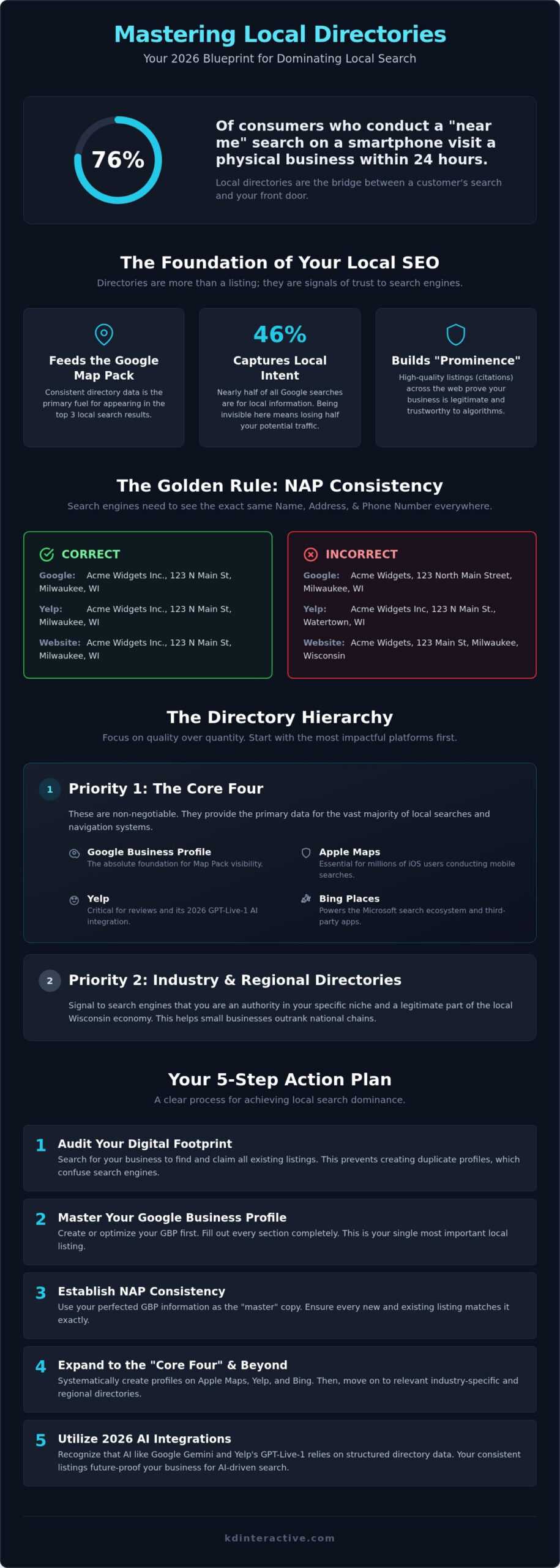
Did you know that 76% of consumers who perform a “near me” search on their smartphone visit a business within 24 hours? For a small business owner in Milwaukee or Watertown, this statistic represents a massive opportunity for growth. If you are currently asking how to get my business in local directories, you likely feel the frustration of being invisible while competitors capture all the local leads. It is common to feel overwhelmed by which platforms actually matter or to fear that a small technical mistake might hurt your search rankings.
We understand that your time is best spent running your business, not untangling complex search algorithms. This guide provides a clear, pragmatic roadmap for listing your small business in local directories to boost your search visibility and dominate the Wisconsin market. You will learn the exact process for maintaining consistent information across the web, improving your Google Map Pack rankings, and utilizing the latest 2026 AI integrations. We have broken down the technical barriers to give you a straightforward path toward digital growth and professional achievement.
Key Takeaways
- Understand why local directories are the digital foundation for showing up in the Google Map Pack for Wisconsin searches.
- Learn the exact steps for how to get my business in local directories while prioritizing your Google Business Profile for maximum impact.
- Master the “Golden Rule” of NAP consistency to ensure search engines can verify your physical location without confusion.
- Identify how to audit your current digital footprint and claim existing listings to avoid the common mistake of creating duplicate profiles.
- Discover how the Google Map Pack with AI Assistant automates your optimization so you don’t have to manage technical updates manually.
Why Local Directories are the Foundation of Your 2026 SEO Strategy
A Business directory is much more than a digital version of the old Yellow Pages. It is the verification layer that search engines use to confirm your business exists at a specific physical location. When you are researching how to get my business in local directories, you are actually building a foundation of trust with modern algorithms. In 2026, AI-driven search engines like Google Gemini and Yelp’s GPT-Live-1 integration rely on structured directory data more than ever. They need to see consistent, verified proof of your existence across multiple platforms before they will recommend you to a customer in your target service area.
This data feeds directly into the Google Map Pack. Since approximately 46% of all Google searches have local intent, being invisible here means losing nearly half of your potential traffic. When a consumer performs a “near me” search, the search engine looks for the most prominent and verified options. If your business information is scattered or incorrect, you won’t make the cut. Effective directory management ensures you capture this high-intent traffic the moment they are ready to buy.
The Link Between Directories and Local Search Rankings
Google doesn’t just take your website’s word for it. It cross-references your site with third-party data to ensure accuracy and legitimacy. Prominence is a core ranking factor in local SEO; it measures how well-known and trustworthy a business appears across the web. A citation is any online mention of your business name, address, and phone number. The more high-quality citations you accumulate, the higher your prominence score becomes, which directly influences your position in local search results.
Why Wisconsin Businesses Can’t Ignore Local Signaling
Local signaling is the best way for a Watertown small business to compete with massive national brands. National companies have huge budgets, but they often lack the deep, verified roots in a specific community that search engines now prioritize. By listing in regional directories like the Wisconsin Chamber of Commerce, you signal that you’re a legitimate, active part of the local economy. This is a key component of local digital marketing, which focuses on winning your specific neighborhood through targeted, regional authority. When you learn how to get my business in local directories, you stop being a generic search result and start being a trusted local landmark.
The Hierarchy of Local Directories: Where You Must List First
Success in local search isn’t about being everywhere; it’s about being in the right places. When you start looking into how to get my business in local directories, you’ll find thousands of options. However, listing in 100 low-quality sites won’t help your rankings as much as securing 10 high-authority placements. Search engines prioritize quality and relevance. You should focus on a hierarchy that starts with the major search engines, moves to data aggregators like Foursquare, and finishes with hyper-local Wisconsin associations. Quality over quantity matters most.
The Core Four: Google, Apple, Bing, and Yelp
Your Google Business Profile is the absolute priority for any Wisconsin small business. It is the primary data source for the Map Pack. If you aren’t sure how do i setup a google business page correctly, you risk missing out on the 98% of consumers who use the internet to find local information. Apple Maps is equally vital because it powers navigation for millions of mobile users. While Yelp has a controversial reputation, its September 2026 integration with OpenAI’s GPT-Live-1 makes it a critical platform for conversational AI search. Bing rounds out the core four, providing essential data for users outside the Google ecosystem.
- Google Business Profile: The foundation of local SEO and Map Pack visibility.
- Apple Maps: Essential for capturing the 76% of “near me” searches that happen on mobile.
- Yelp: Now features GPT-Live-1 for a natural conversational experience for home services and restaurants.
- Bing Places: Feeds data into the Microsoft search environment and various third-party apps.
Industry-Specific and Wisconsin-Regional Directories
Once your core profiles are live, you need to signal your specific expertise and geographic roots. A Milwaukee contractor, for instance, gains more authority from a listing on Houzz or Angi than a generic directory. For professional services, maintaining a profile with the Better Business Bureau (BBB) remains a powerful trust signal. Don’t overlook hyper-local opportunities. Joining a Watertown or Jefferson County business association provides high-relevance links that national competitors simply can’t replicate. This targeted approach is part of a smart strategy that ensures your data remains accurate and competitive, which you can streamline using a Google Map Pack with AI Assistant. Focusing on these high-impact sites is the most efficient way to solve the puzzle of how to get my business in local directories while building long-term authority.
The Golden Rule of Directory Submission: NAP Consistency
NAP stands for Name, Address, and Phone number. It’s the most critical set of data points for any Wisconsin entrepreneur. While it seems simple, the way you present this information determines how search engines perceive your legitimacy. If you’re researching how to get my business in local directories, you’ve likely seen different formats for the same address. One site might list “Suite 100” while another uses “#100.” While a human knows these are the same place, a search algorithm can get confused. This confusion creates “Dirty Data,” which is a collection of conflicting facts that makes your business look unreliable. In 2026, AI assistants use NAP consistency as a primary signal to verify that your business is real and currently operational.
The “Dirty Data” problem often stems from old addresses or disconnected phone numbers that haven’t been purged from the web. If Google sees three different addresses for your business, it won’t know which one is correct. This uncertainty leads to a lack of trust, and a lack of trust leads to lower rankings. You don’t want a customer in Watertown calling a number that’s been out of service for two years because an old directory listing was never updated. Accuracy is the foundation of digital authority.
How Inconsistent Data Hurts Your Milwaukee SEO
Inconsistent information leads to what we call the “split authority” problem. This happens when Google finds multiple versions of your business and doesn’t know which one is the “real” you. Instead of giving one listing 100% of the ranking power, it might split that power between three different incorrect listings. This lack of clarity often results in lower placement in local seo services near me results. Industry data shows that even a minor typo in your address or phone number can result in a 20% drop in local visibility. If your data isn’t clean, you’re essentially handing customers to your competitors.
Standardizing Your Business Profile
The best way to avoid these technical errors is to create a Master NAP Document. This is a single file that contains your business name, address, and phone number exactly as they should appear everywhere. You must decide on one format and stick to it. For example, choose whether you’ll use “(920) 555-0123” or “920-555-0123.” If your business has multiple locations in Wisconsin, create a unique NAP for each branch to prevent data from bleeding together. Consistency isn’t just about being tidy; it’s about making it as easy as possible for Google to trust your location. When you know how to get my business in local directories with perfect consistency, you’ve already won half the battle.
How to Submit Your Business to Local Directories
Submitting your business information is a methodical process that requires precision. If you’re wondering how to get my business in local directories, you can’t just start filling out forms at random. You need a structured approach to ensure your data is clean and your profiles are fully optimized for the 2026 search environment. Following a phase-based plan prevents the creation of duplicate listings and ensures that search engines like Google and Bing can verify your physical location in Wisconsin without hesitation.
Auditing Before You Submit
The first step is a thorough audit of your current digital footprint. You don’t want to create a new profile if one already exists with old data. Use search operators by typing your business name and phone number in quotation marks into a search engine. This reveals every mention of your brand across the web. If you find duplicate listings, you must claim and merge them rather than ignoring them. If your audit reveals widespread errors across multiple platforms, you may need professional web and seo services to clean up your site-wide data and restore your authority.
Optimizing for Maximum Conversion
Once you have claimed your profiles, the optimization phase begins. This is where you turn a simple listing into a lead-generation tool. Your descriptions should be punchy and include your primary keywords along with your specific service area, such as “Best plumber in Milwaukee” or “Reliable HVAC in Watertown.” This helps AI-driven search tools understand exactly what you do and where you do it.
- Visual Proof: Upload at least 10 professional photos. Profiles with high-quality images of your team, equipment, and storefront receive significantly more engagement.
- Strategic Categorization: Choose your primary category carefully. If you’re a “Law Firm,” don’t just settle for “Attorney.” Be as specific as possible to match user intent.
- Verification: Complete the verification process immediately. Whether it’s a phone call, email code, or a physical postcard sent to your Wisconsin address, an unverified listing is a useless listing.
After your profiles are live, you must monitor them for “data decay.” Third-party aggregators or even well-meaning users can sometimes suggest edits that change your hours or phone number. Regular check-ins ensure your information remains 100% accurate. If you want to skip the manual labor and ensure your listings are always perfect, you can get started with our Google Map Pack with AI Assistant today to automate your local growth.
Scaling Your Local Presence with KD Interactive
While the manual steps for how to get my business in local directories are straightforward, maintaining dozens of profiles is a time-consuming commitment. Many entrepreneurs start with good intentions but find that “data decay” sets in as their business grows. KD Interactive acts as your regional partner to ensure your digital presence remains flawless. We understand the Wisconsin market because we live and work here too. We align our success with yours, handling the technical heavy lifting of citation building and reputation management so you can focus on your daily operations in Milwaukee or Watertown.
Our primary solution for local growth is the Google Map Pack with AI Assistant. This tool provides 24/7 optimization, moving far beyond simple data entry. It actively monitors your profiles and responds to the shifting landscape of local search. If you’re looking for the most efficient way how to get my business in local directories while ensuring long-term accuracy, our automated assistant is the answer. It bridges the gap between basic visibility and a dominant market position.
Beyond Directories: Dominating the Milwaukee Map Pack
Listing your business is just the first step in a broader strategy. To truly stand out, you must integrate your directory presence with expert on-page SEO and consistent Content Creation. We ensure your website and your third-party listings work in harmony to build maximum authority. Automated review management is also a critical piece of this puzzle. In 2026, 41% of consumers report that they “always” read online reviews. We help you maintain a spotless reputation that search engines can’t help but reward. Choosing a specialized seo agency is a long-term investment in your revenue, transforming your digital footprint into a lead-generation machine.
Get a Professional Local SEO Audit
We invite you to see exactly where your business stands. Our professional Local SEO Audit analyzes your current directory health and identifies the specific gaps where you’re losing ground to competitors. We don’t use standardized, “one-size-fits-all” templates. Instead, we provide a tailored strategy built on measurable data and regional expertise. Our results-oriented approach is designed specifically for the Wisconsin small business owner who is ready to scale. It’s time to stop being invisible to your local customers. Dominate the Map Pack with KD Interactive and secure your place at the top of the search results.
Take Control of Your Local Visibility Today
Your journey to the top of the Google Map Pack starts with a single, accurate listing. We’ve established that NAP consistency is the bedrock of search engine trust and that prioritizing the right Wisconsin-specific directories is essential for regional authority. Learning how to get my business in local directories is the first step toward a dominant digital presence. It’s the difference between being a hidden gem and a household name in Milwaukee or Watertown.
At KD Interactive, we provide the pragmatic, results-driven local SEO strategies your business needs to scale. Our specialized Google Map Pack with AI Assistant offers 24/7 optimization, ensuring your information stays perfect while you focus on running your company. We’re your regional experts, and we’re ready to help you turn search visibility into tangible revenue. Claim Your Free Local SEO Consultation with KD Interactive and start dominating your neighborhood today. You don’t have to feel invisible anymore. We’re here to help you achieve the professional growth you deserve.
Frequently Asked Questions
How much does it cost to get listed in local directories?
Most foundational directories like Google Business Profile, Bing Places, and Yelp allow you to list your business for free. However, some specialized industry sites or data aggregators charge subscription fees for listing management. For example, major aggregators in 2026 often charge monthly fees to push your data to thousands of smaller sites. While the basic profiles are free, many Wisconsin entrepreneurs choose to invest in professional management to ensure accuracy and save time.
How long does it take for directory listings to affect my SEO?
You should expect to see a measurable impact on your search performance within four to eight weeks after your listings are verified. Search engine crawlers need this time to discover the new citations and cross-reference them with your website data. When you are researching how to get my business in local directories, remember that consistency is the primary factor that determines how quickly Google trusts your location and improves your Map Pack ranking.
Do I need to pay for a Yelp or Yellow Pages listing?
You do not need to pay for a basic business listing on Yelp or the Yellow Pages. These platforms offer free versions that allow you to claim your profile, add photos, and respond to reviews. While their sales teams may contact you to purchase advertising or “enhanced” profiles, these paid features are not required for your foundational SEO. Focus on fully optimizing your free profiles first to build a solid base of digital authority.
What should I do if my business address changes?
Update your Master NAP Document immediately and then systematically change your address on every platform, starting with your Google Business Profile. Address changes are high-priority tasks because conflicting location data can cause an immediate drop in rankings. You must reach out to major data aggregators to ensure the new information flows correctly across the web. This prevents “Dirty Data” from confusing the AI assistants that customers use to find your Milwaukee storefront.
Can I use a PO Box for my local directory listings?
Google and most major directories generally prohibit the use of PO Boxes for local business verification. These platforms require a physical street address to prove that you have a real presence in the community. If you operate a home-based business in Watertown, you should use your residential address. Many platforms allow you to hide your specific street number from the public while still using it for the backend verification process required for ranking.
How do I find industry-specific directories for my niche?
Use targeted search queries such as “[Your Industry] + directory” or “[City] + [Industry] association” to find relevant platforms. For instance, a Milwaukee contractor should look for placements on Houzz or Angi, while a medical professional would prioritize Healthgrades. Checking where your top local competitors are listed is another effective strategy. These niche-specific citations provide the high topical authority that search engines look for when determining which businesses are experts in their field.
What is the difference between a citation and a backlink?
A citation is a mention of your business name, address, and phone number, while a backlink is a clickable URL that leads to your website. Citations are used by search engines to verify your physical location and legitimacy for local searches. Backlinks are used to measure the overall authority and popularity of your website. Both are essential for a complete strategy, but citations are the specific data points that drive your placement in the Google Map Pack.
Is it better to use an automated tool or submit to directories manually?
Automation is much better for maintaining long-term accuracy and scaling your presence, while manual submission is acceptable for your first few core profiles. Manual entry is often prone to typos that can lead to a 20% drop in local visibility. Using a tool like the Google Map Pack with AI Assistant ensures that your data is monitored 24/7. This prevents “data decay” that happens when third-party sites or users suggest incorrect edits to your business information.