
Did you know that 93% of consumers now search online before they ever hire a local service provider? If you’re running a business here in Wisconsin, you’ve likely felt the frustration of watching national chains with massive budgets outrank you for the very services you provide best. It’s exhausting to navigate technical jargon when your priority is managing daily operations and serving your community. You need to know how to optimize my website for local search in a way that is both manageable and effective. We understand that your time is your most valuable asset, and you deserve a digital presence that works as hard as you do.
You can reclaim your local market and attract more foot traffic by following a clear, results-oriented plan. This 2026 guide provides the exact steps to secure a Top 3 ranking in the Google Map Pack and generate a steady stream of high-quality leads. We will walk through the latest video verification standards and show you how to leverage AI-assisted tools to automate your online reputation. You’re about to learn a sustainable, data-driven approach to growth that keeps your business at the forefront of every local search.
Key Takeaways
- Capture regional intent by securing a spot in the Local Pack and adapting your profile to AI-generated search snapshots.
- Use the latest video verification standards and AI assistants to protect your Google Business Profile and manage reputation 24/7.
- Master how to optimize my website for local search by implementing Local Business Schema and geographic modifiers in your meta data.
- Build community authority through strict NAP consistency and hyper-local Wisconsin link-building strategies.
- Track revenue-focused metrics like direction requests and phone calls rather than just monitoring search rankings.
Understanding the Local Search Landscape in 2026
Local SEO is no longer just a technical checkbox; it is the strategic art of connecting your digital presence to your physical community. In 2026, Understanding Local SEO means recognizing that search engines prioritize geographic context to deliver immediate, relevant results to users on the move. When you look for ways on how to optimize my website for local search, you are essentially building a bridge between a neighbor’s urgent need and your specific solution. This connection is vital because local searchers possess a much higher “ready-to-buy” intent than general browsers. Data from May 2026 indicates that 76% of people who search for something nearby visit a business within 24 hours. If you aren’t visible in those critical moments, you’re handing that revenue to a competitor.
The “Local Pack,” or Map Pack, remains the most valuable real estate on any search results page. In 2026, this space has been transformed by AI Optimization (AIO). Search engines now use generative AI to summarize local business data, reviews, and service offerings into a concise snapshot. These summaries allow users to compare businesses without ever clicking through to a website. This shift makes the accuracy of your digital footprint more important than it has ever been. To win in this environment, your data must be structured so that AI agents can easily parse and recommend your services to local Wisconsin residents.
The Anatomy of a Local Search Result
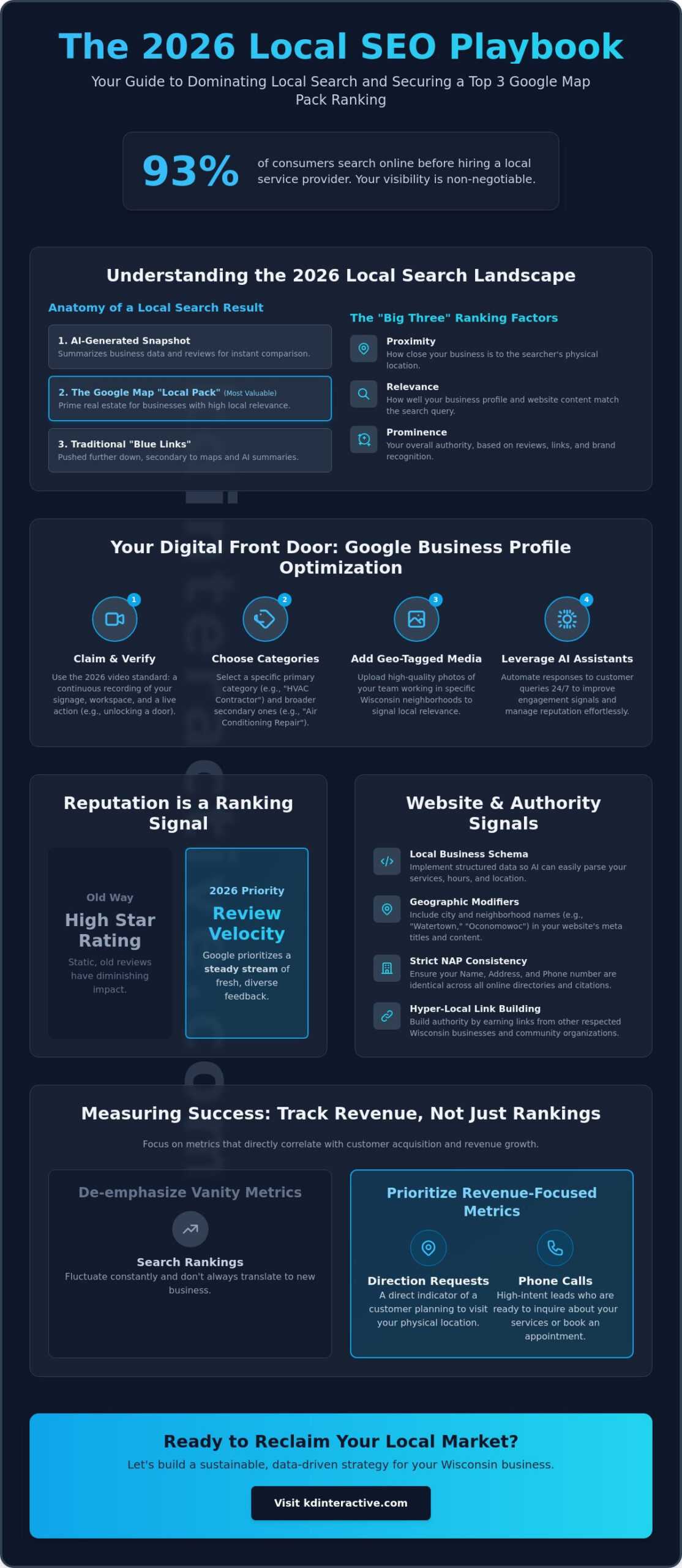
The modern search results page is a layered experience. At the top, you’ll often find an AI-generated snapshot that answers specific queries, followed immediately by the Map Pack. Traditional “blue links” have moved further down the page, making them secondary to the map and AI summaries. Ranking in that top tier still depends on the “Big Three” factors: proximity, relevance, and prominence. Proximity measures how close you are to the searcher, relevance tracks how well your content matches the query, and prominence reflects your overall authority and reputation across the web. Balancing these three is the core of how to optimize my website for local search effectively.
Why a Regional Focus Beats a National One
Small businesses often feel intimidated by national chains, but you have a significant home-field advantage. You can “own” your specific neighborhood in a way a massive corporation cannot. Local expertise builds immediate trust. A resident in Watertown or Oconomowoc wants to know you understand their specific needs and regional challenges. At KD Interactive, our philosophy centers on regional dominance. We believe that by focusing on hyper-local community signaling, you can build a sustainable presence that national brands can’t replicate. This localized approach doesn’t just attract more clicks; it attracts higher-quality leads who are looking for a trustworthy local partner.
Optimizing Your Google Business Profile & Reputation
Your Google Business Profile (GBP) is the digital front door to your business. In 2026, a static profile is no longer enough to win a spot in the Map Pack. You must actively manage this asset to prove to search engines that your business is prominent and reliable. If you are researching how to optimize my website for local search, you’ll find that your GBP and your website work in tandem to establish geographic authority. Claiming your profile is the vital first step. You must sign in to the Business Profile Manager and complete the video verification process. This is the current standard, requiring a single, continuous recording that shows your street signage, your interior workspace, and a live management action like opening a locked door or operating a point-of-sale system.
Choosing the right categories is a critical ranking factor that many Wisconsin business owners overlook. Your primary category should be the most specific match for your core service, while secondary categories provide necessary context. For example, a local contractor might choose “HVAC Contractor” as primary and “Air Conditioning Repair Service” as secondary. To further signal local relevance, upload high-quality, geo-tagged imagery. Photos of your team working in specific neighborhoods tell Google exactly where you operate. For entrepreneurs who cannot be online at all hours, using a Google Map Pack with AI Assistant ensures that customer queries are answered instantly, even during the middle of the night.
Reputation Management as a Ranking Signal
A high star rating is helpful, but review velocity and diversity are now more significant signals for ranking. Google prioritizes businesses that receive a steady stream of fresh feedback over those with old, stagnant reviews. You can learn how to get more Google reviews by implementing a simple, automated request system that follows current guidelines. When negative feedback occurs, use a pragmatic response framework. Acknowledge the issue publicly, apologize for the experience, and offer a direct path to a resolution offline. This professional approach builds trust with future customers who are reading your responses to see how you handle challenges.
Utilizing AI for Local Engagement
AI assistants now manage complex tasks like FAQ responses and appointment bookings directly from the search results page. This automation keeps your profile active and signals “freshness” to Google’s algorithm. By automating GBP posts with localized updates, you maintain a consistent presence without manual daily effort. Integrating these tools is a core part of how to optimize my website for local search while staying focused on your business operations. Automating your GBP management through AI tools effectively reclaims over five hours of your work week, allowing you to focus on direct client service. For a comprehensive strategy that drives results, consider our specialized Local SEO Services to streamline your regional growth.
On-Page SEO and Localized Content Strategy
Your website is the conversion hub where searchers become paying customers. While your Google Business Profile handles initial discovery, your on-page elements prove you are the right choice for the job. To master how to optimize my website for local search, you must align your digital content with the specific way Wisconsin residents search for help. This begins with rigorous local keyword research. Instead of targeting generic industry terms, find the phrases your neighbors actually use, such as “emergency plumber in Oconomowoc” or “best landscaping near Delafield.”
Precision in your technical tags is a powerful ranking signal. Your Title Tags and
Building Authority through Citations and Local Links
Authority is the currency of local search. If Google doesn’t trust that your business is a legitimate, active part of the community, you won’t secure a spot in the Map Pack. This trust is built through consistency and local relevance. The NAP Consistency Rule is your first line of defense. Your Name, Address, and Phone number must be identical across every directory, social profile, and map application. Even minor discrepancies, like using “Suite” on one site and “Ste.” on another, can confuse search algorithms. This confusion leads to “dirty data” in major aggregators like Foursquare or Data Axle. Cleaning up these citations is a foundational step in how to optimize my website for local search. It ensures that when a customer in Madison or Green Bay looks for you, the data is accurate and trustworthy.
Beyond basic directories, you need to build a network of local signals. A regional focus allows you to earn links that national chains simply cannot get. Connecting with local chambers of commerce and neighborhood non-profits creates a digital footprint that screams “local expert.” This “Wisconsin Link Building” strategy is about more than just numbers. It is about establishing your business as a pillar of the community. If you want to accelerate this process and build immediate credibility, our Press Release Distribution services can place your brand on authoritative local news outlets.
The Power of Local Press Release Distribution
News signals activity. When you distribute a press release about a new service, a local hire, or a community initiative, you tell Google that your business is an active participant in the regional economy. KD Interactive leverages authoritative media outlets to boost your local credibility. Why does this matter? One link from a local Wisconsin news site beats ten generic global links every time. These high-relevance connections provide the hyper-local signaling that search engines use to verify your prominence in a specific territory.
Community Involvement as an SEO Factor
Your offline actions can have a direct impact on your online rankings. Sponsoring a local event in Watertown or a charity drive in Milwaukee often results in a high-relevance citation from a trusted community domain. You can also create local “Best of” guides, such as a list of the best coffee shops near your office. These guides attract neighborhood traffic and encourage local organizations to link back to your site. You should also monitor your local digital footprint regularly. Ensuring that every mention of your brand includes a clickable link is a simple but effective way to grow your authority over time.
Measuring Success and Scaling Your Local Growth
Dominating the search results is a powerful milestone, but rankings alone don’t pay the bills. To truly understand how to optimize my website for local search, you must look past vanity metrics and focus on tangible business outcomes. We track success through high-intent actions: phone calls, direction requests, and website conversions. These metrics represent real Wisconsin neighbors reaching out for your services. By setting up Google Search Console, you can monitor your local search impressions and identify exactly which queries bring people to your digital doorstep. This data-driven approach ensures your marketing efforts align with your actual business growth.
Consistency is the secret to long-term regional dominance. Search algorithms and competitor strategies change constantly, which makes a monthly local SEO audit essential for staying ahead. These regular check-ups help you find new keyword opportunities and fix technical issues before they impact your visibility. As your business expands, you might find that managing these details becomes a full-time job. Knowing when to transition from a DIY approach to hiring a professional SEO agency is a critical decision for any growing enterprise. It allows you to delegate the technical complexities while you focus on delivering excellent service to your clients.
Data-Driven Decision Making for Owners
Are your local keywords actually driving revenue, or just traffic? Identifying the specific terms that lead to booked appointments is vital for a pragmatic marketing strategy. We use heatmaps to visualize where your Map Pack visibility is strongest across your service area. This allows you to see exactly which neighborhoods are seeing your business and where you need to bolster your presence. Don’t forget to adjust your strategy based on seasonal local trends in Wisconsin. Whether you are preparing for the winter rush or summer outdoor projects, your content should reflect the immediate needs of your community. This level of specificity is how you maintain a competitive edge over national chains.
Partnering with a Local Expert
KD Interactive provides tailored local SEO packages designed to scale alongside your business. We understand the unique challenges faced by small businesses in the Wisconsin market because we share those same roots. Our team doesn’t just offer standard services; we provide a methodical, results-oriented partnership built on trust and transparency. We help you navigate the evolving landscape of local search so you can achieve professional achievement and market leadership. Ready to see where your business stands in the local market? Get your professional local SEO assessment from KD Interactive today and start your journey toward regional dominance.
Take Control of Your Wisconsin Growth
You now have a clear roadmap to outpace national chains and claim your rightful place in the regional market. By mastering how to optimize my website for local search, you’ve moved from being overwhelmed by technical jargon to holding a methodical, actionable strategy. We’ve explored the necessity of modern Google Business Profile verification, the power of hyper-local content, and the importance of tracking real revenue rather than just rankings. These steps are the foundation of a digital presence that serves your community and your bottom line.
Managing this level of technical visibility while running a business is a heavy lift. We specialize in Wisconsin small business growth and offer a results-driven approach backed by transparent data tracking. Our proprietary Google Map Pack with AI Assistant is built to automate your reputation management and capture leads 24/7. Your business deserves to be found by the neighbors who need you most. Dominante your local market with KD Interactive’s SEO services and start building a sustainable future today. We’re ready to help you achieve the expansion and professional achievement you’ve worked so hard for.
Frequently Asked Questions
How long does it take to see results from local SEO?
Most Wisconsin businesses see noticeable movement in their rankings within three to six months of consistent optimization. While technical fixes to your website can show impact sooner, building the necessary authority and review velocity takes time. Your specific industry competition in cities like Milwaukee or Madison will also influence the timeline. We focus on sustainable growth that delivers a steady stream of leads rather than temporary spikes.
Do I need a physical office to rank in local search?
You don’t need a storefront to rank if you operate as a Service Area Business. Service providers like plumbers or landscapers can set a specific service radius in their Google Business Profile without showing a home address. To succeed, you must still complete the video verification process and prove you are a legitimate local operator. This allows you to appear in the Map Pack for the specific neighborhoods you serve.
What is the most important factor for ranking in the Google Map Pack?
Google relies on a combination of proximity, relevance, and prominence to determine your rank. While you can’t control where the searcher is standing, you can maximize your relevance through precise category selection and prominence through review management. Keeping your profile active with regular posts and responding to every customer review are the most effective ways to signal to Google that your business is the best local choice.
Is local SEO different from regular SEO?
Local SEO is a specialized branch that focuses on geographic intent and Map Pack visibility. Traditional SEO aims for broad organic rankings, but local strategies target customers who are ready to visit a physical location or hire a nearby pro. When you learn how to optimize my website for local search, you focus on geographic modifiers and local citations that traditional global campaigns often ignore.
How much should a small business spend on local SEO services?
Your investment should align with your specific growth goals and the level of competition in your regional market. Rather than looking for the lowest price, focus on the projected return on investment from new lead generation. A professional strategy includes everything from technical audits to content creation. We recommend a budget that allows for consistent monthly management to maintain your authority against national competitors.
Can I optimize my website for local search without a blog?
You can achieve strong rankings by focusing on high-quality service area pages and a robust Google Business Profile. While a blog is helpful for capturing long-tail queries, it’s not a strict requirement for Map Pack success. Your priority should be ensuring your core service pages are fast, mobile-friendly, and clearly state your service areas. This focused approach is a practical way on how to optimize my website for local search.
How do I handle multiple locations for local SEO?
Each location needs its own dedicated landing page on your website with unique, localized content. You should also maintain separate Google Business Profiles for each branch to ensure accurate map data for every neighborhood. Managing these through Location Groups in the Business Profile Manager allows for efficient bulk updates. This structure helps search engines understand that you are a prominent multi-location expert in the Wisconsin region.
What happens if my business address changes?
You must update your Google Business Profile immediately to reflect the new location and trigger any required re-verification. It is equally important to sync this change across all major directories and aggregators to maintain NAP consistency. Discrepancies in your address can quickly erode search engine trust and cause your rankings to slip. A methodical audit of your digital footprint ensures your customers and search engines always have the right data.