
A star rating alone rarely gives customers the details they need to assess a specialist business. Industry-specific review sites add relevant context: patients can compare medical practices, travelers can evaluate hotels, and clients can read feedback about lawyers, car dealers, and restaurants. These sources help people judge businesses using details tied to the service they’re considering.
When customers have industry-specific questions, it makes sense to look beyond broad review platforms. The right review source can make feedback more useful, while general platforms such as Google and Yelp can still support local visibility. This guide explains how niche review sources help and highlights options across medical, hospitality, legal, automotive, food, and other industries.
You’ll also see how specialized platforms differ from broad review sites and where each fits into a customer’s decision process. Use the examples to identify sources relevant to your field and better understand where customers may encounter your business.
Key Takeaways
- Match review platforms to the questions customers ask in your industry, from healthcare and legal services to automotive and hospitality.
- For food and beverage businesses, consider how niche platforms capture feedback about dining experiences and influence where customers choose to eat.
- Use broad platforms for general visibility and specialized sites for feedback that speaks directly to your field.
- Prioritize the review sources most relevant to your customers, then align your local search strategy and content with those platforms.
Review sources for medical, hospitality, legal, automotive, and other industries
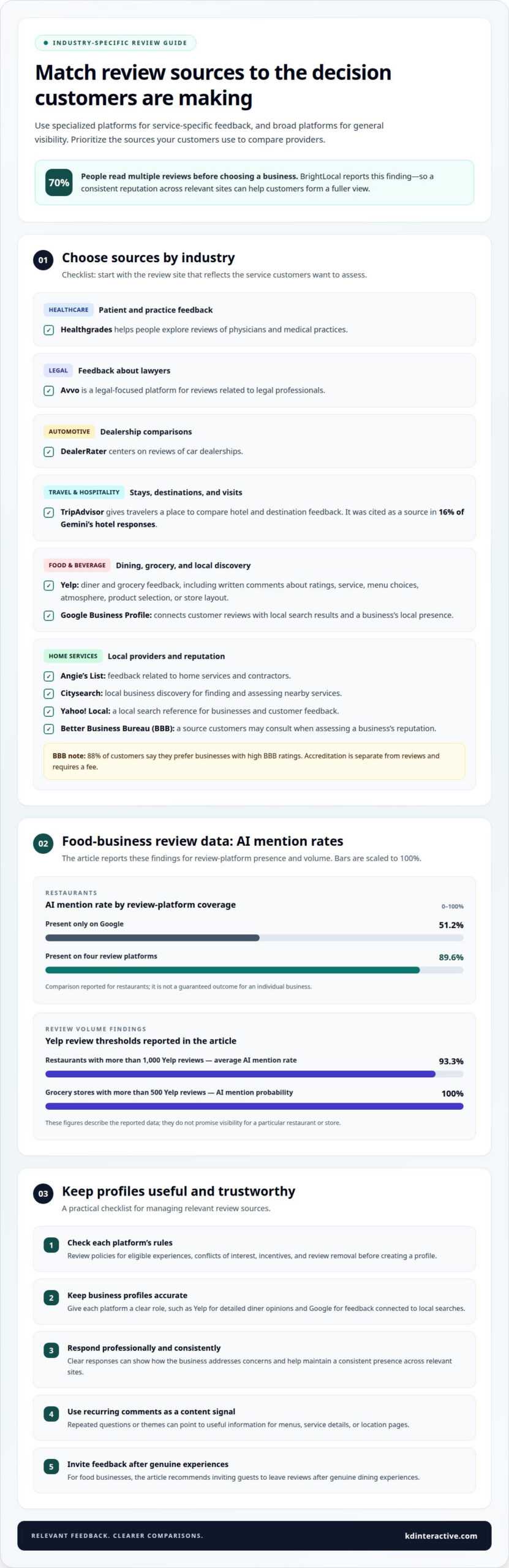
Specialized review websites give customers feedback related to a particular service. In healthcare, Healthgrades helps people explore physician and practice reviews. Avvo focuses on legal professionals, while DealerRater centers on car dealerships. These industry-specific review sites can surface relevant feedback when customers search for and compare providers.
Tourism and hospitality businesses can use travel-focused platforms to reach people planning a stay or visit. TripAdvisor is a recognizable hospitality review site for traveler feedback about hotels and destinations. It was cited as a source in 16% of Gemini’s hotel responses. Review platforms for travel can also help visitors compare experiences before choosing where to stay or what to do.
- Healthgrades: A source for patient feedback about physicians and medical practices.
- Avvo: A legal-focused platform for reviews related to lawyers.
- DealerRater: A review source centered on car dealerships.
- TripAdvisor: A travel and hospitality platform for hotel and destination feedback.
What rules govern reviews on industry-specific sites? Each platform sets its own policies for what reviewers can post and how content is moderated. Before creating a profile, read the site’s rules on eligible experiences, conflicts of interest, incentives, and review removal.
Choose platforms based on how customers make decisions in your field. A patient comparing practices may value medical feedback, while a hotel guest may prioritize traveler experiences. BrightLocal reports that 70% of people read multiple reviews before choosing a business, so a consistent online reputation across relevant websites can help customers form a fuller view. Keep profiles accurate, respond professionally to feedback, and use recurring themes to identify questions your business content should answer.
A commenter reported that roughly 20% of customers at one small business used reviews as a major source when deciding to buy. Separately, a Warrior Forum participant said they preferred Yelp over other review sites. The reported share concerns one small business, while the preference is attributed to one participant.
Industry-specific review platforms for food and beverage
Restaurants and food retailers can benefit from review sources that reflect dining and shopping experiences. Yelp helps people compare restaurants through customer feedback, while Google Business Profile reviews may appear alongside local search results. For a neighborhood café, comments about service, menu choices, and atmosphere give prospective diners more context than a star rating alone.
Give each platform a distinct role. A restaurant can monitor Yelp for detailed diner opinions and Google for feedback associated with local searches. Grocery businesses can also pay attention to Yelp reviews, where customers may discuss product selection, store layout, or service. Hotels are different: travel platforms focus on stays, while restaurant review sites center on meals and dining visits.
- Yelp: Useful for restaurant and grocery feedback, including written comments that explain a customer’s rating.
- Google Business Profile: Connects customer reviews with a business’s local search presence.
Review volume and platform coverage may also shape how food businesses appear in AI-generated answers. Restaurants with more than 1,000 Yelp reviews had an average AI mention rate of 93.3%. Grocery stores with more than 500 Yelp reviews reached 100% AI mention probability. In restaurant data, businesses present only on Google had a 51.2% AI mention rate, compared with 89.6% for businesses present on four review platforms.
These figures aren’t a promise of visibility for an individual restaurant. They show why maintaining accurate profiles and responding consistently matters across relevant sites. Invite guests to leave reviews after genuine dining experiences, and use recurring comments to identify useful topics for menus, service details, or location pages. A direct, clear response to customer feedback can also show how the business addresses concerns. For stronger restaurant-focused pages, content creation for food businesses can turn common customer questions into practical website information.
Which review platforms are best for home services and contractors?
Contractors need review sources that help homeowners assess local service providers. Angie’s List, Citysearch, and Yahoo! Local are examples of platforms suggested for finding reviews about local companies. Their usefulness depends on whether customers in a contractor’s service area use them to compare providers.
Consider these options by purpose:
- Angie’s List: A place to look for feedback related to home services and contractors.
- Citysearch: A local business discovery platform that can help customers find and assess nearby services.
- Yahoo! Local: A local search reference for discovering businesses and customer feedback.
- Better Business Bureau (BBB): A source customers may consult when assessing a business’s reputation.
BBB ratings can influence customer preferences: 88% of customers say they prefer businesses with high BBB ratings. That makes a BBB profile relevant to contractors who want customers to see trust signals alongside project feedback. Accreditation is separate from reviews, and becoming accredited requires a fee.
Choose review sites that reflect the work customers need. A homeowner searching for a roofer may value comments about communication, timelines, and completed projects. Someone looking for a plumber may focus on responsiveness and whether the service addressed the problem. Specific, factual feedback helps prospective customers understand the experience behind an overall rating.
Keep business details consistent across profiles, including the company name, phone number, and service area. Industry-specific review sites may also provide business citations that help keep local information accurate across the web. Respond professionally to feedback, and use recurring questions or concerns to improve service descriptions and website content. For example, if customers often ask whether a contractor handles basement repairs, make that service clear on relevant profiles and pages. Prioritize platforms your local customers actually use instead of spreading attention across every directory.
A Warrior Forum participant suggested Angie’s List, Citysearch, and Yahoo! Local as places to find online reviews, not as a ranking of contractor platforms.
How do industry-specific review sites compare with Google, Yelp, and Trustpilot?
Google, Yelp, Trustpilot, and niche platforms serve different discovery needs. Google connects reviews with business profiles and local searches. Yelp helps customers discover businesses through consumer feedback. Trustpilot offers a broader place to assess customer experiences with brands. Industry-specific review sites add feedback focused on a particular service category.
Each type reaches customers with a different mindset. Google can introduce a business during a general local search. Yelp helps people browse options and read customer opinions. Trustpilot is useful when customers want to understand broader experiences with a brand. Specialized sites often attract people further along in the buying process, already looking for a provider in their field.
- Google: Supports local discovery through business profiles and customer reviews.
- Yelp: Helps customers explore businesses and compare written feedback.
- Trustpilot: Offers a broad platform for customer experiences with brands.
- Industry-specific platforms: Provide feedback within a defined service category.
Google processes nearly 90% of online searches, making its broad discovery role distinct from specialist platforms. But broad reach doesn’t make every review equally relevant. Someone choosing a specialized service may value detailed, category-specific feedback more than general comments about a brand. A business can use each platform to address a different part of its online reputation.
Build a practical review presence by matching platforms to customer intent. Keep core business details consistent on Google and other relevant profiles. Monitor category-focused sites for feedback about your service, then use recurring themes to clarify website content. Treat Trustpilot as an additional source when brand-wide customer experiences matter, not as a substitute for local or specialist feedback.
Use a focused local search strategy to connect these review signals with business visibility. Strengthen your local search presence with a strategy that aligns customer feedback, profiles, and useful content.
KD Interactive
KD Interactive helps businesses connect relevant review sources with a clear local search strategy. When customers use different platforms to compare providers, Local SEO Services and Keyword Research can help shape where your business appears and which search topics its content addresses.
Content Creation can explain services, answer common customer questions, and add useful context alongside review profiles. Press Release & Distribution can support broader visibility when a business has news to share. These services can help businesses bring reviews, local search presence, and website information together rather than treating them as separate efforts.
Contact KD Interactive to discuss how a focused digital marketing approach can support your business.
Turn customer feedback into your next growth step
Make your review strategy an ongoing way to understand customer needs. Choose platforms that reflect how people evaluate your services, then use recurring feedback to identify gaps in your website content and local visibility. A focused approach can connect your reputation strategy to the real questions prospective customers ask.
KD Interactive supports this work through Local SEO Services, Content Creation, and Press Release & Distribution. These services help align your search presence and useful business information with the customers you want to reach. Consider how industry-specific review sites fit your audience, then use that insight to guide your next visibility steps.
Contact KD Interactive to discuss your needs and take a practical next step. A clear plan for industry specific review sites can help keep your reputation efforts focused on the customers you want to reach.
Frequently Asked Questions
What Are Business Review Sites?
Business review sites are online platforms where customers share feedback about companies, products, or services. They may display star ratings, written comments, and business profile details. Some serve broad audiences, while others focus on fields such as healthcare or travel. A review site differs from a company’s testimonial page because customer feedback appears on a platform independent of the business being reviewed.
Where Should I Be Collecting Reviews in Volume?
Prioritize platforms customers already use to find businesses like yours, then make review requests part of a consistent follow-up process. For a local business, that might mean Google Business Profile alongside a relevant specialist platform. Direct customers to one clear destination at a time, and track which sources receive responses. Follow each platform’s policies, and focus on genuine feedback rather than volume alone.
What are the best review sites by industry in the United States?
The best fit depends on where customers look for providers in your field. In the United States, Healthgrades serves healthcare searches, Avvo focuses on legal professionals, DealerRater covers car dealerships, and TripAdvisor supports travel and hospitality research. Restaurants may consider Yelp, while local businesses across industries can use Google Business Profile. Treat these as starting points, then prioritize platforms relevant to your customers and services.
How can businesses claim and manage profiles on industry review sites?
Read each site’s rules on eligible experiences, conflicts of interest, incentives, and review removal. Keep business details accurate and consistent across profiles, monitor feedback, and respond professionally.