
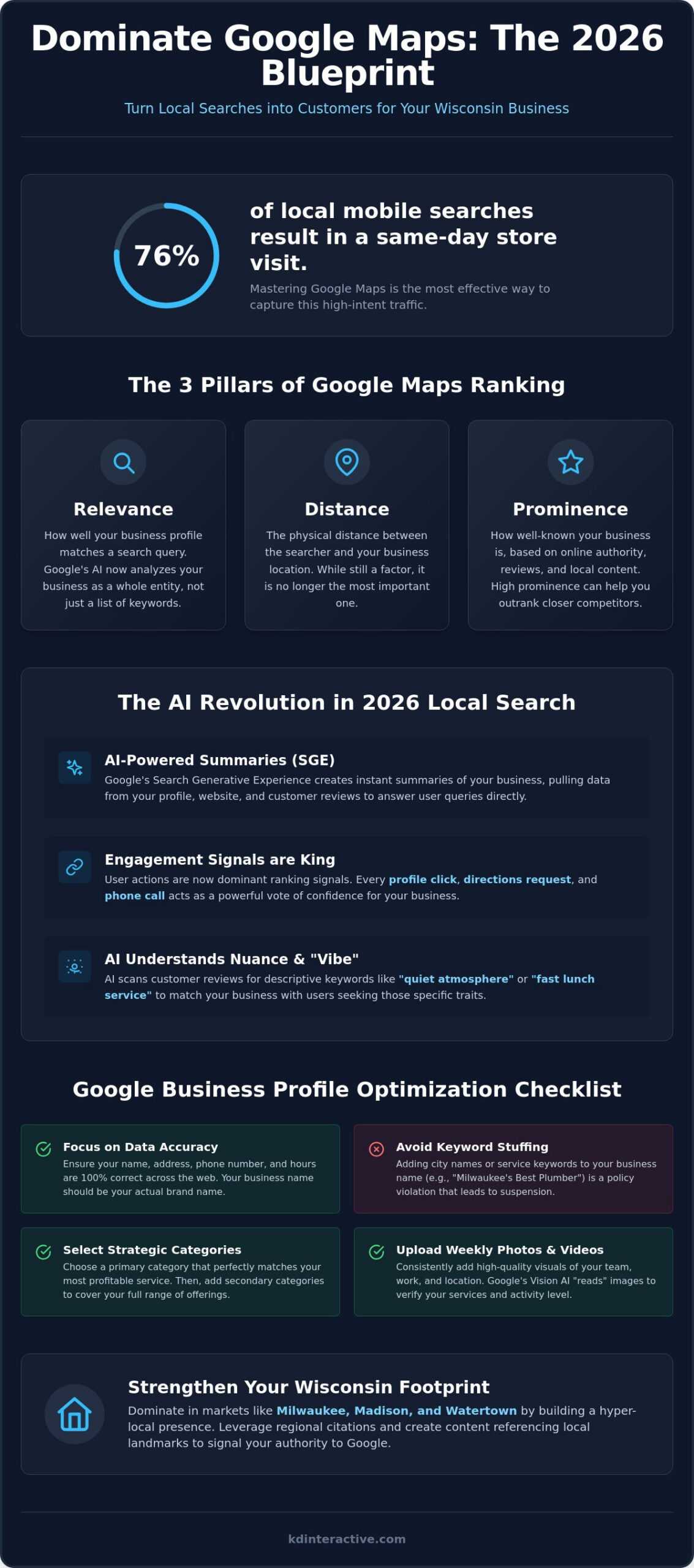
Did you know that 76% of local mobile searches result in a store visit on the same day? For Wisconsin business owners in Milwaukee, Madison, and Watertown, mastering how to rank in google maps is the single most effective way to turn those searches into sales. It’s frustrating to watch a less-qualified competitor across town capture your customers simply because they appear in the top three results while your own listing stays buried.
You’ve likely felt the pressure of changing 2026 algorithms and the confusion of AI-powered search updates. It’s hard to find the time to manage complex digital tasks when you’re focused on serving your community and growing your company. This guide provides a pragmatic, results-oriented blueprint to help you dominate the Google Map Pack and drive more local customers to your business this year.
We’ll break down the core ranking factors of relevance, distance, and prominence. You’ll also see how neighborhood-level SEO and tools like our Google Map Pack with AI Assistant can give you a predictable way to manage your online reputation and stay ahead of the competition.
Key Takeaways
- Master the three foundational pillars of local search—relevance, distance, and prominence—while adapting to Google’s 2026 AI-powered summaries.
- Learn the specific profile optimizations required to understand how to rank in google maps by prioritizing category selection and precise data accuracy.
- Shift your reputation strategy from simple star ratings to building review velocity and encouraging the specific keywords that signal authority to search engines.
- Strengthen your regional footprint in the Milwaukee, Madison, and Watertown markets by leveraging hyper-local citations and landmark-based content.
- Discover how the Google Map Pack with AI Assistant provides a methodical way to monitor your performance and adapt to algorithm shifts in real-time.
Decoding the 2026 Google Maps Ranking Algorithm
Google’s algorithm isn’t a mystery; it’s a methodical system built on three classic pillars. Relevance, distance, and prominence still dictate the order of the Map Pack. However, the way Google measures these factors has evolved. In 2026, the engine has moved beyond simple keyword matching to focus on “entity relevance.” This means the system looks at your business as a whole entity rather than just a collection of words on a page. Understanding Local SEO is essential for any Wisconsin entrepreneur who wants to stay visible as these technical shifts occur.
Learning how to rank in google maps in 2026 requires a shift in mindset. You’re no longer just trying to satisfy a search engine; you’re trying to satisfy an AI that summarizes your entire business for the user. Google’s Search Generative Experience (SGE) now creates instant summaries of local shops. It pulls data from your profile, website, and customer reviews to tell a searcher exactly why they should visit you. This makes your digital footprint more important than ever before.
Engagement is now the dominant ranking signal. When people click your profile, request driving directions to your Watertown shop, or tap the call button, Google sees those actions as votes of confidence. These user behavior signals carry massive weight. If users consistently choose your business over a closer competitor, Google will reward you with a higher position. It’s a pragmatic approach that favors businesses that actually deliver value to their community.
The Role of AI in Local Search Relevance
AI has changed how Google interprets what you do. It doesn’t just look for the services you’ve listed in your profile. It scans thousands of customer reviews to understand the specific nuances of your brand. If your Milwaukee restaurant is frequently praised for its “quiet atmosphere” or “fast lunch service,” AI uses those “vibe” and “atmosphere” tags to match you with users seeking those exact traits. You can align your business description with these AI-driven search patterns by using natural, descriptive language that mirrors how your customers actually talk.
Why Proximity Isn’t Everything Anymore
Many business owners assume they can’t rank for searches made a few miles away. That’s a mistake. While proximity is a factor, high prominence can often help you outrank a competitor who is physically closer to the searcher. By building digital authority through press release distribution and local content, you can expand your ranking radius across Madison and surrounding areas. Local Prominence is the digital reflection of a business’s real-world reputation. If Google sees you as a leader in your field, it will show your listing to a wider geographic audience. Mastering how to rank in google maps means focusing on this authority to beat the proximity trap.
Optimizing Your Google Business Profile for 2026
Your Google Business Profile (GBP) is the digital front door to your company. In 2026, simply having a profile isn’t enough; you must optimize every single field to satisfy both human customers and Google’s AI. While some national “experts” suggest keyword-stuffing your business name with city identifiers, this tactic now leads to immediate suspension. Instead, focus on data accuracy and detail to truly understand how to rank in google maps.
Category selection remains one of the most powerful ranking levers. Your primary category should align perfectly with your most profitable service. Don’t stop there. Secondary categories provide essential context that helps Google’s AI understand your full range of offerings. If you’re a contractor in Madison, listing “Kitchen Remodeler” as your primary and “Bathroom Remodeler” as your secondary ensures you appear for a wider variety of high-intent searches.
Visuals have also evolved. In 2026, high-quality, AI-optimized photos are the standard. Google’s Vision AI now “reads” the contents of your images to verify your services. Uploading weekly photos of your team at work in Milwaukee or your finished projects in Watertown signals that your business is active and legitimate. Combining this with regular Google Posts keeps your profile fresh and proves to the algorithm that you are engaged with your audience.
Mastering the Initial Setup
Getting started requires a clean foundation. The verification process is your first line of defense, ensuring your listing is live and protected from unauthorized changes. If you are starting from scratch, follow our guide on how do i setup a google business page for a smooth setup. Selecting a primary category that matches high-intent searches is the most critical decision you’ll make during this phase.
Advanced Profile Features You Can’t Ignore
Once the basics are set, dive into advanced features. Enable Google Messaging to increase your responsiveness score; fast replies are a major trust signal in 2026. Use the ‘Products’ and ‘Services’ menus to feed Google’s AI structured data about what you sell. Don’t overlook the ‘Attributes’ section. Highlighting traits like “Women-led” or “Veteran-owned” helps you stand out in a crowded market. If managing these details feels overwhelming, our Google Map Pack with AI Assistant can help automate the heavy lifting while you focus on your clients.
Building Local Authority Through Reviews and Reputation
Many business owners believe that a one-time surge of reviews from friends and family is enough to fix their visibility. In 2026, Google’s algorithm is far more sophisticated. It prioritizes review velocity, which is the steady, consistent frequency of new feedback over time. A sudden spike followed by months of silence looks suspicious to search engines and can actually hurt your progress. If you want to understand how to rank in google maps, you must view reputation management as a continuous business process rather than a one-off task.
The content of your reviews now carries more weight than the star rating itself. Google’s AI analyzes the specific keywords your customers use. When a client in Milwaukee mentions your “punctual plumbing repair” or a customer in Madison praises your “organic landscaping techniques,” those specific phrases tell Google exactly what services you excel at. This sentiment analysis directly feeds into your relevance score, helping you appear for niche searches that your competitors might miss. This data-driven approach is a core component of a modern local digital marketing strategy.
Responsiveness is another critical signal of a healthy, active business. Replying to every review, whether positive or negative, shows both Google and potential customers that you are attentive and professional. A simple “thank you” to a loyal customer in Watertown goes a long way. It proves that there is a real person behind the digital profile, which builds the trust necessary to convert a searcher into a caller.
Strategies for Generating Authentic Feedback
To maintain a high review velocity, you need a frictionless process. Don’t wait for customers to remember to leave feedback on their own. Use QR codes on your business cards or at your point-of-sale to capture “moment of service” reviews. Automated follow-up messages can also prompt clients to share their experiences while the details are still fresh. Google’s algorithm prioritizes reviews that include specific service mentions and photos.
Managing Negative Reviews Professionally
Negative feedback is inevitable, but it isn’t the end of your ranking. We recommend the “Pragmatic Response” framework: acknowledge the issue, offer a brief apology, and immediately move the conversation offline. A well-handled negative review often builds more trust than a perfect 5.0 score because it demonstrates your commitment to customer satisfaction. Never buy reviews or use “review gating” to filter out unhappy customers. These shortcuts lead to profile suspensions and permanent damage to your local authority. Instead, focus on honest, transparent engagement to master how to rank in google maps over the long term.
Hyper-Local Signaling for Wisconsin Businesses
National SEO guides often provide generic advice that fails to account for the unique regional markets of the Midwest. If you want to master how to rank in google maps, you must ground your digital presence in the physical reality of Wisconsin. Google’s algorithm looks for specific local signals that prove your business is a pillar of its community. This goes beyond a simple address; it involves building a network of digital mentions from Wisconsin-specific directories and local organizations.
Creating hyper-local content is a methodical way to signal your relevance to the Milwaukee, Madison, and Watertown areas. Instead of just listing your services, mention local landmarks such as the Milwaukee Art Museum or the State Capitol in Madison. This contextual data helps Google’s AI associate your business with specific geographic “entities.” You can further strengthen these signals by using our web and seo services to optimize your location-specific landing pages.
Building “local backlinks” is another results-oriented tactic. A link from a community organization in Watertown or a regional news outlet carries more weight for local search than a generic link from a national blog. These connections act as digital endorsements of your real-world reputation. We also recommend using Wisconsin-based press releases to announce company milestones. This approach builds the geographic authority necessary to dominate regional search results.
Dominating the Milwaukee and Madison Markets
Success in larger markets requires neighborhood-level precision. Don’t just target “Plumber in Milwaukee.” Instead, focus on high-intent keywords like “Plumber in Third Ward” or “Shorewood emergency plumbing.” This specificity reduces competition and places you directly in front of customers in your immediate vicinity. Leveraging local sponsorships and events also provides unique opportunities for digital visibility. When your business is mentioned on a local festival website, it reinforces your status as a trustworthy local expert.
Technical Signals: Schema and NAP Consistency
Technical precision is non-negotiable for local visibility. Implementing Local Business Schema markup on your website provides Google with structured data about your hours, location, and services. You must also ensure your Name, Address, and Phone (NAP) information is identical across every directory on the web. Even minor discrepancies, such as “Street” versus “St.”, can confuse the algorithm and dilute your authority. Audit your digital footprint regularly to catch and correct conflicting data. For a comprehensive assessment of your current standing, request a professional SEO keyword analysis to identify where your technical signals need strengthening.
Partnering for Success: The Google Map Pack with AI Assistant
Some online guides claim you can manage your local SEO in just a few minutes a day. That might have worked in 2016, but in 2026, the “set it and forget it” approach is a recipe for falling behind. Google’s algorithm is now more dynamic than ever, requiring constant oversight to maintain a top position. If you want to master how to rank in google maps, you need a system that adapts as fast as the search engine does. This level of consistency is what separates the market leaders from businesses that struggle to stay on the first page.
Our Google Map Pack with AI Assistant was designed specifically to solve this problem for busy Wisconsin entrepreneurs. This tool doesn’t just track your position; it actively monitors your rankings and adjusts your strategy in real-time. By analyzing engagement signals and local search trends across Milwaukee and Madison, the AI Assistant ensures your profile remains optimized even when the algorithm shifts overnight. This methodical oversight allows you to move from simply “being found” to “being chosen” through data-driven reputation management.
Choosing the right seo agency means finding a partner that understands the regional nuances of your market. We aren’t a national firm with a generic template. We have deep roots in Watertown and a specialized focus on the unique competitive landscape of the Midwest. This regional empathy allows us to create bespoke strategies that resonate with your specific audience while our technology handles the complex backend tasks.
The KD Interactive Advantage
We take a pragmatic approach to small business growth. Our team focuses on the metrics that actually drive revenue, such as phone calls and foot traffic, rather than just vanity numbers. The AI Assistant identifies ranking opportunities before your competitors even notice a change in their traffic. This proactive stance is essential for maintaining market leadership in a data-driven world. We provide the expert guidance you need to turn search visibility into professional achievement.
Your Next Steps to Map Pack Dominance
Are you ready to stop losing customers to less-qualified competitors? Your journey starts with a local SEO audit to see exactly where you currently stand in the Map Pack. From there, we develop a clear 90-day roadmap focused on visibility and lead generation. This plan provides a predictable way to grow your business without the stress of managing digital marketing on your own. Ready to dominate the local pack? Contact KD Interactive today!
Secure Your Future in the Wisconsin Map Pack
Ranking in the top three results is no longer a passive goal; it’s a strategic necessity for your business growth. You’ve seen that mastering how to rank in google maps in 2026 requires a blend of technical precision, hyper-local signaling, and consistent review management. By focusing on neighborhood-level authority and leveraging the power of engagement signals, you can ensure your company remains the first choice for customers in Milwaukee, Madison, and Watertown.
Managing these moving parts while running a business is a significant challenge. As Wisconsin-based local SEO specialists, KD Interactive provides the methodical oversight you need to stay ahead. Our proprietary Google Map Pack with AI Assistant is already trusted by small businesses across the region to identify ranking opportunities and adapt to algorithm shifts in real-time. We don’t just aim for visibility; we aim for the professional achievement that comes with market leadership.
The digital landscape is changing, but your path to expansion is clearer than ever. Take the first step toward a predictable flow of local leads today. Claim your top spot in the Google Map Pack with KD Interactive. We’re ready to partner with you for long-term success.
Frequently Asked Questions
How long does it take to rank #1 on Google Maps?
Ranking usually takes between three to six months for established businesses in competitive Wisconsin markets. If you’re in a high-density area like Milwaukee, the timeline may be longer compared to a smaller community like Watertown. Your starting point, current review count, and the strength of your local citations all play a role. Consistent effort is required to see a permanent move into the top three results.
Does my physical address affect my Google Maps ranking?
Proximity is one of the three foundational ranking pillars. Google naturally prioritizes businesses that are physically closer to the person searching. However, building significant digital prominence can help you outrank a closer competitor. If your Madison business has higher authority and better engagement signals, you can still capture customers from several miles away despite the distance factor.
Can I rank in Google Maps if I don’t have a physical office?
You can certainly learn how to rank in google maps even without a traditional storefront. Service Area Businesses (SABs) allow you to specify the regions you serve, such as Milwaukee or Madison, without displaying a home address. This is the ideal setup for contractors or mobile service providers who meet clients at their locations rather than hosting them at a physical office.
How do I remove a fake negative review from my business profile?
You must flag the review for a specific policy violation, such as spam or harassment, through your profile dashboard. Google will only remove reviews that clearly violate their terms of service. If a removal request is denied, your best course of action is to provide a professional, pragmatic response. This demonstrates to other potential customers that you’re a reliable partner who cares about satisfaction.
Is it worth paying for Google Maps ads to boost my organic ranking?
Paying for local services ads provides immediate visibility but doesn’t directly change your organic position. However, the increased traffic can lead to more calls and direction requests. These engagement signals are vital for long-term growth. When people interact with your profile through an ad, it reinforces your prominence, which can indirectly help you understand how to rank in google maps more effectively.
What is the difference between Google Maps ranking and organic SEO?
Google Maps ranking focuses specifically on the “Map Pack” results at the top of the page, driven by your business profile. Organic SEO refers to the traditional blue links that appear below the map. While they’re different systems, they support each other. A strong website with local keywords will improve your profile’s relevance, while a high-ranking map listing drives more traffic back to your site.
How often should I update my Google Business Profile?
We recommend updating your profile at least once a week to maintain peak visibility. This includes uploading a new photo of your work in Watertown or posting a brief update about your services. Regular activity signals to Google’s 2026 algorithm that your business is operational and engaged. Frequent updates also provide more data for the AI to summarize when users search for your specific offerings.
What are the most important local SEO factors for 2026?
Relevance, distance, and prominence remain the core factors, but the weight of user behavior has increased. Google now prioritizes engagement signals like clicks, calls, and driving direction requests. Review sentiment also matters more than ever, as AI tools scan your feedback for specific service mentions. Focus on building a methodical reputation management process to ensure you stay ahead of competitors in the Milwaukee and Madison markets.