
Did you know that 76% of consumers who search for something nearby on their smartphone visit a business within 24 hours? As a Wisconsin business owner, you know being found is vital, but you’re likely tired of staring at confusing data and wondering which phone calls actually came from Google Maps. We understand small business because we are one. We know you don’t have time to waste on expensive tools that don’t provide a clear path to revenue. This guide will show you exactly how to track local seo performance in 2026 so you can stop guessing and start growing your presence in Milwaukee or Madison.
You deserve to see if your marketing investment is paying off. We’ll show you how to measure the metrics that matter, from the 200 average monthly interactions on a verified profile to the impact of the April 2026 Google review policy updates. You will learn how to use affordable tools like Whitespark, starting at $14 per month, to create a simple success dashboard. We’ll cover the shift toward AI answer engines, which now trigger in 43% of local searches, and provide a step-by-step plan to prove your SEO leads directly to more revenue.
Key Takeaways
- Understand why ranking in Madison doesn’t guarantee visibility in Sun Prairie and how “proximity bias” affects your local reach.
- Learn exactly how to track local seo performance by focusing on Geo-Grid rankings and Google Business Profile interactions instead of just national keyword lists.
- Discover the right toolkit for your budget, from free Google tools to professional automated stacks like Semrush or Whitespark.
- Follow a simple two-step process to audit your business data and connect your profile to a real-time success dashboard.
- Identify data “red flags” and learn how to turn clicks into actual phone calls and revenue for your Wisconsin business.
Why Traditional SEO Tracking Fails Local Businesses
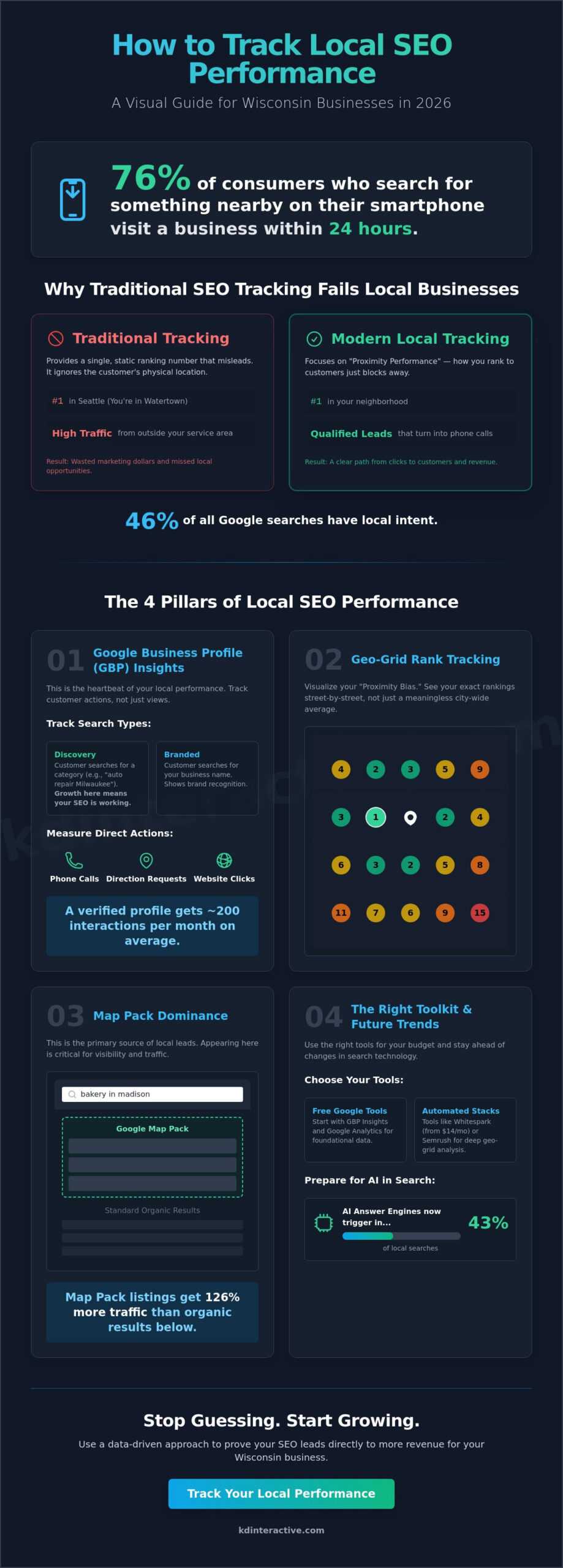
Traditional rank tracking tools often lie to small business owners. They provide a single, static number that doesn’t reflect how real customers in your neighborhood actually find you. If you’re a service provider in Watertown, you don’t care if you rank on page one in Seattle. You need to know how you appear to someone standing three blocks away from your front door. This is where Local search engine optimization (local SEO) differs from national strategies. Because 46% of all Google searches have local intent, using a “one size fits all” tracking method will lead to wasted marketing dollars and missed opportunities.
The biggest hurdle in understanding how to track local seo performance is the “Proximity Bias.” Google’s algorithm is highly sensitive to the user’s physical location. A bakery in Madison might hold the top spot for a search performed at the State Capitol, but that same business could disappear from the results entirely if the user moves a few miles toward Sun Prairie. If your current reports only show an “average” rank across the state, you’re flying blind. You need data that visualizes your visibility street by street, not just city by city.
Total website traffic is another vanity metric that can lead you astray. It’s exciting to see a spike in visitors, but if those clicks are coming from outside your service area, they won’t pay your Wisconsin taxes. High traffic with zero phone calls is a major red flag. We focus on “Proximity Performance” because it measures the intent that leads to revenue. Local search intent is the bridge between a query and a physical visit.
The Local Map Pack vs. Standard Results
The “Map Pack” or “3-Pack” is the block of three business listings that appears at the top of Google search results, usually accompanied by a map. This is the primary source of local leads. Businesses listed here see 126% more traffic than those appearing only in the organic blue links below. Standard rank trackers often miss the daily fluctuations within the Map Pack. We prioritize the Google Map Pack with AI Assistant to ensure our clients dominate this specific space. Tracking the Map Pack requires specialized tools that can simulate searches from specific GPS coordinates to give you an honest view of your reach.
The “Wisconsin Factor” in Local Search
Regional behavior in Wisconsin doesn’t always follow national trends. In Milwaukee, search volume for “fish fry” might skyrocket every Friday, while Madison residents often search using specific neighborhood names like “Willy Street” or “Hilldale” rather than just the city name. If you aren’t tracking how you rank for these hyper-local landmarks and neighborhood terms, you’re missing the nuances of your own market. Effective tracking must account for these local quirks to prove that your SEO strategy is actually connecting with your neighbors.
The 4 Essential Metrics for Measuring Local Visibility
Measuring success in the local search landscape isn’t about vanity metrics like total impressions. It’s about the volume of customers walking through your door or picking up the phone. To master how to track local seo performance, you need a data-driven approach that focuses on the four pillars of local visibility. These metrics provide a clear picture of your ROI and help you stop guessing where your marketing dollars are going. We understand small business because we are one, and we know you need results you can actually see in your bank account.
Mastering Google Business Profile Insights
Google Business Profile (GBP) Insights is the heartbeat of your local performance. You must distinguish between “Discovery” searches and “Branded” searches. Discovery searches occur when a potential customer looks for a category like “auto repair Milwaukee” without knowing your name. Branded searches happen when they search for you specifically. If your discovery numbers are climbing, your SEO is working. You also need to track “Actions,” which include phone calls, direction requests, and website clicks. Since a verified profile receives about 200 interactions per month on average, these clicks are the most direct path to revenue. For those just starting, our Google Business Page Setup Guide provides the necessary context for optimizing these fields.
Geo-Grid Tracking: Your Competitive Map
A standard “Rank #1” claim is often misleading. In cities like Madison or Milwaukee, your ranking can change block by block. A Geo-Grid is a visual map with pins showing exactly where you rank at specific GPS coordinates. If you rank in the top three at the Fiserv Forum but drop to number ten by the time a customer reaches the Third Ward, you have a geographic “blind spot.” Using grid data allows you to identify these gaps and adjust your strategy to dominate specific zip codes. This hyper-local view is the only way to truly understand your reach in a competitive Wisconsin market.
Review velocity and sentiment are also critical. In 2026, 87% of consumers read online reviews for local businesses. Google rewards profiles with a steady flow of fresh, authentic feedback. However, stay compliant with the April 2026 policy update that prohibits staff review quotas and on-site kiosks. Tracking how fast you get reviews and the tone of those reviews helps you build “local authority” that AI algorithms trust. Combining these reputation metrics with broader local marketing strategies ensures your business stays ahead of the curve. If you’re ready to see how your business stacks up, you can get a free consultation to analyze your current visibility.
Finally, track your local conversion actions. These are the “bottom of the funnel” events that lead to sales. Phone calls, booking button clicks, and requests for directions are more valuable than a thousand anonymous website visits. By monitoring these four essential metrics, you can transform confusing data into a simple dashboard of success.
Choosing Your Toolkit: Manual vs. Automated Tracking
Choosing the right tools shouldn’t feel like a second job. We understand small business, because we are one! We know that every dollar and every minute counts for a shop in Milwaukee or a service provider in Madison. When you’re figuring out how to track local seo performance, you’ll likely start with the “Free Stack.” This includes Google Search Console, GA4, and Google Business Profile Insights. These platforms provide foundational data, but they can be overwhelming without a clear plan. To avoid “tool fatigue,” you need one source of truth that tells you if your marketing is actually ringing the cash register.
While the free options are great for starting out, many Wisconsin business owners graduate to a “Pro Stack” for automated reporting. As of April 2026, dedicated tools have become quite affordable. Whitespark’s Local Rank Tracker starts at just $14 per month, while BrightLocal plans begin at $39 per month. These tools do the heavy lifting by simulating searches from specific GPS coordinates. This is vital because 43% of local searches now trigger AI Overviews, and manual tracking simply can’t keep up with how these “answer engines” pull data from your profile.
Setting Up GA4 for Local Success
Google Analytics 4 (GA4) is powerful, but it’s often filled with “noise” from outside your service area. If you’re a contractor in Waukesha, traffic from California doesn’t help your bottom line. You must filter your reports by city or region to focus strictly on Wisconsin visitors. We recommend setting up custom “Events” to track local button clicks, such as “Call Now” or “Get Directions.” This technical setup is a core part of our Web and SEO services, ensuring that your data reflects real local intent rather than random web bots.
The Value of an SEO Dashboard
Small business owners need a “one-page” view of performance. Staring at three different tabs is a recipe for confusion. A unified dashboard combines your rank tracking, review growth, and conversion data into one place. This allows you to monitor key metrics for local SEO without becoming a data scientist. At KD Interactive, we use a pragmatic, results-oriented approach to reporting. We even offer an “SEO Calculator” to help you quantify the exact dollar value of your search visibility. Whether you choose manual spreadsheets or automated agency reporting, the goal is the same: proof that your SEO leads to revenue.
Step-by-Step: How to Set Up Your Local SEO Dashboard
Setting up a dashboard is the moment your data transforms into a decision-making tool. You don’t need a complex or expensive system to understand how to track local seo performance effectively. We recommend a four-step process that keeps things simple and focused on your bottom line. We understand small business, because we are one! We know you need a reporting structure that provides clarity, not more confusion. Whether you’re a contractor in Milwaukee or a retailer in Madison, these steps ensure your reporting is accurate and actionable.
Auditing Your Local Citations
Step 1 is to audit your NAP (Name, Address, Phone) consistency across the web. If your old office address in Green Bay is still listed on an obscure directory while your new one is on Google, your local authority will suffer. Consistent data is the foundation of accurate tracking because it confirms to search engines that your business is legitimate and reliable. This audit is a critical first step in any Local Digital Marketing strategy. In 2026, AI-driven search summaries rely on this data 67% of the time to generate answers for potential customers. If your citations are messy, your dashboard data will be too.
Step 2 involves connecting your Google Business Profile (GBP) to your tracking tool. This allows you to see your interactions in real-time alongside your website traffic. Once connected, move to Step 3: Define your primary “Conversion Actions.” Don’t just track every click. Focus on the actions that lead to revenue, such as phone calls, form fills, and booking requests. Since 28% of local searches result in a purchase, these specific actions are your most important metrics. Finally, Step 4 is to schedule a monthly review. Compare your digital data against your actual revenue to ensure your SEO investment is growing your bank account.
Connecting Calls to Revenue
Connecting your phone calls to specific search terms is the “holy grail” of local tracking. Attribution is the process of matching a sale to the specific search that started it. To get this right, you can use call tracking numbers that are specific to your local listings. These numbers tell you exactly which lead came from your Map Pack profile versus your organic website links. This doesn’t hurt your SEO as long as the tracking is implemented correctly with dynamic number insertion.
You should also verify your digital data by simply asking every new customer, “How did you find us?” This human touch catches the leads that software might miss. If your dashboard shows 50 calls but your staff only recorded 10 new leads, you know there is a gap in your internal intake process. If you’re ready to stop guessing and start seeing real numbers, get your free consultation today. We’ll help you build a dashboard that proves your marketing is working for your Wisconsin business.
Beyond the Data: Turning Metrics into Wisconsin Business Growth
Data is only as valuable as the actions you take because of it. Knowing how to track local seo performance gives you the power to spot red flags before they become disasters. For example, if your dashboard shows high traffic but zero phone calls, your content might be attracting visitors from outside your service area. This often happens when keywords are too broad. You might need to pivot your strategy from “legal services” to “family law attorney in Milwaukee” to capture customers who are ready to hire. We understand small business, because we are one! We know that a spike in website hits doesn’t pay the bills; only paying customers do.
Local SEO is a marathon, not a sprint. In 2026, Google’s AI-driven algorithms reward consistency and “freshness” above all else. If you haven’t updated your photos or responded to a review in 30 days, your visibility will likely drop. Use your performance data to set realistic expectations. You won’t dominate all of Madison overnight, but by tracking your progress month-over-month, you can prove that your search presence is a growing asset for your business.
Identifying Growth Opportunities
When a competitor starts outranking you in a specific neighborhood like the Third Ward or Wauwatosa, don’t panic. Use this as a signal to dig into your review sentiment. Are customers praising your competitor’s speed or their pricing? You can use these insights to improve your actual business operations. If you notice you’re ranking well for “emergency repairs” but not “preventative maintenance,” you’ve just found a new content opportunity. Fine-tuning these details is a core part of our Local SEO Services, helping you turn defensive data into offensive growth.
Proving ROI: The Ultimate Small Business Metric
The ultimate metric for any Wisconsin business owner is the “Cost Per Lead.” You can calculate this by dividing your total SEO investment by the number of tracked conversions, such as phone calls and form fills. If you spend $500 a month and generate 20 high-quality leads, your cost per lead is $25. This concrete number is much easier to present to stakeholders than “average keyword rank.” It proves that your digital presence is a predictable revenue generator rather than a mysterious expense.
Remember that 88% of consumers trust online reviews as much as personal recommendations in 2026. Your tracking dashboard should show your reputation growing alongside your rankings. When you see these two metrics climb together, you know you’re building a brand that neighbors trust. Ready to see your real numbers? Get your FREE consultation with KD Interactive today! We’ll help you turn your local search data into a clear plan for success.
Take Control of Your Local Search Success Today
You now have a clear roadmap for your 2026 marketing strategy. You’ve learned that proximity performance matters more than national rankings. You know how to use Geo-Grids to find blind spots and how to set up a dashboard that actually connects your phone calls to your revenue. Understanding how to track local seo performance shouldn’t be a mystery; it should be a reliable part of your growth plan. We understand small business, because we are one! We know you need transparent reporting and measurable results to justify every dollar you spend.
As Wisconsin-based experts, we specialize in Google Map Pack dominance for businesses in Milwaukee, Madison, and every town in between. Our methodical approach ensures you aren’t just getting clicks; you’re getting customers. The only way we succeed is if your business succeeds. Don’t let your competitors capture the 76% of customers who visit a business within 24 hours of a local search. Your business deserves to be found by your neighbors.
Help my business grow NOW with a FREE local SEO consultation!
Let’s start building your success story today with a plan tailored specifically for your goals. You’ve got the tools and the knowledge; now it’s time to dominate your local market.
Frequently Asked Questions
How often should I check my local SEO performance?
Check your core metrics once a month to identify meaningful trends without getting distracted by daily fluctuations. A monthly review allows you to compare your digital interactions against your actual revenue. We understand small business, because we are one! You don’t have time for daily monitoring. A 30 day window provides enough data to see if your strategy is succeeding or if you need to adjust your keyword focus.
What is the most important metric for a local business?
Conversion actions, specifically phone calls and direction requests, are the most vital metrics for a local business. While rankings and traffic are helpful indicators, they don’t directly pay the bills. Tracking how many people actually clicked to call from your Map Pack listing tells you exactly how many leads your SEO is generating. These “bottom of the funnel” events are the clearest proof of your marketing ROI.
Can I track local SEO for free?
Yes, you can effectively monitor your growth using free tools like Google Business Profile Insights and Google Search Console. These platforms provide essential data on how customers find your listing and what actions they take. While they lack the hyper local precision of paid Geo-Grid tools, they are a great starting point for any Wisconsin business owner looking to understand how to track local seo performance without a large initial investment.
Why do my rankings change when I move to a different part of town?
Your rankings change because Google uses a “Proximity Bias” to show users the most convenient results based on their current GPS coordinates. If you are standing in the Third Ward, you’ll see different businesses than someone searching from Wauwatosa. This is why a single “city wide” rank is a myth. Proximity is one of the strongest ranking factors, making hyper local visibility essential for capturing customers in specific neighborhoods.
How long does it take to see results in my local SEO tracking?
You should expect to see measurable movement in your tracking data within 90 to 180 days of starting a campaign. Local SEO is a marathon, not a sprint. While some quick wins occur after verifying a profile, sustainable growth in the Map Pack requires consistent updates and review management. Google’s algorithm needs time to recognize your business as a trusted, authoritative local leader in your specific Wisconsin market.
What is a good conversion rate for a Google Business Profile?
A healthy conversion rate for a verified Google Business Profile typically falls between 5% and 10% of total interactions. If your profile receives 200 clicks or interactions per month, you should see 10 to 20 actual leads. If your conversion rate is lower, it’s a red flag that your profile might be missing key information, fresh photos, or prompt review responses that build customer trust and encourage clicks.
How do I track phone calls from my Google Map listing?
You can track these calls using the built-in “Call” button data in your Google Business Profile Insights. For more detailed attribution, many businesses use unique call tracking numbers. These numbers allow you to see exactly which leads came from your Map listing versus your website links. This data helps you calculate your cost per lead and proves that your local search presence is driving real world revenue for your shop.
Is Google Analytics 4 (GA4) necessary for local SEO?
GA4 is necessary because it tracks what happens after a customer clicks through to your website from a local search. While GBP Insights tracks map interactions, GA4 tells you if those visitors actually filled out a contact form or booked a service. It’s the best way to understand how to track local seo performance across your entire digital footprint. Filtering by region ensures you only focus on your Wisconsin based audience.