
Google should usually remain your main review destination, but Facebook recommendations can matter when local customers use the platform to assess a business. To learn how to get reviews on other sites besides Google, focus on the platforms your customers actually use, keep your business details accurate, and make it easy for satisfied customers to share honest feedback.
It makes sense to seek reviews in more than one place: customers may look beyond Google before choosing a local business. But spreading every request across several platforms can dilute your efforts. This guide explains when to prioritize Google, when a second review site is worth managing, and how to ask without encouraging customers to copy the same review across sites. You’ll also see how balanced feedback helps people make informed decisions and how thoughtful responses can turn concerns into practical improvements.
Key Takeaways
- Prioritize the review platforms your local customers actually use, and keep your business details accurate on each one.
- Focus most review requests on Google; manage a second platform when it fits your industry or customers rely on it.
- Make it easy for customers to leave honest feedback, and avoid reposting the same review across multiple sites.
- Use balanced reviews and thoughtful replies to build trust and spot opportunities to improve the customer experience.
1. Choosing which review platforms to manage
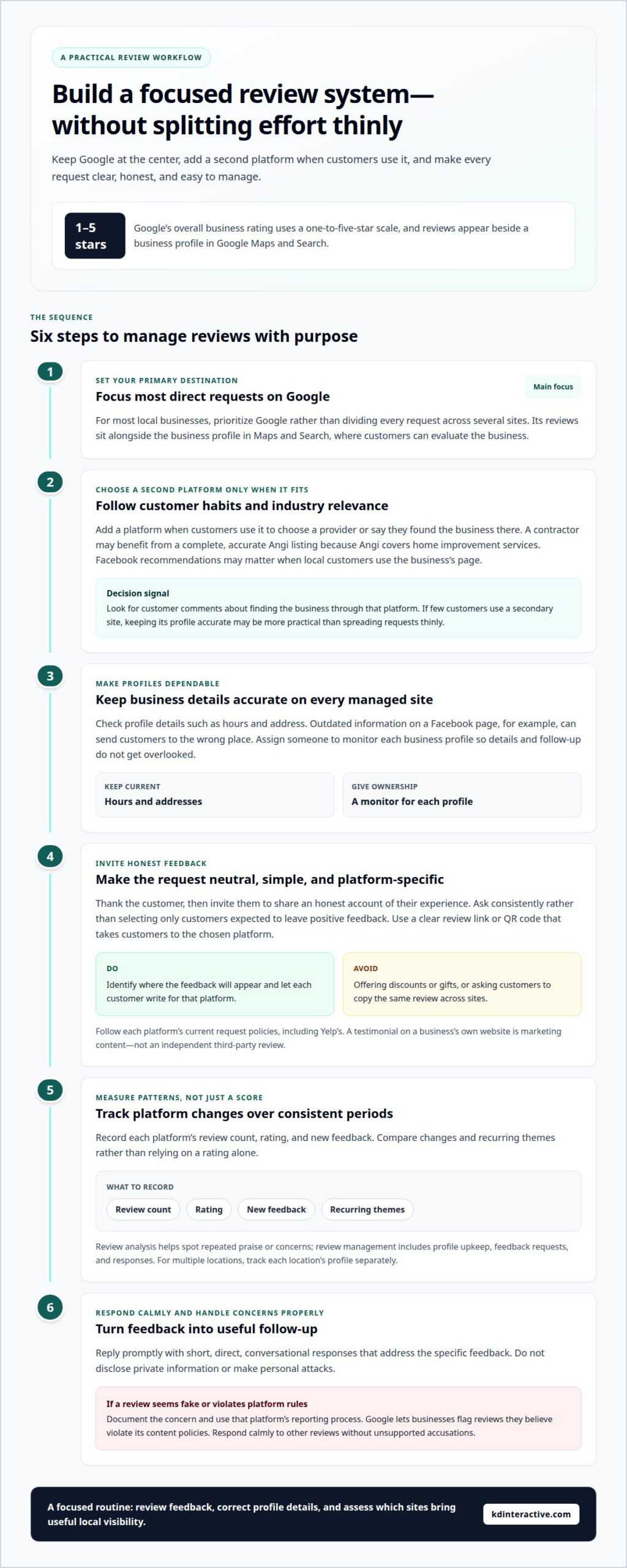
Start with Google, then add a platform your customers use in your industry. Google reviews appear beside a business profile in Google Maps and Search, and its overall rating uses a one-to-five-star scale. A Facebook page can also shape local impressions, but outdated hours or addresses can send customers to the wrong place. Choose platforms based on where customers find and evaluate your business, not simply on how many sites exist.
Separate review analysis from review management. Analysis means comparing customer feedback to spot patterns, such as repeated praise for a service or concerns about appointment scheduling. Management involves keeping each profile accurate, asking for feedback, and responding to reviews. For example, use a review link or QR code to make it easier for customers to leave feedback on the platform you’ve chosen.
To track review growth and compare platforms, record each platform’s review count, rating, and new feedback over consistent periods. Compare changes and recurring themes rather than relying on a rating alone.
For reviews across sites, assign someone to monitor each business profile and respond promptly with short, direct, conversational replies. Address the customer’s specific feedback, and never disclose private information or use personal attacks. For a business with multiple locations, track each location’s profile separately so local issues and feedback don’t disappear into a company-wide average.
If a review appears fake or violates a platform’s rules, document the concern and use that platform’s reporting process. Google lets businesses flag reviews they believe violate its content policies. Respond calmly to other reviews without making unsupported accusations.
Make platform management a focused routine: review customer feedback, correct profile details, and assess which sites bring useful local visibility. If few customers use a secondary platform, maintaining an accurate profile may be more practical than spreading requests thinly. For businesses with several locations, clear ownership and separate profile tracking help teams see where follow-up is needed.
2. Should I ask customers for reviews on more than one platform?
For most local businesses, focus direct review requests on Google instead of splitting them across several sites. A second platform can make sense when customers use it to choose a provider or say they found the business there. This keeps the process manageable and builds feedback where it can inform local decisions.
Industry fit matters. Angi covers businesses that provide home improvement services, so a contractor may benefit from a complete, accurate listing there. Before prioritizing any trade directory, look for customer comments about finding the business through that platform. Facebook recommendations may also matter if local customers use the business’s page, but keep its address and hours accurate.
Yelp and other review platforms have their own rules for requesting feedback. Keep requests neutral, invite honest opinions, and follow each platform’s current policies. Don’t offer discounts, gifts, or other incentives in exchange for reviews: a reward can compromise the independence of customer feedback.
A simple request works best: thank the customer for choosing the business, then invite them to share an honest account of their experience. Ask customers consistently, rather than selecting only those expected to leave positive reviews. Don’t ask customers to post the same review on multiple sites. Each platform should receive feedback written for that place and based on the customer’s own experience.
For a non-Google review link or QR code, use the business’s profile link on the chosen platform and make the destination clear. Add the link to a follow-up message or display the QR code where customers can scan it after an interaction. The request should identify the platform, so customers know where their feedback will appear. Concise, neutral review request content can help keep that invitation clear.
3. Review sites beyond Google
Third-party review sites can extend a business’s reputation beyond its own website. Yelp licenses reviews, ratings, photos, and business details to other companies, giving its content a wider role than a single profile page. Treat each platform as a distinct source of customer feedback instead of assuming every review stays where it was written.
Reviews and testimonials serve different purposes. A testimonial published on a business’s own website is marketing content, not an independent third-party review. Keep that distinction clear in website copy and customer-facing materials. For example, label an on-site endorsement as a testimonial, and identify the external platform where a customer posted a review. Clear sourcing helps readers understand where feedback came from.
Third-party content may also appear in AI-generated answers. Tripadvisor was cited in 16% of Gemini’s hotel responses, while Grok referenced Instagram content in 21% of restaurant responses. These findings don’t mean every review site affects every answer equally. They do show why a business may consider its broader online presence when deciding how to get reviews on other sites besides Google.
Use platform-specific feedback as context, not as a simple ranking contest. A detailed comment can explain a customer’s experience, while a star score offers a quick summary. Keep the original review on its source platform instead of copying it elsewhere, and share clearly attributed testimonials on your own website. This preserves the distinction between independent feedback and business-created content, while giving potential customers clearer context when they encounter reviews or business information elsewhere.
4. Why online reviews matter
Reviews give potential customers first-hand details that a star rating alone can’t show. Someone comparing local businesses can use balanced feedback to weigh service, communication, or convenience. Several positive reviews can also matter for businesses seeking a place in the top ten search results, but ratings aren’t the whole story. Specific comments help people judge whether a business fits their needs.
Pay attention to honest, balanced reviews, including negative ones. A complaint about unclear appointment times, for example, can reveal a gap between customer expectations and the service provided. Treat feedback as useful evidence, not just a score to defend. Look for repeated concerns across reviews, then decide what change could improve the next customer’s experience.
A thoughtful response can show readers that the business takes feedback seriously. Address the reviewer’s specific point, acknowledge a mistake when appropriate, and apologize when warranted. Keep the reply concise and conversational. Google review replies are public, so don’t include private details or turn the response into a personal argument. For a complex issue, invite the reviewer to continue the conversation privately.
Use a simple review routine: read new feedback, note recurring themes, respond to concerns, and follow up on practical improvements. For example, if several customers mention difficulty finding an entrance, clearer directions may help future visitors. After making a change, watch for feedback that indicates whether the experience improved. Reviews can inform decisions about service, communication, and the information customers need before choosing a business.
Want to turn recurring customer questions into useful website content? Explore content creation support to make those insights clearer to prospective customers.
KD Interactive: Google Map Pack with AI Assistant
KD Interactive helps local businesses connect review activity with a broader local visibility strategy. Its Google Map Pack with AI Assistant and Local SEO Services support businesses working to strengthen their presence in local search. When customer feedback reveals recurring questions, Content Creation can help address those topics clearly. Press Release Distribution can also support announcements that matter to the business and its community.
This is a practical next step when accurate profiles, consistent review responses, and useful website information need to work together. A focused approach can help make it easier for potential customers to find relevant business details and understand what the business offers, without treating reviews as a guaranteed ranking shortcut.
Contact KD Interactive to discuss your local visibility needs.
Make customer feedback part of your next growth decision
Your next step in deciding how to get reviews on other sites besides Google is to make feedback useful beyond the profile itself. Treat it as a regular input to business planning, alongside the questions customers ask and the information they need before choosing you. Assign clear responsibility for review follow-up so customer comments can lead to practical improvements instead of being postponed.
Start with one manageable action: decide who will review new feedback and how the business will use recurring themes. That creates a dependable process without asking your team to be everywhere at once. As priorities change, revisit which platforms deserve attention and whether customer-facing information still reflects the experience you want to provide.
If you’re ready to connect local visibility with a focused digital marketing plan, Contact KD Interactive. Build on what customers are telling you, and take the next step with confidence.
Frequently Asked Questions
Do Facebook recommendations matter for a local business?
Yes, Facebook recommendations can matter when local customers use a business’s page to assess it. Treat the page as a useful supporting profile, not an automatic substitute for Google or an industry directory. A customer may check the page before visiting, for example, so accurate hours and address details help them find the business and understand what it offers.
How do you check what other sites say about your business?
Search the business name with its city, then search its phone number to find review profiles and listings. Record each site, profile link, current details, and recent feedback in a simple tracking sheet. For example, put each location in its own row so an outdated address or recurring customer concern doesn’t get lost among reviews for other branches.
Should I ask customers for reviews on more than one platform?
Usually, focus requests on Google and add another platform when customers use it to choose businesses in your field. A home improvement contractor might prioritize a relevant trade directory if customers say they find providers there. Keep the other listing accurate and respond to feedback, but don’t spread every request across sites or ask customers to publish identical reviews in several places.
Where Should I Be Collecting Reviews in Volume?
For most local businesses, direct most review requests to Google rather than dividing them evenly among platforms. Google reviews appear in Search and Maps, where customers may encounter the business profile. Choose a second destination when it serves a clear purpose, such as a trade directory customers use to compare home improvement providers. Keep requests neutral and focused on honest feedback.
Which review sites besides Google are most important for local businesses in the United States?
There isn’t one best second site for every U.S. business. Facebook can support local discovery, Yelp may matter to customers seeking local businesses, and Tripadvisor is relevant to travel and hospitality. Trustpilot and industry-specific platforms may suit particular customer journeys. For home improvement businesses, Angi is a relevant directory. Prioritize sites that match how customers evaluate your services.
How should businesses choose review platforms based on their industry and location?
Choose platforms by matching the listing to the service and the customers’ local decision process. A hotel could focus on Tripadvisor, while a home improvement business could maintain its Angi listing. Then consider whether local customers mention using that directory to find providers. If they do, keep the profile accurate and monitor new feedback alongside Google reviews.