
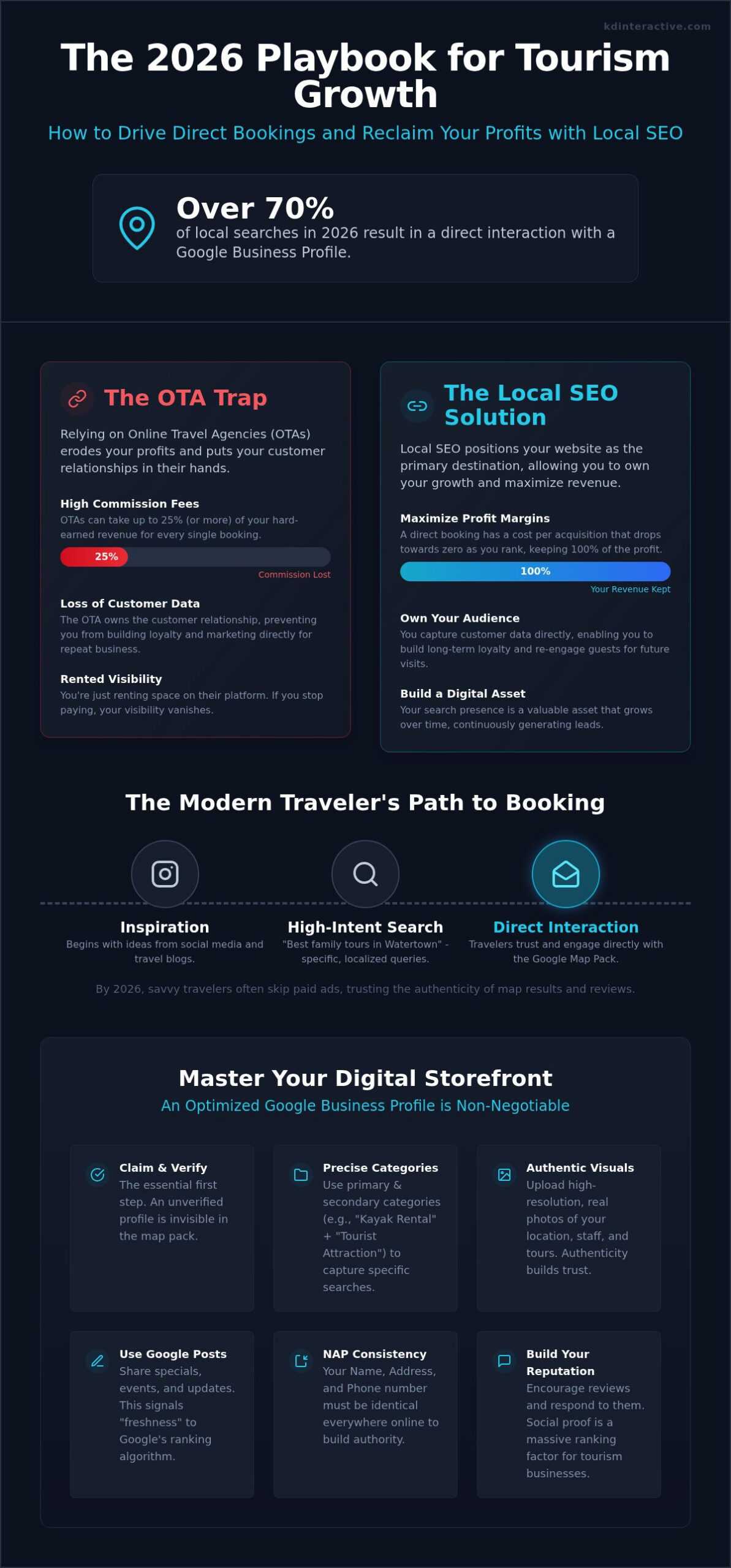
Did you know that over 70% of local searches in 2026 now result in a direct interaction with a Google Business Profile? If you’re still handing over a massive chunk of your revenue to high-commission travel platforms, you’re missing the most effective way to grow. We know it’s frustrating to watch your hard-earned profits vanish into fees just to stay visible. Relying on those third-party sites often feels like a necessary evil, but it doesn’t have to be your primary strategy. It’s time to prioritize local seo for tourism businesses to reclaim your bottom line.
You deserve a digital presence that works as hard as you do. This guide will show you how to dominate the local map pack and drive direct bookings without the middleman. We’re going to share the same pragmatic, results-oriented tactics we use to help entrepreneurs in Wisconsin and across the region outshine the competition. You’ll learn how to leverage the latest Google updates, utilize AI-driven tools for reputation management, and transform your profile into a self-sustaining lead generation engine. Let’s build a strategy that puts you back in control of your business growth and market leadership.
Key Takeaways
- Escape the “OTA Trap” and protect your margins by capturing high-intent travelers at the exact moment of discovery.
- Master the specific optimization techniques for local seo for tourism businesses to dominate the Google Map Pack and increase your search visibility.
- Build a powerful “Reputation Engine” using review velocity and authentic social proof to turn casual searchers into confirmed guests.
- Create specialized content that establishes your brand as a regional authority, effectively targeting long-tail keywords that global platforms overlook.
- Leverage AI-driven tools to manage your digital presence around the clock, ensuring no booking opportunity is missed while you focus on your guests.
Why Local SEO is the Lifeblood of Modern Tourism in 2026
Local SEO for tourism businesses is no longer just a digital checkbox; it’s the primary way you capture travelers at the exact moment of high-intent discovery. When a visitor arrives in a new city and searches for “boat rentals” or “boutique hotels,” they aren’t looking for a directory. They’re looking for a solution. Local SEO ensures your business is the one they find. By 2026, the digital landscape has matured to the point where “near me” queries drive the vast majority of foot traffic and immediate bookings for regional attractions.
Many tourism operators fall into the “OTA Trap,” relying entirely on third-party platforms like Expedia or TripAdvisor to fill their calendars. While these sites provide visibility, they eat your margins with commission fees that can reach 25% or more. They also own the customer relationship, leaving you with little data to build long-term loyalty. SEO fixes this by positioning your website as the primary destination. It allows you to bypass the middleman and keep your revenue where it belongs, in your business.
Traveler behavior has shifted significantly. In 2026, users often skip the “Sponsored” ads at the top of the page. They’ve learned that these results are paid placements rather than the most relevant options. Instead, they go straight to the maps. They trust the Google Map Pack because it provides authentic reviews, real-time photos, and direct contact information. If you’re visible here, you’re tapping into a stream of customers who are ready to book right now.
The Profit Margin Argument for Direct Bookings
The math is simple and pragmatic. A direct booking via SEO costs you the initial investment in content and optimization, but once you rank, the cost per acquisition drops toward zero. Compare this to an OTA booking where you pay a fee for every single guest, forever. By owning your search presence, you build brand equity that stays with you. You aren’t just renting space on someone else’s platform; you’re building a digital asset. Local SEO is the most cost-effective acquisition channel for tourism.
Traveler Intent: From Inspiration to Map Pack
The travel search journey starts with inspiration on social media, but it ends with a search for specifics. Once a traveler decides on a destination like Watertown or Madison, their search intent becomes highly localized. They move from “things to do in Wisconsin” to “best family-friendly tours in Watertown.” Understanding what is local digital marketing is foundational to capturing this traffic. The Local 3-Pack is the most valuable real estate on the internet because it sits at the intersection of local seo for tourism businesses and immediate consumer need.
Optimizing Your Google Business Profile for Maximum Tourist Reach
Your Google Business Profile (GBP) is the digital storefront for your tourism operation. If you haven’t claimed and verified your profile yet, you’re essentially invisible to the 70% of travelers who interact directly with these profiles before booking. Verification is the non-negotiable first step to establishing trust and authority. Effective local seo for tourism businesses starts here; without a verified profile, you cannot rank in the map pack or respond to the reviews that drive traveler decisions.
When selecting categories, you must be precise. Your primary category should reflect your core business, but secondary categories allow you to capture specific search intents. For instance, a kayak rental shop in Watertown might use “Canoe & Kayak Rental” as primary and “Tourist Attraction” as secondary. This nuanced approach is a key part of successful tourism marketing strategies. Visuals are your most powerful sales tool. Travelers in 2026 prioritize authenticity over polished stock imagery. Upload high-resolution photos of your actual tours, your staff, and your location to prove you’re a legitimate, high-quality option. Google Posts then act as your real-time bulletin board. Use them to highlight seasonal specials or limited-time events, keeping your profile “fresh” for Google’s ranking algorithms.
A Step-by-Step GBP Optimization Checklist
Consistency is the backbone of local seo for tourism businesses. Ensure your Name, Address, and Phone number (NAP) are identical across your website, social media, and directories. Your business description should be keyword-rich but written for humans; describe the experience, not just the service. Don’t ignore the Q&A section. Populate it with common questions like “Is parking available?” or “What should I bring?” to remove friction for potential guests. If you need help with the technical hurdles, see our guide on how do i setup a google business page.
Advanced Features: Booking Integration and Attributes
To truly maximize direct bookings, set up the “Book Online” button. This feature allows travelers to convert instantly without leaving the Google interface. Additionally, use attributes to differentiate your brand. Travelers today often search for “locally owned” or “sustainable” options. These small badges build immediate rapport and trust. If managing these constant updates feels overwhelming, our Google Map Pack with AI Assistant can help you maintain a competitive edge without the manual labor.
The Reputation Engine: Reviews as a Tourism Ranking Factor
Reviews are the fuel for your local search engine. In 2026, Google’s algorithm places immense weight on “freshness.” If your profile hasn’t seen a new review in over 30 days, your visibility in the Map Pack will likely drop. This happens because Google wants to ensure they are recommending active, reliable businesses to travelers. For local seo for tourism businesses, maintaining a steady stream of feedback is just as important as the total number of stars you have. It’s about showing the world that you’re delivering great experiences right now, not just three years ago.
The psychological impact of social proof is the final nudge a traveler needs to book. Travelers are naturally risk-averse; they want to know exactly what to expect before they commit their vacation time and budget. A profile filled with recent, detailed reviews acts as a powerful trust signal that offsets any hesitation. Interestingly, a perfect 5.0 rating can sometimes look manufactured to savvy users. Responding to negative reviews with empathy and a solution-oriented approach actually increases conversions. It proves that you’re a real person who stands behind your service, which builds far more trust than a sterile, perfect record.
Automating Your Review Collection Process
You don’t have time to chase every guest for a comment. Successful operators automate this process using follow-up emails or strategically placed QR codes at the point of departure. This ensures a consistent “Review Velocity,” which is the rate at which you acquire new feedback. A one-time surge of 50 reviews followed by months of silence looks suspicious to both Google and potential customers. Our local seo services near me can help you implement these systems to maintain a 4.5+ star rating without adding hours to your work week.
Leveraging Positive Feedback in Your Marketing
Your reviews are a goldmine for content. Take a glowing testimonial and turn it into a social media post or a featured quote on your website. Beyond the visual appeal, reviews act as “user-generated keywords.” When a guest writes about your “scenic sunset tour in Milwaukee,” they’re naturally using the exact phrases other travelers use in search queries. This organic language helps local seo for tourism businesses rank for long-tail terms that you might not have targeted in your primary content. It’s a pragmatic way to let your happy customers do the heavy lifting for your marketing strategy.
Content Strategy for Local Tourism: Beyond Generic Guides
Large travel platforms provide generic, high-level summaries of destinations. They can’t offer the boots-on-the-ground expertise that you possess. To win at local seo for tourism businesses, you must produce content that proves you are the local authority. This means moving beyond “what to do in Wisconsin” and focusing on hyper-specific, long-tail keywords. A blog post titled “best family-friendly tours in Watertown” will attract a much more qualified lead than a general guide. These visitors are searching with specific intent and are far more likely to book directly with you.
Mobile optimization is no longer optional for your content strategy. In 2026, 63% of all online travel bookings are made via mobile devices. Travelers are often searching for their next activity while they are already on the road. Your content needs to be scannable, fast-loading, and easy to navigate on a smartphone. Additionally, utilizing professional Press Release Distribution can help you build local authority. A well-placed story in a regional Wisconsin publication provides high-quality backlinks that national competitors simply cannot earn.
Developing a Local Content Calendar
Consistency is key to staying relevant in Google’s eyes. A structured calendar allows you to highlight seasonal events or “hidden gems” that only a local would know. Whether it is a summer festival in Milwaukee or a winter retreat near Madison, this content keeps your site fresh. Utilizing professional web and seo services ensures your site structure supports this local traffic. “Best of” lists and “Know Before You Go” guides are magnets for direct bookings because they solve the traveler’s immediate problems and build trust before they even arrive.
Visual SEO: Optimizing Images and Video for Local Search
Search engines are increasingly visual in 2026. Geotagging your images reinforces your location signals to Google, confirming exactly where your services are offered. Don’t forget to use descriptive alt-text to capture travelers searching in Google Images. Short-form video is also rising in local search results. A 15-second clip of your tour or facility provides more reassurance than a thousand words. If you are ready to dominate your territory and stop paying high commissions, explore our Content Creation services to start building your local authority today.
Scaling Your Tourism Growth with KD Interactive
You’ve built your business on delivering great experiences; now you need a digital partner that delivers results. Local seo for tourism businesses shouldn’t be a mystery or a drain on your time. At KD Interactive, we don’t just offer services; we offer a collaboration designed to turn your search visibility into measurable booking growth. Our flagship Google Map Pack with AI Assistant acts as your 24/7 marketing partner, ensuring your business stays at the top of the 3-pack while you focus on your guests.
Choosing a local seo agency based in Wisconsin gives you a distinct advantage over national generalists. We understand the specific tourism cycles of territories like Watertown, Milwaukee, and Madison. We know that a strategy for a summer lakeside attraction requires a different approach than a winter retreat. This regional expertise allows us to craft bespoke strategies that national firms simply can’t replicate. We align our own success with your progress, ensuring a pragmatic and results-oriented partnership.
The AI Advantage in 2026 Local Search
Our AI Assistant is the solution to the “no time” objection that many small business owners face. It manages customer interactions and profile updates in real-time, ensuring your Google Business Profile remains active and “fresh” according to 2026 standards. You can scale your reputation management effortlessly, responding to reviews and answering traveler questions without adding hours to your workday. Our AI Assistant provides the constant activity required to maintain Map Pack dominance and ensure no booking opportunity slips through the cracks.
Next Steps: Your Roadmap to Direct Booking Dominance
Your journey toward direct booking dominance starts with a clear understanding of your current performance. A professional SEO audit is the first step in identifying where you are losing potential guests to high-commission platforms. We’ll work with you to customize a strategy that aligns your specific business goals with the latest local search trends. It’s time to stop renting your customers from OTAs and start owning your market leadership through data-driven tracking and proven local expertise. Schedule your consultation with KD Interactive today.
Claim Your Market Leadership in the Local Map Pack
Winning the direct booking battle requires more than just a basic website; it demands a strategic, data-driven approach to local seo for tourism businesses. By reclaiming your presence in the Google Map Pack, you stop renting your guests from third-party platforms and start building long-term brand equity. We’ve explored how a verified profile, consistent review velocity, and hyper-local content create a self-sustaining lead generation engine that national competitors simply can’t touch.
At KD Interactive, we understand the unique seasonal challenges of the Wisconsin tourism landscape. Our pragmatic, results-oriented approach combines deep regional expertise with our flagship Google Map Pack with AI Assistant. This ensures your profile stays fresh and competitive without demanding every hour of your day. You don’t have to navigate these technical shifts alone. We’re here as your collaborator to help you expand your visibility and professional achievement.
Ready to see where your business stands? Get Your Free Local SEO Audit & Strategy Session today. Let’s build a roadmap that puts you back in control of your profits and your growth. Your future guests are searching right now; make sure you’re the one they find.
Frequently Asked Questions
How long does it take to see results from local SEO in the tourism industry?
Results generally manifest within three to six months of consistent optimization. While technical fixes provide immediate boosts, building authority and “freshness” takes time. Your current profile health and the competition level in your specific Wisconsin territory will influence this timeline. We focus on sustainable, long-term growth rather than quick hacks, moving your business from basic visibility to measurable booking growth as efficiently as possible.
Can local SEO help me compete with big sites like TripAdvisor or Expedia?
You can outrank global platforms by winning the Local 3-Pack. TripAdvisor and Expedia dominate broad searches, but they can’t match your hyper-local relevance for “near me” queries. By prioritizing local seo for tourism businesses, you capture travelers at the exact moment of high-intent discovery. We help you leverage your regional expertise to show up where OTAs often fall short: the Google Map Pack.
What is the most important ranking factor for the Google Map Pack in 2026?
Google favors “freshness” and authenticity above almost everything else in 2026. This means having recent reviews, updated photos, and active Google Posts. While proximity and relevance remain core pillars, an inactive profile will see a drop in visibility after 30 days. Our Google Map Pack with AI Assistant is specifically designed to manage these constant updates, ensuring your profile remains a primary source for AI-driven search results.
How much should a small tourism business spend on local SEO services?
Investment levels vary based on your market’s competitiveness and the number of locations you manage. Instead of looking at a flat fee, consider the ROI of reducing your reliance on high-commission platforms. A pragmatic strategy should pay for itself by increasing direct bookings and building brand equity. We focus on results-oriented solutions that scale with your progress and help you reclaim profit margins from third-party sites.
Is it better to hire a local Wisconsin SEO expert or a national agency?
A local expert provides specialized knowledge that national agencies simply lack. We understand the unique travel patterns in Milwaukee, Madison, and Watertown. This regional insight allows us to target long-tail keywords that actually convert for your specific area. Working with a Wisconsin-based partner ensures you have a collaborator who understands your community and shares your identity as a local entrepreneur.
What happens if I have multiple locations for my tour or travel business?
Each location needs its own unique Google Business Profile to rank in the Local Map Pack. You must ensure NAP consistency for every branch while creating location-specific content. This helps Google understand that you provide services in multiple territories. We assist multi-location businesses in managing these profiles through data-driven tracking, ensuring each site captures its share of local search intent without diluting your overall brand authority.
How do I handle negative reviews on my Google Business Profile?
Respond to every negative review with empathy and a pragmatic solution. This transparency builds trust with potential guests who read your responses to gauge your customer service. A well-handled complaint often proves your reliability more effectively than a perfect record. Our reputation management tools help you monitor feedback in real-time, allowing you to address concerns before they impact your ranking or traveler confidence.
Do I need a blog to rank well in local tourism search results?
A managed blog is essential for capturing long-tail search traffic that standard service pages miss. It allows you to target phrases like “best family-friendly tours in Watertown” and establish your status as a local expert. High-quality content informs and converts visitors who are still in the research phase. Providing unique, locally relevant guides builds the authority needed for local seo for tourism businesses to truly succeed.