
What if your home office could outrank the biggest storefront in town without ever revealing your private address to the public? Many entrepreneurs feel disadvantaged because they lack a commercial lease, but the 2026 search landscape actually favors “Service Authority” over physical proximity. Mastering local seo without a physical address is no longer a workaround; it’s a legitimate strategy for contractors, consultants, and mobile pros who want to dominate the Map Pack. Google’s latest protocols now require service-area businesses to hide their locations, meaning the playing field is more level than ever before.
We know the frustration of trying to stay compliant with Google’s strict bans on virtual offices while keeping your home life private. It’s a common hurdle that shouldn’t stop your business from growing. This blueprint teaches you how to navigate video verification and secure a verified profile without a public storefront. You’ll learn the data-driven methods to rank for multiple cities and generate leads through AI-enhanced engagement. Let’s transform your remote operation into a local powerhouse that commands attention across your entire service territory.
Key Takeaways
- Understand why Google prioritizes service reliability over physical storefronts in the 2026 search landscape.
- Master the technical steps for local seo without a physical address to secure a verified Google Business Profile without compromising your privacy.
- Learn how to structure high-converting service area pages that capture local search intent across multiple regions.
- Discover the critical role of AI assistants and review velocity in maintaining a top position within the Google Map Pack.
- Explore how a localized, data-driven strategy helps you outrank established brick-and-mortar competitors throughout the Wisconsin market.
The Reality of Local SEO Without a Storefront in 2026
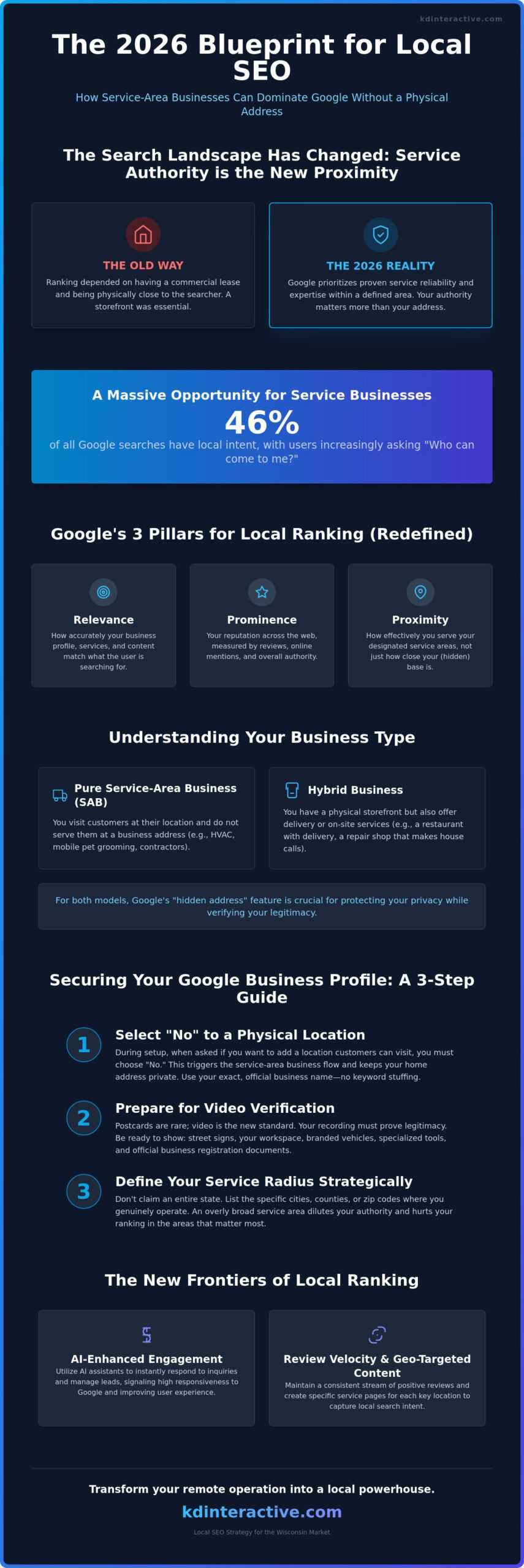
Google evaluates your business through three main pillars: Relevance, Prominence, and Proximity. Relevance measures how well your business profile matches what the user needs. Prominence looks at your reputation across the web, including reviews and mentions. Proximity used to mean how close your front door was to the searcher, but now it includes how effectively you cover your designated service zones. For Wisconsin small businesses, this shift is a massive opportunity. Local entrepreneurs in areas like Waukesha, Milwaukee, or Madison can now compete with larger national chains by proving deep, verified roots in their specific communities.
What is a Service-Area Business (SAB)?
A pure SAB is a business that visits customers at their location and does not serve them at a business address. This differs from a hybrid model, where a business might have a physical shop but also offers delivery or on-site repairs. Whether you are in HVAC, mobile pet grooming, or digital consulting, your strategy for local digital marketing focuses on where you work rather than where you sit. This model allows you to scale across multiple zip codes without the overhead of multiple leases, provided you can prove you actually operate in those areas.
Why Google Doesn’t Require an Address Anymore
Google’s guidelines have evolved to protect your privacy while maintaining data integrity. The “hidden address” feature in a Google Business Profile allows you to verify your identity with a home address while keeping it invisible to the public. This change reflects a fundamental shift in search intent. Users are no longer just asking “Where can I go?” but are increasingly asking “Who can come to me?” This makes Local search engine optimization more about service quality and verified expertise than physical real estate. Service Authority is the new proximity; it’s the measure of how much Google trusts you to deliver results within a specific geographic boundary.
Step-by-Step: Setting Up Your Google Business Profile as an SAB
Setting up your presence for local seo without a physical address requires a specific sequence to avoid immediate red flags. When you begin the process, Google will ask if you want to add a location customers can visit. As a service-area business, you must select “No.” This ensures your home address remains private while allowing Google to use it for backend verification. If you’re wondering how do i setup a google business page without a storefront, the key is accuracy in your business name and category from the very first click. Avoid the temptation to add keywords to your business name; Google’s 2026 enforcement is strict, and mismatches with your official registration will trigger a suspension.
The Verification Hurdle: Video and Mobile Evidence
Postcards are largely a thing of the past. In 2026, video verification is the default requirement for most new listings. You’ll need to record a continuous video that proves your business is legitimate. Start outside to show your street signs or house number, then move to your workspace. Show your branded vehicle, specialized tools, or even your official Wisconsin business registration documents. This process can feel intrusive, but it’s the most effective way to build trust with the algorithm. Keeping your profile clean and compliant is easier when you work with local SEO experts who understand these technical nuances.
Defining Your Service Radius Strategically
It’s tempting to list every city in Wisconsin to cast a wide net. However, claiming you serve the entire state from a single home office will likely tank your rankings. Google’s algorithm prioritizes realism. Stick to a service area that you can reasonably reach within a two-hour drive. You can define your territory by listing up to 20 specific cities, counties, or ZIP codes. Focus on core hubs like Milwaukee, Madison, or Watertown where you have a genuine client base. This concentration tells Google you are a local authority in those specific spots, making you much more likely to appear in “near me” searches for those communities.
To maintain a healthy profile that avoids the dreaded suspension, follow this checklist:
- Use your legal business name: Do not add descriptors like “Best Plumber” if it isn’t part of your registered name.
- Select specific categories: Choose one primary category that most accurately describes your core service.
- Update your hours: Ensure your operating hours are consistent across your website and social profiles to maintain NAP consistency.
- Verify your phone: Use a local area code whenever possible to reinforce your regional presence and build rapport with local customers.
Building Local Authority Through Geo-Targeted Content
Without a physical storefront, your website serves as your primary “location” in the eyes of both Google and your customers. Relying on a single home page is a strategic mistake for anyone pursuing local seo without a physical address. You need dedicated Service Area Pages that function as digital offices for every city you serve. These pages prove to the algorithm that you aren’t just a generic service provider but a local expert with deep roots in the community. When a homeowner in Waukesha searches for your services, they want to see content that speaks specifically to their neighborhood, not a one-size-fits-all landing page.
Professional web and seo services are vital for this strategy because most local service searches happen on mobile devices. If a customer is dealing with a leaky pipe or a broken furnace, they’re searching on their phone. If your site doesn’t load instantly or provide a seamless mobile experience, you lose that lead to a competitor. Mobile responsiveness and fast load times are core ranking signals in 2026, especially for businesses that travel to their clients. High-quality content must be supported by a technical foundation that ensures your local seo without a physical address efforts aren’t wasted on a site that’s hard to navigate.
The Anatomy of a Service Area Page
A high-converting Service Area Page needs more than just a city name in the headline. You must include local maps of the specific city, such as Madison or Milwaukee, and testimonials from residents in those exact ZIP codes. Mentioning local landmarks like the Milwaukee Art Museum or the State Capitol helps signal geographic relevance to search engines. Use “near me” phrases naturally within the text, such as “reliable electrician services near me in Watertown.” Local schema markup acts as a digital beacon that tells search engines exactly where your service boundaries lie, effectively bridging the gap left by a hidden physical address.
Local Link Building for Businesses Without a Storefront
Prominence is built through digital associations and local recognition. Join the Wisconsin Chamber of Commerce or local business associations in the Fox Valley to earn high-authority local backlinks. Press releases are another powerful tool for establishing a presence; distributing a release about a local community project or a new service launch in Janesville creates a verifiable digital footprint. These “Wisconsin SEO” signals anchor your business in the region. They prove your physical presence through community involvement and digital mentions rather than a static map pin, ensuring you remain competitive against brick-and-mortar rivals.
Reputation and AI: The New Frontiers of Local Ranking
AI is fundamentally changing how these reviews are processed and displayed. Google’s AI Overviews now trigger in 43% of local searches, pulling information directly from your business profile, posts, and customer feedback. If your reviews mention specific problems you solved in Oconomowoc or Menomonee Falls, the AI will use that data to recommend you for conversational queries. Managing this level of engagement manually is a massive task for a busy entrepreneur. This is why our Google Map Pack with AI Assistant is a game-changer. It ensures every interaction is handled with precision, keeping your profile active and favored by the latest search algorithms.
Turning Reviews into Local SEO Fuel
Don’t just ask for a review; ask for a story. Encourage your clients to mention their specific city and the service they received. When a customer writes about a “water heater repair in Brookfield,” they are providing Google with verified geographic data. Review velocity is now more critical than a perfect score. A steady stream of recent feedback shows you are currently active and reliable. Effectively managing your online reputation ensures that 87% of consumers who read reviews see a business that is responsive and professional.
Optimizing for AI Search Intent
Modern search engines like Perplexity and Google Gemini prioritize businesses that provide clear, structured answers. Your profile shouldn’t just list services; it should answer the questions your customers are actually asking. Structure your FAQ sections to address conversational queries like “Who provides the fastest emergency plumbing in Sun Prairie?” Using AI tools to monitor local search trends in real-time allows you to pivot your content strategy before your competitors even notice a shift in the market.
When you respond to reviews, use it as an opportunity to reinforce your service area. A response like “We were happy to help with your roofing project in Wauwatosa” adds another layer of geographic relevance to your profile. This methodical approach to local seo without a physical address turns every completed job into a ranking signal. Ready to automate your growth and dominate the local pack? Explore our Google Map Pack with AI Assistant to stay ahead of the competition and capture every local lead.
Next Steps: Dominating the Wisconsin Market with KD Interactive
Transitioning from an invisible remote business to a recognized local authority takes more than just a few setting changes. It requires a methodical commitment to your digital presence. You now have the blueprint for local seo without a physical address, but implementation is where many entrepreneurs encounter technical friction. Whether you are operating out of a home office in Waukesha or managing a mobile fleet in Green Bay, your strategy must be as precise as the services you provide. Auditing your current visibility is the first step toward reclaiming the leads you’ve been losing to storefront competitors.
Success in the 2026 local market depends on how well you bridge the gap between your remote operations and your customers’ neighborhoods. Before you accelerate your growth, ensure your foundation is solid with this final audit checklist:
- Profile Integrity: Is your Google Business Profile verified with a hidden address and a primary category that matches your legal registration?
- Geo-Relevance: Do you have dedicated service area pages for hubs like Milwaukee, Madison, or Appleton?
- Review Momentum: Is your review velocity consistent, and are customers mentioning their specific cities?
- Technical Readiness: Is your website optimized for mobile users and structured to answer conversational AI queries?
Why a Tailored Approach Beats Generic SEO
National agencies often treat every market the same, but the Wisconsin business climate is unique. A generic seo agency might not understand the geographic nuances between the Fox Valley and the Milwaukee suburbs. At KD Interactive, we align our history with the small business entrepreneur because we share the same local roots. We don’t use standardized templates. Instead, we utilize specialized tools like our Google Map Pack with AI Assistant to ensure your business stays ahead of search algorithm shifts in real-time. This data-driven approach turns your service area into a fortress that national competitors can’t easily penetrate.
Claim Your Local Visibility Today
Are you ready to stop being the best-kept secret in your territory? Mastering local seo without a physical address is the most cost-effective way to scale your business without the burden of commercial rent. We understand the importance of your privacy; our strategies ensure your home address remains completely protected while your service area visibility expands. The future of Wisconsin business belongs to the mobile and the remote. Contact us for a professional assessment of your local search performance. Let’s work together to position your business as the top-rated expert in every city you serve.
Future-Proof Your Local Authority Today
The 2026 search landscape has shifted the advantage toward agile, service-oriented entrepreneurs. You no longer need a brick-and-mortar storefront to dominate the Map Pack; you need a strategy that prioritizes Service Authority and AI-enhanced engagement. By mastering local seo without a physical address, you protect your privacy while expanding your reach into every city you serve. Success now depends on your ability to generate high-velocity reviews and maintain a technically sound, geo-targeted website that answers the conversational queries of modern searchers.
Our team at KD Interactive specializes in Wisconsin local SEO and the technical nuances of the Google Map Pack with AI Assistant. We provide pragmatic, results-oriented strategies that align with your growth goals. Don’t let your lack of a physical office keep you invisible to local customers who are searching for your expertise right now. Get Your Free Local SEO Assessment from KD Interactive and start building your digital fortress. Your business has the potential to lead the market, and we’re ready to help you claim that top spot.
Frequently Asked Questions
Can I use a PO Box or Virtual Office for my Google Business Profile?
No, you cannot use a PO Box or a virtual office address to verify your Google Business Profile. Google requires a physical address where you can receive mail and verify your business’s existence, even if you hide that address from the public later. Using a prohibited address type is a direct violation of current guidelines and will lead to an immediate suspension of your profile.
How does Google know where I am if I hide my address?
Google uses the physical address you provide during the private verification process to anchor your business in a specific region. While this address is hidden from the public, the algorithm uses it on the backend to determine your geographic relevance for local searches. It also cross-references this data with your defined service areas to ensure you are a legitimate provider within those boundaries.
What is the best way to get verified as a service-area business in 2026?
Video verification is the most reliable method for service-area businesses in 2026. You should record a continuous video that shows your branded equipment, service vehicle, and official business documents at your base of operations. This provides the transparency Google requires to confirm you are a real entity performing local seo without a physical address while protecting your home privacy.
Will hiding my address hurt my rankings compared to businesses with a storefront?
Hiding your address does not inherently hurt your rankings if you focus on building high Service Authority. While storefronts benefit from physical proximity, service-area businesses can outrank them by maintaining high review velocity and geo-targeted website content. Google’s 2026 algorithm prioritizes your reputation and the quality of your service within your designated zones over a static map pin.
How many service areas can I list on my profile without getting suspended?
You can list up to 20 different service areas on your Google Business Profile. These can be specific cities, counties, or ZIP codes within a reasonable driving distance of your home base. Listing too many areas or claiming an entire state can trigger a suspension, so it is best to focus on core hubs like Milwaukee, Madison, or Janesville where you actually work.
Do I need a separate website page for every city I serve in Wisconsin?
Yes, creating individual Service Area Pages for each major city you serve is highly recommended for dominating the local market. These pages allow you to optimize for specific regional keywords and showcase testimonials from local residents. This strategy is essential for local seo without a physical address because it provides the geographic signals search engines need to rank you in multiple locations.
How do I handle local citations if I don’t have a physical address to list?
You should use your consistent business name and phone number across all directories, even if the physical address is hidden. Many modern citation sites allow you to list your business as a service-area provider without revealing a specific street address. Maintaining this consistency across the web builds the prominence Google looks for when ranking businesses that operate remotely.
What should I do if my SAB profile gets suspended during verification?
If your profile is suspended, you must first ensure you are fully compliant with Google’s latest guidelines regarding business names and address types. Once you’ve corrected any errors, submit a reinstatement request along with digital copies of your business license, utility bills, or insurance documents. This process requires patience and precision to prove your legitimacy as a local Wisconsin expert.