
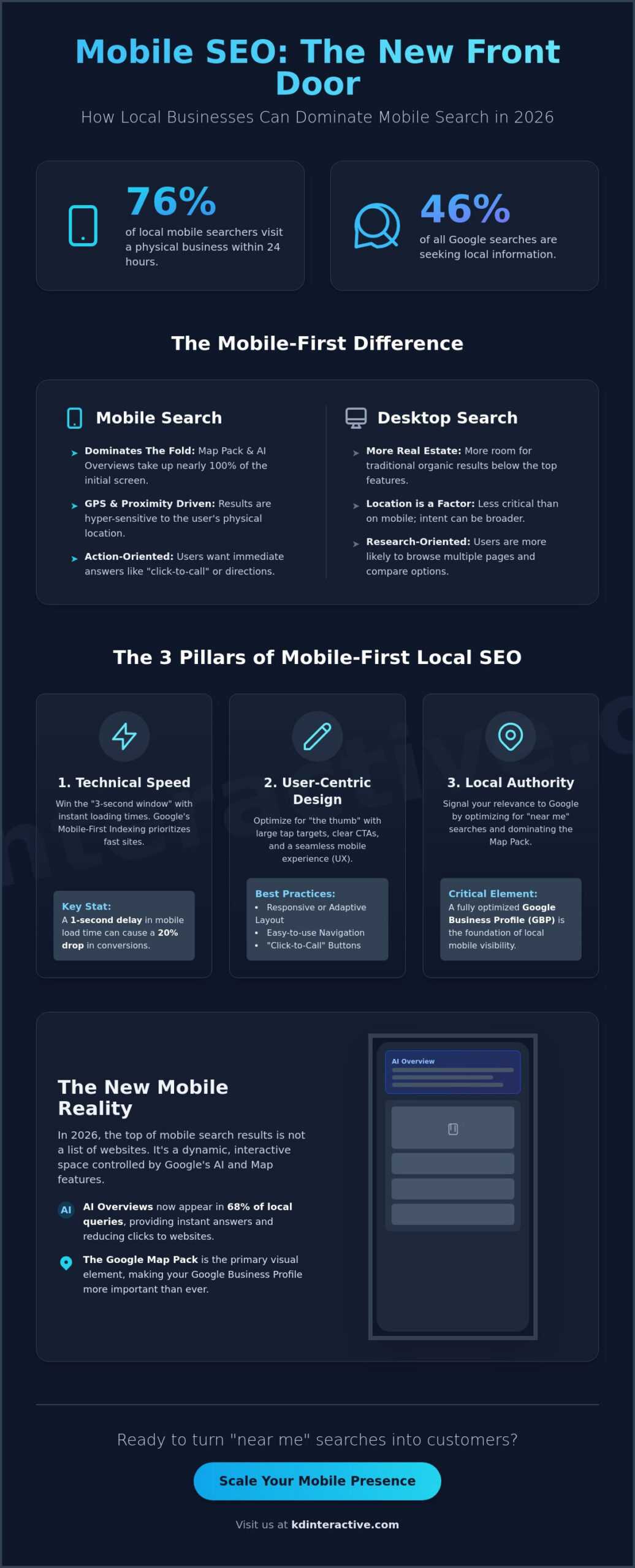
Did you know that 76% of people who search for a local business on their smartphone visit a physical location within 24 hours? With 46% of all Google searches now seeking local information, your mobile presence is your new front door. If you aren’t prioritizing mobile seo for local businesses, you’re likely watching potential revenue walk straight to a competitor who ranks higher in the Google Map Pack.
We understand the struggles of small business because we are one. Whether you’re serving customers in Milwaukee, Madison, or anywhere across Wisconsin, it’s frustrating to deal with high mobile bounce rates or technical shifts like the March 27, 2026, Core Algorithm Update. You deserve a website that loads instantly on 5G and converts “near me” searches into “click-to-call” leads. This guide will show you how to dominate search results by optimizing your Google Business Profile and mastering the AI Overviews that now appear in 68% of local queries. We’ll break down the latest 2026 ranking factors so you can stop worrying about jargon and start growing your business.
Key Takeaways
- Master the strategy of mobile seo for local businesses to capture high-intent customers who search while they’re already on the move.
- Identify the technical pillars of mobile performance, including how to optimize for “the thumb” and achieve instant loading speeds.
- Compare responsive and adaptive design models to determine which structure best supports your long-term growth and maintenance.
- Perform a real-world mobile audit of your own site to catch the same bottlenecks that are currently driving your customers to competitors.
- See how AI-enhanced tools can help you dominate the Google Map Pack and turn simple searches into measurable revenue.
Why Mobile SEO is the “Front Door” of Your Local Business in 2026
Think of your website as your digital storefront. In 2026, most customers aren’t walking past your physical windows first; they’re finding you on a five inch screen while they’re on the move. We define mobile seo for local businesses as the strategic process of optimizing your site so that smartphone users with immediate local intent find you exactly when they need you. It isn’t just about making your site look “pretty” on a phone. It’s about winning the three second window of opportunity when a customer decides where to spend their money.
The data confirms this shift. Recent 2026 statistics show that 76% of people who conduct a “near me” search visit a related business within 24 hours. To capture these leads, you need a firm grasp on the fundamentals of search engine optimization (SEO), but you must apply those rules specifically to the mobile experience. Google now uses mobile-first indexing, which means the search engine primarily looks at the mobile version of your content to determine your rank. If your mobile site is lacking, your desktop site cannot save you. We understand small business, because we are one! We know that for a contractor in Milwaukee or a retail shop in Watertown, being invisible on a smartphone means losing the local race before it even starts.
The Power of Local Micro-Moments
Mobile search is driven by “I-want-to-go” moments. These are high-intent instances where a user needs a solution right now. In 2026, speed is the ultimate trust factor. If your site takes more than two seconds to load on a 5G connection, the user will bounce back to the search results and click your competitor. This intersection of technology and local intent is exactly what local digital marketing is all about. You aren’t just building a website; you’re building a bridge to a customer who is ready to buy.
Mobile SEO vs. Desktop SEO: The Local Difference
Searching on a phone is fundamentally different than searching on a laptop. Here is why the local mobile experience requires a specialized approach:
- Screen Real Estate: On a mobile device, the Google Map Pack and AI Overviews take up nearly 100% of the initial screen. If you aren’t in those top spots, you don’t exist.
- GPS and Proximity: Mobile results are hyper-sensitive to the user’s physical location. A person searching for “plumber” in Madison will see different results than someone searching from Sun Prairie.
- User Behavior: Mobile users want “click-to-call” buttons and directions. They rarely browse multiple pages; they want the answer immediately.
By focusing on these mobile-specific behaviors, you can dominate the local market and ensure that when neighbors search for your services, your business is the first one they see.
The 3 Core Pillars of Mobile-First Local SEO
Winning at mobile seo for local businesses requires more than just a site that fits on a small screen. It demands a focus on three specific areas: technical speed, user-centric design, and local authority. Core Web Vitals represent the heartbeat of 2026 mobile performance, acting as the standardized metrics Google uses to judge how users experience your site’s speed and stability. If you ignore these pillars, you aren’t just losing rank; you’re actively pushing customers toward your competitors in Milwaukee or Madison. We understand small business, because we are one, and we know that technical jargon doesn’t matter as much as the results it produces.
Technical performance starts with Largest Contentful Paint (LCP). This metric measures how long it takes for the main content of your page to become visible to the user. On a mobile device, users expect this to happen almost instantly. Beyond speed, your website must be relevant to the physical location of the searcher. You must ensure your Google Business Page is fully optimized to feed accurate data to mobile searchers. This is where your contact information meets the mobile map interface, creating a seamless path from a search result to a physical visit.
Speed and Performance: The 3-Second Rule
Every second counts when a customer is searching on the go. Industry data from 2026 shows that every second of delay in mobile load time causes a 20% drop in conversions. For a local service provider, that’s a massive amount of lost revenue. We recommend optimizing all images and using Next-Gen formats like WebP to keep file sizes small without losing quality. Your server response time is also critical. If you’re a Wisconsin business using a server located halfway across the world, you’re adding unnecessary latency. Localized hosting or a robust Content Delivery Network (CDN) can shave off those critical milliseconds that keep a user on your page.
Mobile UX: Designing for the Fat Thumb
Mobile users don’t have the precision of a mouse cursor; they use their thumbs. If your buttons are too small or packed too closely together, you create “accidental clicks” that frustrate potential customers. Your “Click-to-Call” button should be the most prominent element on your mobile site. It’s the primary way local leads reach out when they’re ready to buy. Keep your forms short and simple as well. Every extra field on a mobile form reduces the chance of someone completing it. If your mobile experience feels like a chore, customers will leave. You can boost your local visibility by ensuring your mobile UX is built specifically for conversion and ease of use.
Responsive vs. Adaptive Design: Choosing the Right Setup
Choosing the right technical structure for your website is a decision that impacts your ranking for years. We define responsive design as a single site that fluidly flows to fit any screen size. In contrast, adaptive design uses specific, static layouts built for specific devices. For the vast majority of mobile seo for local businesses, responsive design is the superior choice. It is easier to maintain, more cost-effective, and much faster for Google to understand. We understand small business, because we are one, and we know you need a solution that works without constant technical tinkering.
When we provide web and seo services, we recommend responsive design as the gold standard for 2026. Small businesses in Wisconsin, from growing contractors in Milwaukee to boutique shops in Madison, don’t have the resources to manage three different versions of a website. Responsive design offers the best cost-to-benefit ratio because it future-proofs your digital presence. Whether your customer is using a three year old smartphone or the latest folding device, your site will look professional and function perfectly.
Why Google Prefers Responsive Design
Googlebot loves simplicity and efficiency. A responsive site uses a single URL for every page, which avoids the “m.website.com” redirect trap that often slows down mobile users. This single URL structure makes crawling and indexing much more efficient for search engines. It also ensures your content remains consistent across all devices. If your mobile site has less information than your desktop site, you risk a ranking drop because Google now uses the mobile version as the primary source for its index. Keeping your content identical across all screens protects your authority and your leads.
Common Mobile Design Mistakes to Avoid
Don’t let poor design choices drive away your neighbors. The “pinch-to-zoom” nightmare is a major conversion killer; if a customer has to manually resize your page to read a phone number, they’ll leave within seconds. You should also avoid unplayable content like heavy scripts or outdated formats that don’t work on iOS or Android. Finally, be very careful with intrusive interstitials. In 2026, large mobile pop-ups that block the user’s view of the content are the fastest way to trigger a Google penalty. We want your business to succeed, and that starts with a clean, accessible mobile experience that respects the user’s time.
How to Audit Your Mobile SEO in 5 Steps (DIY Guide)
You don’t need a degree in computer science to understand how your site performs for neighbors on the go. While many agencies charge high fees for a basic analysis, we believe in empowering you to check your own digital health first. We understand small business, because we are one! This DIY audit helps you identify the same bottlenecks that professional tools find. By following these steps, you can ensure your mobile seo for local businesses is actually working to drive revenue.
- Step 1: The Real-World Test. Leave your office and walk a block away. Search for your service on your phone. If you don’t appear in the top three results of the Google Map Pack, you’re losing customers to nearby competitors right now.
- Step 2: Speed Diagnostics. Run your URL through Google PageSpeed Insights. Look specifically at your mobile score. If your Largest Contentful Paint (LCP) is over 2.5 seconds, your site is too slow for 2026 standards.
- Step 3: Conversion Check. Tap your “Click-to-Call” and “Get Directions” buttons. It sounds simple, but a broken link here is a guaranteed way to lose a lead.
- Step 4: Information Parity. Compare your mobile site to your desktop site. Is your address, phone number, and service list identical? Missing data on mobile can trigger ranking drops under Google’s mobile-first indexing.
- Step 5: The Slow Connection Stress Test. Use your phone’s settings to simulate a weak LTE signal. Try to fill out your contact form. If it hangs or crashes, your “ready to buy” customers are walking away.
Using Free Tools for a Quick Health Check
Google Search Console is your best friend for long-term monitoring. Check the “Mobile Usability” report to find pages with text too small to read or buttons too close together. You can also use Chrome DevTools on your computer to see how your site looks on dozens of different devices. You can use the Google Mobile-Friendly Test tool by entering your URL to see exactly how Googlebot renders your page on a smartphone. These tools provide a data-driven look at your site’s performance without any guesswork.
Analyzing Your Mobile Competitors in Wisconsin
Take a look at who is currently winning the Map Pack in Milwaukee or Madison for your top keywords. Are they offering mobile-only coupons? Do they have more recent reviews with mobile-friendly photos? Identifying these “low-hanging fruit” opportunities allows you to adjust your strategy and dominate the local market. If your audit reveals technical issues you can’t fix alone, Get Your FREE Consultation today and let us help your business grow NOW!
Scaling Your Mobile Presence with KD Interactive
Transitioning from a basic website to a high-performing digital asset requires a partner who knows the local terrain. At KD Interactive, we help you move beyond being merely “mobile-friendly” to becoming mobile-dominant. We understand small business, because we are one! This means we don’t just look at code; we look at how your neighbors in Milwaukee and Madison interact with their phones. Effective mobile seo for local businesses in 2026 requires a proactive stance against algorithm shifts, such as the March 27, 2026, Core Update. We provide the local expertise you need to stay ahead.
One way we help you succeed is by integrating our Google Map Pack with AI Assistant. This tool automates mobile engagement, ensuring that when your business appears in that 68% of local queries featuring AI Overviews, you’re ready to respond. Unlike large, national agencies that treat you like a number, we offer transparent reporting and a personal touch. We believe the only way we succeed is if your business succeeds. Our data-driven approach ensures that every change we make is designed to increase your visibility and grow your revenue.
Tailored Mobile Strategies for Small Business
We don’t believe in one-size-fits-all solutions. Our team performs custom on-page optimization specifically for mobile-first indexing, ensuring Google sees the best version of your brand. We also execute local link building strategies that target mobile-heavy directories and Wisconsin-specific platforms. This builds the authority you need to dominate the Map Pack. Because search engines never stop evolving, we provide continuous monitoring to protect your rankings from the next big shift. You get a customized plan that fits your specific goals and budget.
Ready to Dominate Local Mobile Search?
The path from a simple audit to real-world growth starts with a single step. You’ve learned how critical speed, UX, and local relevance are to your success. Now, it’s time to put those insights into action. Whether you’re a service provider in Watertown or a retailer in Milwaukee, your mobile presence is your most valuable marketing tool. Don’t let another day go by where your competitors are capturing the 76% of mobile searchers who visit a business within 24 hours. We are ready to help you boost your rankings and turn those clicks into calls. Get Your FREE Consultation and Mobile SEO Audit today and start winning the local race.
Dominate Your Local Market with a Mobile-First Strategy
Your digital front door is now mobile. We’ve shown that 76% of local searchers visit a business within 24 hours. To win these customers, you must master mobile seo for local businesses by prioritizing technical speed and a “thumb-friendly” user experience. Don’t let your Milwaukee or Madison competitors take the lead because your site loads slowly on a 5G connection. Every second of delay on a smartphone can cost you 20% of your potential conversions.
We understand small business, because we are one! Our expert local SEO team based in Wisconsin is ready to help you implement advanced tools like our Google Map Pack with AI Assistant. You’ll receive transparent, results-driven reporting that shows exactly how your visibility is increasing in your specific service area. The only way we succeed is if your business succeeds.
Help my business grow NOW with a Mobile SEO Audit!
You now have the tools and the DIY audit steps to begin your journey toward the top of the search results. Let’s turn those “near me” searches into real-world revenue together. We’re ready to help you succeed and dominate your local market.
Frequently Asked Questions
Is mobile SEO different from regular local SEO?
Yes, mobile SEO focuses on the unique technical and behavioral constraints of smartphone users. While regular local SEO covers broad visibility, mobile seo for local businesses specifically targets the “on-the-go” intent and device-specific ranking factors like screen size and loading speed. It’s about winning that three second window of local intent when a customer is searching from a sidewalk in Milwaukee or a car in Madison.
How fast should my local business website load on a phone?
Your website should load in under 2.5 seconds to meet Google’s 2026 Core Web Vitals standards. Any delay beyond three seconds can lead to a 53% abandonment rate according to industry benchmarks. We recommend aiming for a Largest Contentful Paint (LCP) of 1.5 seconds or less. This ensures you don’t lose impatient local customers to faster competitors who are just a tap away.
Do I need a separate app for my small business to rank on mobile?
No, you don’t need a separate app to rank well in local mobile search results. In 2026, a responsive website is more effective for search visibility than a standalone app. Apps require a download, which creates a barrier for new customers. A well-optimized mobile site appears directly in the Google Map Pack, capturing leads without requiring any extra steps from the user.
What is the most important mobile SEO factor for the Google Map Pack?
Your Google Business Profile (GBP) signals are the most important factor, accounting for 32% of the ranking weight in 2026. This includes having an accurate address, a local phone number, and consistent categories. Proximity to the searcher also plays a massive role on mobile devices because Google uses the user’s real-time GPS data to serve the most relevant nearby results for their current location.
Can I do mobile SEO myself or do I need an agency?
You can handle basic tasks like updating your business hours or responding to reviews yourself. However, technical optimizations like improving server response times or managing AI Overviews often require specialist expertise. We understand small business, because we are one! We know that a professional partner can often save you time and prevent costly ranking drops during major algorithm updates like the one on March 27, 2026.
Why does my website look different on an iPhone vs. an Android?
Different devices use various screen resolutions and browser engines to render your content. While iPhones use Safari, many Android devices rely on Chrome. A responsive design ensures your site fluidly adjusts to these differences. If your site looks broken on one device, it’s likely a sign that your CSS code isn’t truly responsive or your images are improperly sized for different mobile viewports.
How do I track how many customers are calling me from mobile search?
You can track these leads using Google Search Console and your Google Business Profile performance tab. These tools provide specific data on “click-to-call” actions. For more advanced tracking, you can use unique tracking phone numbers or set up event tracking in Google Analytics 4. This data allows you to see exactly which mobile keywords are driving your real-world revenue and growing your Wisconsin business.
What happens if my website is not mobile-friendly in 2026?
Your business will likely become invisible to 60% of searchers who use mobile devices as their primary tool. Google’s mobile-first indexing means the search engine may stop crawling your desktop site entirely if the mobile version is poor. You’ll see a sharp decline in rankings, fewer Map Pack appearances, and a significant loss of traffic to competitors who have prioritized mobile performance and speed.