
A bigger discount isn’t always the best way to win Small Business Saturday. If you’re balancing tight margins, limited planning time, and the need to bring local customers through the door, choose an offer that gives shoppers a reason to choose you without cutting too deeply into profit. The most useful small business saturday promotion tips start with that balance.
Small Business Saturday falls on November 28, 2026, giving you a clear date to plan around. But a compelling promotion takes more than a one-day deal. Nearby customers need to find accurate event details, understand why the offer is worthwhile, and have a reason to return afterward.
This practical checklist will help you choose an offer that fits your business and margins, promote it through relevant online and offline channels, and track the response. You’ll also find ways to turn event-day interest into future visits, whether you’re reaching shoppers in a Wisconsin community or another local market. From shaping the promotion to reviewing what worked, you can build a focused plan without adding unnecessary complexity.
Key Takeaways
- Set one clear event goal first, then choose an offer that supports it without putting unnecessary pressure on your margins or capacity.
- Match local promotion channels with the shoppers you want to reach and the information they need.
- Work backward from November 28, 2026, to organize planning, promotion, event-day tasks, and follow-up.
- Track redemptions, inquiries, bookings, and relevant website activity against your goal to understand the response.
- Build on event-day interest with a thoughtful follow-up, while treating one event’s results as useful evidence, not proof of long-term impact.
Small Business Saturday 2026: Set a clear promotion goal before choosing an offer
A promotion is easier to plan when you know what it needs to accomplish. Before choosing a discount or event, decide what would make the day worthwhile for your business. Start with one goal and a measure you can track, so your offer supports a clear priority instead of adding work without a way to evaluate the result.
Small Business Saturday takes place on the Saturday after Thanksgiving. In 2026, that date is November 28. The U.S. shopping day encourages consumers to support small businesses during the holiday shopping season. American Express established the event in 2010, and the U.S. Small Business Administration co-sponsors it. The history of Small Business Saturday explains its place alongside major holiday shopping events.
What is Small Business Saturday, and who is it for?
The occasion gives local retailers, restaurants, service businesses, and other community-focused businesses a timely reason to connect with nearby customers. The right activity depends on how your business serves people: a retailer might highlight seasonal merchandise, while a service business could focus on bookings or inquiries. You don’t need to copy another business’s campaign. Make the day relevant to your customers and your capacity.
Choose a promotion goal you can measure
Pick one main goal based on your current priority and what your team can handle. Sales, new customers, repeat visits, and local awareness can all be valid aims, but trying to optimize for all of them at once can make the promotion harder to design and evaluate. These small business saturday promotion tips begin with matching the goal to a simple success measure.
- Sales: Count transactions or sales tied to the promotion.
- New customers: Track first-time purchases, inquiries, or bookings when you can identify them reliably.
- Repeat visits: Measure return visits or later bookings from customers who engaged with the event.
- Local awareness: Monitor relevant website activity, calls, or inquiries, while recognizing these may not all lead to a sale.
Choose one primary measure before settling on an offer. For example, a salon focused on filling its schedule might track bookings, while a shop hoping to attract new customers could count redemptions of an event-specific offer. If you have reliable historical data, record a comparable baseline, such as the same weekday or a previous relevant period. Use it as context, not a guaranteed benchmark. One event can show what happened, but it can’t prove by itself what caused the result.
Choose a Small Business Saturday offer that attracts customers without eroding margin
The best offer is one your customers value and your business can deliver profitably. A steep discount may attract attention, but it can also reduce margin or strain inventory. Compare a few formats against your promotion goal, costs, and available capacity before committing. Consider not just the headline offer, but also what it costs to fulfill and how easy it will be for staff to explain.
For event background and participation resources, the U.S. Small Business Administration provides an official Small Business Saturday hub. The event is officially cosponsored by the SBA, alongside American Express.
Discounts, bundles, and value-added offers
Use a discount only when your margins and inventory can support it. A bundle can make complementary items more appealing together, while an added service or small extra can give customers more value without lowering the main price. For example, a shop might pair related products, while a service business could offer a relevant extra that fits its team’s capacity. Before choosing, calculate the cost of the offer and check that the items or appointment slots will be available.
Events, loyalty rewards, and limited-quantity promotions
A demonstration, tasting, or workshop can give customers a reason to visit if it suits your business and staffing. Loyalty rewards work best when the next step is clear, such as a defined reward for a future visit. Limited offers should reflect genuine time, inventory, or capacity constraints. State the terms plainly, including who can redeem the offer and how, so customers know what to expect.
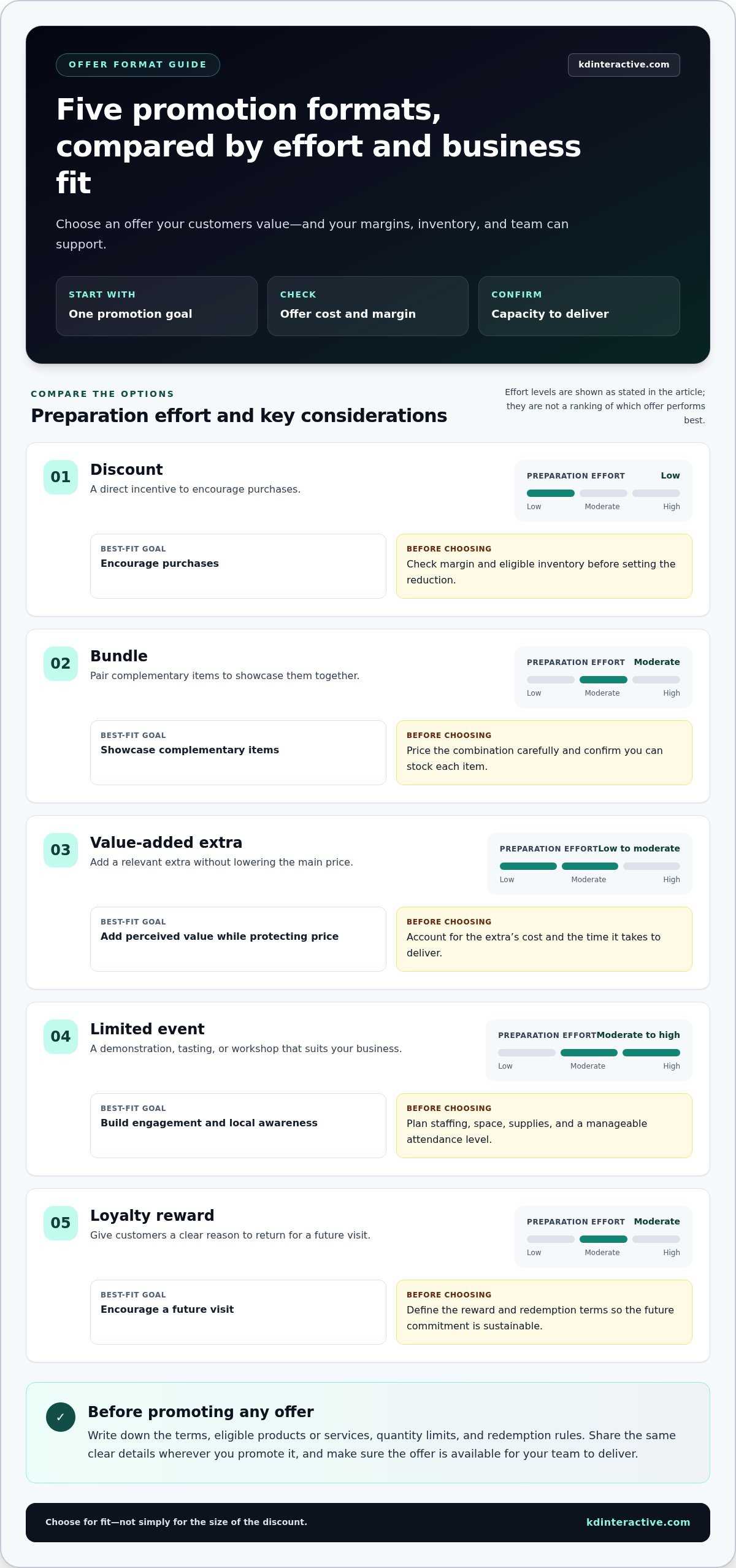
| Offer type | Best-fit goal | Preparation effort | Margin or capacity consideration |
|---|---|---|---|
| Discount | Encourage purchases | Low | Check margin and eligible inventory before setting the reduction. |
| Bundle | Showcase complementary items | Moderate | Price the combination carefully and confirm you can stock each item. |
| Value-added extra | Add perceived value while protecting price | Low to moderate | Account for the extra’s cost and the time it takes to deliver. |
| Limited event | Build engagement and local awareness | Moderate to high | Plan staffing, space, supplies, and a manageable attendance level. |
| Loyalty reward | Encourage a future visit | Moderate | Define the reward and redemption terms so the future commitment is sustainable. |
Before promoting your offer, write down its terms, eligible products or services, quantity limits, and redemption rules. Make the same details easy to find wherever you share the promotion. Clear local event information helps nearby customers understand what’s available, though visibility alone can’t guarantee sales. If your offer depends on local search visibility, local SEO and content support can help make event details easier for nearby customers to find.
Compare promotion channels to reach nearby Small Business Saturday shoppers
You don’t need to post everywhere to reach local customers. Start with the channels your customers already use, then make sure each one points to the same offer and accurate event details. A consistent date, location, and call to action helps shoppers move from discovering your promotion to deciding what to do next.
Make local search listings useful before event day
Update your Google Business Profile with accurate hours, contact details, and relevant event information. Give customers a clear website page or post with the offer terms, location, and accessibility details. Keep your business name, address, hours, and event information consistent across listings. Before publishing, check the information on a phone as well as a computer so customers can quickly find the essentials.
| Channel | Audience | Effort | Useful content and role |
|---|---|---|---|
| Google Business Profile | People searching nearby for businesses or event details | Low | Current hours, contact details, and event information support local discovery and help customers plan a visit. |
| Website page or post | Shoppers who want full details before visiting or booking | Low to moderate | Explain the offer, terms, location, and accessibility. It can serve as the main reference to share from other channels. |
| Social posts | Followers and people reached through local sharing | Moderate | Use concise, visual updates and a clear next step to build awareness and direct interested shoppers to full details. |
| Opted-in email | Existing customers who agreed to receive messages | Low to moderate | Send a direct reminder with the offer, date, and action to take. It can re-engage people already familiar with your business. |
| Community partners | Customers connected to nearby organizations or businesses | Moderate | Share accurate event details through suitable community calendars or neighboring businesses to extend local reach. |
Coordinate social, email, and community promotion
Adapt the message to each channel, but keep the offer, date, and call to action consistent. Only send promotional email to people who have opted in. In Wisconsin, a community calendar, business association, or neighboring shop may help surface an event to local audiences. The Small Business Saturday tips from the SBA also encourage collaboration with neighboring businesses and advance promotion.
Start with the channels you can keep accurate and active rather than stretching your time across every platform. A coordinated plan can make the customer journey clearer: local search helps shoppers find you, your website answers questions, and social posts or community partners spread the word. A useful digital marketing plan connects those channels to the same goal and offer.
Use this small business saturday promotion checklist and timeline
Small Business Saturday is November 28, 2026. Work backward from event day, allowing more time if your promotion involves special inventory, staffing, bookings, or a community event. Assign one person to each task, even if that person is you. These small business saturday promotion tips help keep planning manageable and make sure the offer is delivered and tracked consistently.
Plan backward from November 28
- October 3 to 17, six to eight weeks out: Choose the promotion, confirm inventory or appointment capacity, set terms, and assign responsibilities. A simpler offer may need less lead time; a larger event needs more coordination.
- Late October to early November: Publish event details, prepare staff, and schedule messages on the channels you’ve selected. Check that links, hours, and location details are accurate.
- Week of November 28: Review stock or appointment availability, confirm staff understand the offer, and check that public listings and reminders still show the right information.
- November 28 and the days after: Display the offer clearly, record activity, and follow up with participants within 48 hours where appropriate.
Before the event: finalize and publish the promotion
Before announcing the offer, document what’s included, any exclusions, quantity or redemption limits, and who handles questions. Make sure staff can explain the terms in the same straightforward way. Then publish a concise event page or post with the date, hours, location, and offer details. Schedule reminders across your selected channels, and test links and business information before sharing them.
Choose a tracking method in advance. A dedicated offer code, booking note, or simple redemption tally can connect customer activity to the promotion without adding a complicated process. Tell staff what to record and where, including customer questions that reveal unclear terms or useful opportunities for future updates.
On event day and after: deliver, record, and follow up
Keep the offer visible at the point of decision, whether that’s a counter, booking page, or event entrance. Make redemption steps easy to follow. Record redemptions, inquiries, bookings, and notable questions using the same method throughout the day. Afterward, thank participants and invite an appropriate next interaction, such as a return visit or future booking, without sending repeated messages.
Use the results to refine your next local promotion. If you want stronger local visibility for event details, explore local SEO support for your business.
Measure results and turn local promotion attention into ongoing growth
After the event, compare what happened with the goal you chose during planning. Don’t judge the promotion by one number alone. Look at your main measure alongside customer actions and operational notes to understand what drew interest, what converted, and what you might change next time.
What should a small business measure after the promotion?
Review transactions or bookings alongside offer redemptions and inquiries. If you used a dedicated code, booking note, or tally, connect those records to the promotion. Relevant website activity can add context, especially if people viewed the event page or checked practical details before visiting. Treat web activity as a sign of interest, not proof that it caused a purchase.
- Compare results with your goal: Look at the measure you selected, such as transactions, bookings, or redemptions.
- Review the customer journey: Check inquiries and website activity alongside completed actions to see where interest led to a visit or booking.
- Capture what numbers miss: Note customer feedback, questions about the offer, operational issues, and unexpected demand.
Separate observed results from assumptions. You may see more bookings on the day, but one event can’t establish that the promotion alone caused the increase or that the same approach will work long term. Record which offer, channel, and message appeared to prompt useful actions, then compare those observations with reliable past data where available. These small business saturday promotion tips are most valuable when they help you make a more informed next decision, not when they imply a guaranteed outcome.
Build on local visibility after Small Business Saturday
Keep useful information current after the event. Remove or revise expired offers and update your website and Google Business Profile when hours, services, or other event details change. Accurate local search information helps nearby customers find the right details, while useful content can answer questions and maintain awareness beyond a single shopping day. Neither guarantees rankings or sales, but both make it easier for people to understand what your business offers.
Review what customers asked and use those questions to shape future updates, such as clearer service information or a helpful local post. For broader local-search context, consult Local SEO Services Near Me: The Small Business Owner’s Complete Guide. Wisconsin businesses can also explore local SEO support for your Wisconsin business.
Turn your Small Business Saturday plan into lasting local momentum
A strong Small Business Saturday promotion starts with one clear goal, an offer that fits your margins and capacity, and a practical plan to reach nearby customers. The most useful small business saturday promotion tips also include tracking what people do, so you can learn from redemptions, bookings, inquiries, and customer feedback instead of relying on impressions alone.
Keep event information accurate across your website and local listings, then use what you learn to shape future content and promotions. One event won’t prove what drives long-term growth, but it can help you make a more informed next move.
KD Interactive supports small businesses with Wisconsin-focused local SEO services, content creation and blog management, reputation management, and analytics tracking. A focused plan can help make local business information easier to find and keep useful content working beyond a single event.
Frequently Asked Questions
When is Small Business Saturday in 2026?
Small Business Saturday 2026 is Saturday, November 28, the Saturday after Thanksgiving in the United States. Add the date to your planning calendar and work backward: confirm your offer and capacity, publish accurate event details, and schedule reminders. Starting early gives you room to coordinate staff, inventory, and community partners, especially if your promotion includes a special event or product bundle.
What is a good Small Business Saturday promotion?
A good promotion fits your business goal, customer needs, margins, and capacity. A retailer might bundle complementary products, while a restaurant could offer a limited tasting or a service business could focus on event-day bookings. The best small business saturday promotion tips start with clear terms: specify what’s included, eligible products or services, and any limits. Choose an offer you can explain and deliver consistently.
How can a small business promote Small Business Saturday for free?
Use channels you already manage: update your Google Business Profile, publish event details on your website, and share posts on your social accounts. Ask suitable community organizations or neighboring businesses to share the information, and send email only to people who opted in. American Express also provides free Small Business Saturday marketing materials, including social posts and printable posters. You don’t need to accept its cards to download those materials.
Is Small Business Saturday worth participating in?
It can be worthwhile if the event supports a business priority and the promotion is manageable to deliver. Set a goal first, such as gaining bookings, attracting new customers, or encouraging repeat visits, then choose a way to measure it. Consider the time, inventory, staffing, and any offer costs involved. Afterward, compare observed results with your goal. One event can inform future plans, but it can’t guarantee lasting sales.
How do I attract customers on Small Business Saturday?
Give nearby customers a clear reason to choose your business and make the details easy to find. Share a relevant offer or experience, confirm your hours and location information, and repeat the same date and terms across your website, local listings, social posts, and community partners. Make the next step obvious, such as visiting, booking, or redeeming an offer. Track responses to learn which channels prompted useful customer actions.
Should I offer a discount on Small Business Saturday?
Offer a discount only if your margins, inventory, and capacity can support it. A price reduction may suit a goal of encouraging purchases, but it isn’t the only option. Bundles, a useful extra, a demonstration, or a clearly defined loyalty reward can give customers a reason to act without a storewide discount. Set eligibility and redemption terms in advance, and choose an offer that remains worthwhile for your business.
How can local SEO help with Small Business Saturday promotions?
Local SEO helps nearby customers find accurate information about your business when they search online. Keep your Google Business Profile and website details consistent, and publish useful event content with the offer, hours, location, and terms. These steps support discovery and help shoppers plan, but they don’t guarantee rankings, visits, or sales. Explore KD Interactive’s Wisconsin-focused local SEO, content creation, reputation management, and analytics support for small businesses.