
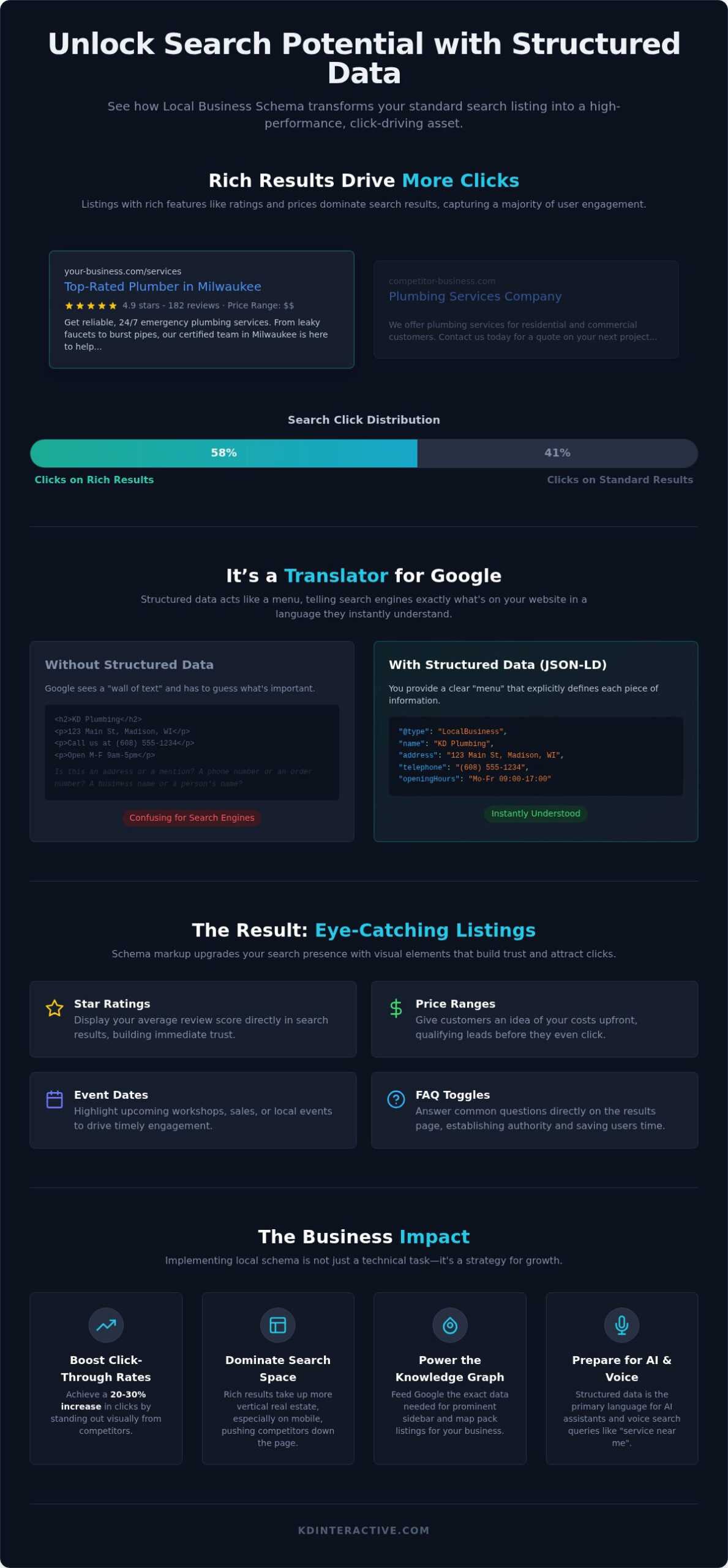
Did you know that search listings featuring “Rich Results” like star ratings and price ranges snag 58% of all clicks, while standard links are left with just 41%? It’s frustrating to put in the work to hit page one only to watch potential customers in Milwaukee or Madison click on a competitor because their listing looks more professional. Many owners feel overwhelmed by technical terms like local business schema markup, but you don’t need a computer science degree to bridge this gap. We understand that SEO often feels like a foreign language designed to keep small business owners out of the loop.
In this guide, we’ll demystify how structured data acts as a direct translator between your Wisconsin company and Google. You’ll learn the secret to claiming those eye-catching search features that drive real revenue and higher click-through rates. We are going to break down exactly which data types your business should prioritize and provide a methodical roadmap for implementation. By the end, you will have a clear strategy to turn your search presence into a high-performing asset that stands out from the crowd.
Key Takeaways
- Learn how structured data acts as a digital translator, helping Google display your Wisconsin business with eye-catching “Rich Results.”
- Discover why local business schema markup is the essential secret to securing a prominent spot in the Google Map Pack.
- Understand the direct link between visual search features, like star ratings, and a significant boost in your website’s click-through rates.
- Explore user-friendly tools and plugins that allow you to audit and implement schema without writing a single line of code.
- See how professional SEO services streamline technical implementation so you can focus on running your business while we handle the data.
What is Structured Data? The “Translator” for Your Website
Think of your website as a conversation. When a person visits your site, they see paragraphs, images, and headlines. However, search engines see your site differently. They see a massive wall of text that they have to interpret manually. Structured data is a standardized format, or vocabulary, that provides specific information about a page to help search engines understand it instantly. While your website’s text is “unstructured” data, adding local business schema markup provides the code that acts as a bridge between your content and the algorithms.
To understand the difference, use a pragmatic analogy. Imagine walking into a restaurant in Milwaukee. If the chef just points at a pile of ingredients, you’ll have a hard time knowing what’s for dinner. A menu solves this by telling you exactly what is in the kitchen, how much it costs, and what the ingredients are. Structured data is that menu for Google. It tells the search engine: “This is not just a random string of numbers; it is our business phone number. This is not just a street name; it is our physical location in Madison.”
The Role of Schema.org and JSON-LD
In 2026, the global standard for this digital vocabulary is Schema.org. This organization provides a universal dictionary that all major search engines use to identify specific types of information. To implement this dictionary on your site, we use a format called JSON-LD. Google officially recommends JSON-LD because it’s non-invasive. It lives in the background of your code, meaning it won’t affect your website’s visual design, loading speeds, or user experience. It’s a clean, efficient way to feed data directly to search engines without cluttering your layout.
Visualizing the Result: Rich Snippets
The most exciting benefit of using local business schema markup is the creation of “Rich Snippets.” These are visual upgrades to the standard blue links we see in search results. Instead of a plain text description, your listing can feature eye-catching elements that draw the user’s eye immediately. Common examples include:
- Star Ratings: Showing your average review score directly in search.
- Price Ranges: Giving customers an idea of your service costs upfront.
- Event Dates: Highlighting upcoming workshops or local sales.
- FAQ Toggles: Answering common questions right on the results page.
These features build immediate trust. When a potential client in Watertown sees your gold stars and clear pricing before they even click, you’ve already established professional authority. This visual advantage is what turns a simple search into a high-value lead. It makes your business look like an industry leader while your competitors are stuck with basic text.
Why Structured Data is Essential for SEO in 2026
Visibility isn’t just about where you rank; it’s about how you look when you get there. In 2026, simply appearing on page one isn’t enough to guarantee a lead. High-performing results now rely on feeding the Knowledge Graph, which is that detailed sidebar information box you see on the right side of search results. By implementing local business schema markup, you provide the specific data points Google needs to populate these boxes with your hours, address, and phone number. This creates an immediate impression of authority and reliability for your Wisconsin enterprise.
Boosting Click-Through Rates (CTR)
Search results featuring “Rich Results” like star ratings and prices receive 58% of all user clicks, while standard listings only capture 41%. For a business in competitive markets like Milwaukee or Madison, this gap is the difference between a busy phone line and a quiet office. Research indicates that businesses using local schema can see a 20-30% increase in click-through rates. This isn’t just about the stars; it’s about digital real estate. Rich results take up significantly more vertical space on mobile devices, pushing your competitors further down the screen. This visual dominance signals to Google that your result is highly relevant, providing an indirect ranking boost over time. To ensure you’re following the best practices for these features, it’s helpful to review Google’s guidelines for Local Business structured data.
Future-Proofing for AI Search
The search landscape is shifting toward AI-driven experiences and voice queries. When someone asks a smart speaker for a service “near me” in Watertown, the AI doesn’t read your entire website from scratch. It looks for structured entities it can trust. In 2026, structured data is the primary language of AI-driven search. It helps AI assistants categorize your services with precision, ensuring you appear in AI Overviews and conversational recommendations. If your data isn’t structured, these engines might skip your business for a competitor who is already speaking their language.
Integrating these technical elements into your broader Local SEO Services ensures your brand remains visible as search technology evolves. We focus on these data-driven details so your business stays ahead of the curve without you needing to learn the code yourself. By making your site easier for machines to read, you make it much easier for customers to find you.
The Most Important Schema Types for Local Wisconsin Businesses
Generic SEO advice often misses the mark for regional companies. A law firm in Madison needs a different technical approach than a manufacturing plant in Milwaukee. To maximize your visibility, you must choose the right categories from the Schema.org structured data library. Google recommends using the most specific subtype available for your industry. If you’re a plumber, don’t just use “LocalBusiness”; use “Plumber.” This precision helps the algorithm match you with the exact “near me” searches happening in your neighborhood.
LocalBusiness Schema: Your Digital Business Card
This is the mandatory starting point for any local business schema markup strategy. It acts as a digital fingerprint that validates your Name, Address, and Phone (NAP) information. Consistency here is vital for your broader local digital marketing efforts. If your website code says one thing and your Google Business Profile says another, your rankings will suffer. Wisconsin businesses with branches in multiple cities, like Watertown and Oconomowoc, need to create unique schema blocks for each location. This tells Google exactly which branch serves which community, preventing “cannibalization” where your own locations compete against each other.
Service and Review Schema for Professionals
Service-based businesses like HVAC contractors, attorneys, or dentists rely heavily on trust. Review schema allows you to pull your hard-earned star ratings directly into the search results. It’s a psychological trigger that builds confidence instantly. When paired with comprehensive web and seo services, these tags ensure your reputation is visible before a user even lands on your site. You can also use Service schema to list your specific capabilities, such as “Emergency Furnace Repair” or “Family Law,” making you more relevant for long-tail searches.
Don’t overlook FAQ and Product schema either. FAQ markup is a clever way to take up more space on the search page. It creates interactive drop-down menus under your listing, answering common customer questions and pushing competitors out of sight. For retailers in Milwaukee or Watertown, Product schema displays inventory levels and prices, giving shoppers a reason to visit your store instead of a national chain. These technical choices turn a standard website into a high-visibility sales tool that speaks directly to your local audience.
How to Implement Schema Markup Without Writing Code
Many small business owners in Milwaukee and Madison avoid local business schema markup because the raw code looks intimidating. You don’t need to be a developer to win at SEO. Start by auditing your current site with Google’s Rich Results Test. This free tool shows you exactly what Google sees right now and identifies missing opportunities. Research shows that fewer than 33% of small local business websites have correctly implemented structured data. By simply fixing your errors, you’re already ahead of the majority of your competitors in Watertown.
For businesses using WordPress, plugins like Yoast or Rank Math handle the basic heavy lifting. These tools allow you to enter your business name, address, and phone number into a simple form, which then generates the necessary code in the background. If your needs are more complex, such as listing multiple service areas or specific price ranges, managed services can handle the technical implementation for you. Once your data is live, monitor your performance in Google Search Console under the “Enhancements” tab. This area tracks how many rich results you’re earning and alerts you if Google encounters any issues with your code.
Using Schema Generators and Plugins
If you prefer a hands-on approach without writing code, follow this three-step process. First, identify your high-priority pages. Your Home, Services, and Contact pages are the most vital for local visibility. Second, use a “Schema Generator” tool. These web-based forms let you type in your details and click a button to create a custom JSON-LD code block. Finally, paste that code into your website’s header or use an SEO plugin to map the data to the correct fields. This methodical approach ensures your local business schema markup is accurate and effective.
Testing and Validating Your Data
Validation is the most critical step. Use the Schema Markup Validator to catch errors before they affect your rankings. Common mistakes include missing required fields, like a physical address, or “hidden text” violations where the schema describes services that aren’t actually visible on the page. Remember that SEO isn’t a “set it and forget it” task. Google updates its requirements frequently, so regular audits are necessary to maintain your visual advantage in search results.
If you’d rather focus on running your business while experts handle the technical details, our web and seo services provide a complete, managed path to implementation. We ensure your data is always valid and optimized for the latest search engine standards.
Maximizing Your Local Visibility with KD Interactive
Wisconsin entrepreneurs are experts at what they do, whether that’s providing legal counsel in Madison or manufacturing parts in Milwaukee. You shouldn’t have to become a part-time coder to get noticed on Google. At KD Interactive, we remove the technical burden of local business schema markup by making it a standard feature of our local SEO service. We don’t just give you a list of things to fix; we build the digital infrastructure that lets search engines trust your brand.
Our strategy creates a powerful synergy between your website’s code and the Google Map Pack with AI Assistant. By providing precise, geo-targeted data, we ensure the AI Assistant has the most accurate information to recommend your business to local searchers. In 2026, these AI-driven recommendations are becoming the primary way users find services on the go. This methodical approach is why regional expertise in Watertown and the surrounding areas matters. We understand the local geography and search habits, allowing us to tailor your schema to capture the specific ‘near me’ queries that drive your revenue. We make sure your address and service areas are mapped with pinpoint accuracy so you never miss a local lead.
Our Data-Driven Approach to Wisconsin SEO
We believe that technical SEO should always serve a commercial purpose. A perfect code block is useless if it doesn’t result in more phone calls or store visits. As a results-oriented SEO agency, our philosophy is built on partnership. We treat your business growth as our primary metric for success. This means we use structured data to beat national competitors who often rely on generic, one-size-fits-all strategies. We focus on the granular details that make your business the obvious choice for a local customer.
Ready to Stand Out in the Search Results?
It’s time to stop blending in with the standard blue links. You deserve to be the business with the gold stars, the clear price ranges, and the interactive FAQ toggles that dominate the search page. Request a professional assessment of your site’s schema today to see exactly where you can gain a visual advantage. We are here to provide the dependable, regional expertise you need to expand your visibility and achieve professional growth. Let’s work together to make sure your Wisconsin business is impossible to ignore.
Claim Your Visual Advantage in Wisconsin Search
Implementing local business schema markup is no longer a technical luxury; it’s a competitive necessity for any business in Milwaukee, Madison, or Watertown. By providing a clear digital menu for search engines, you unlock rich results that capture 58% of all user clicks. This strategy doesn’t just improve your appearance. It future-proofs your brand for AI-driven search and ensures your information is the primary source for local assistants. You don’t need to master the underlying code to see these professional results.
Our team at KD Interactive specializes in pragmatic, results-oriented strategies that take the technical burden off your shoulders. We are Wisconsin-based local SEO specialists who focus on measurable outcomes like increased leads and Google Map Pack optimization. We’re ready to act as your partner in professional achievement and local market leadership. Dominate your local market-Contact KD Interactive for a professional SEO assessment today! Your business has a story to tell, and we’ll make sure Google’s algorithms translate it perfectly for your next customer.
Frequently Asked Questions
Is structured data a direct ranking factor for Google?
Structured data is not a direct ranking factor in the same way that backlinks or site speed are. However, it creates a visual advantage that significantly boosts your click-through rate. When more people in Milwaukee click on your listing because of star ratings, Google receives a signal that your page is relevant. This improved engagement often leads to better rankings over time as a byproduct of higher user interest.
Do I need to be a developer to add structured data to my website?
You don’t need to be a developer to implement local business schema markup on your site. Modern SEO plugins for platforms like WordPress allow you to enter your business details into a simple form. These tools then generate the necessary JSON-LD code automatically. For more complex needs, a local expert can handle the implementation to ensure your data is error-free and follows the latest 2026 search standards.
How long does it take for rich snippets to appear in search results?
Rich snippets don’t appear instantly after you add the code. It typically takes Google anywhere from a few days to several weeks to recrawl your site and process the new information. You can speed up this process by using Google Search Console to request a re-indexing of your high-priority pages. Keep in mind that Google does not guarantee rich results will show for every query, even if your code is perfect.
Will structured data help my business show up in the Google Map Pack?
Yes, structured data is a critical component for appearing in the Google Map Pack. It acts as a secondary verification of your business name, address, and phone number (NAP). By aligning your website’s code with your Google Business Profile, you build the trust necessary for Google to recommend you to local searchers. This is a core part of our methodical approach to increasing visibility for Wisconsin small businesses.
What is the difference between Schema and Structured Data?
Structured data is the general concept of organizing information in a way that machines can read. Schema, specifically Schema.org, is the actual vocabulary or “dictionary” that the major search engines agreed to use. Think of structured data as the act of writing a letter, while Schema is the specific language you use to write it. Using the correct vocabulary ensures your message isn’t lost in translation when Google crawls your site.
Can I get penalized for using structured data incorrectly?
Google can issue manual actions or penalties if you use structured data in a deceptive way. This usually happens if you include “hidden” markup that doesn’t match the visible content on your page or if you fabricate fake reviews. We always recommend a transparent approach that follows official guidelines. Maintaining an honest, data-driven strategy protects your site’s reputation and ensures your long-term success in the Madison and Watertown search markets.
Which schema is most important for a small service-based business?
The LocalBusiness schema, or a more specific subtype like HVACBusiness or Attorney, is the most vital starting point. This foundation ensures Google knows exactly who you are and where you operate in Wisconsin. Pair this with Review schema to showcase your star ratings and Service schema to list your specific offerings. Together, these tags make your listing more informative and trustworthy, helping you stand out from competitors who only use basic text.