
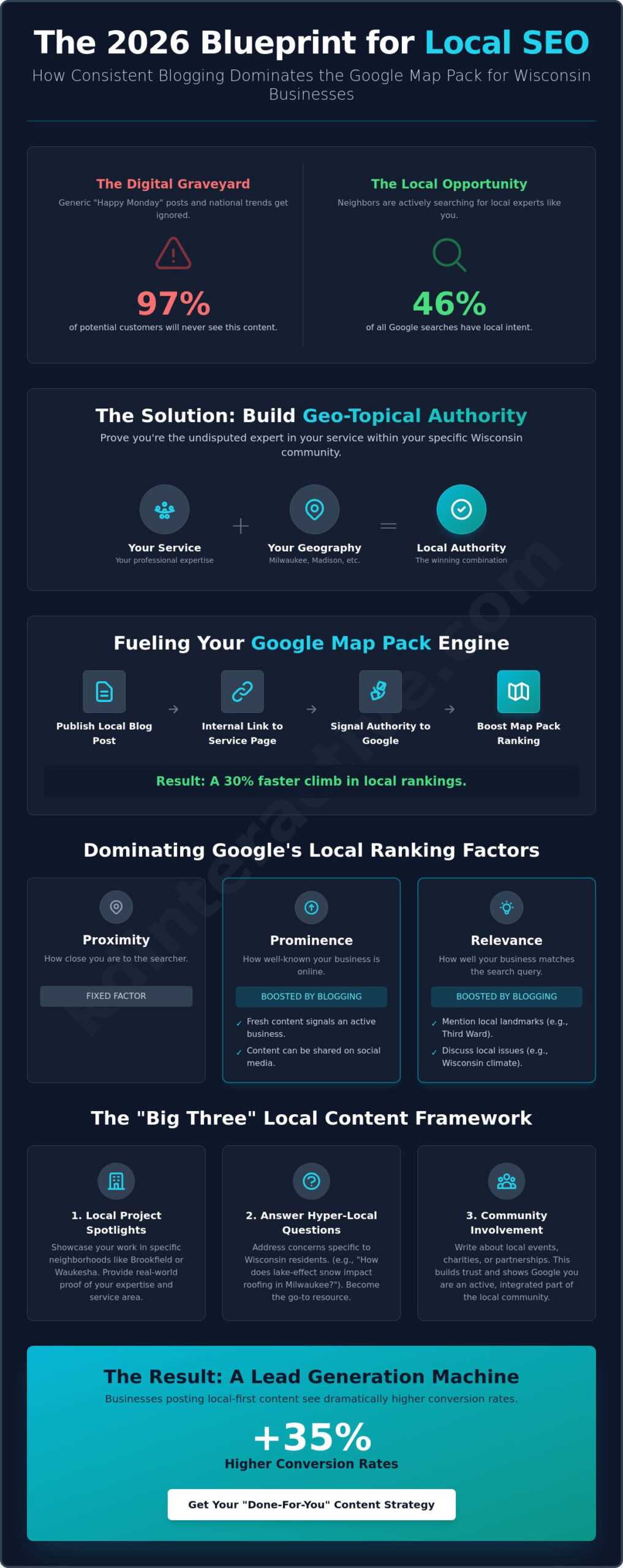
Most local business blogs are a digital graveyard of “Happy Monday” posts that 97% of your potential customers will never see. Since 46% of all Google searches have local intent, failing to find the right blog ideas for local businesses is a wasted opportunity to capture neighbors who are ready to buy. We understand small business because we are one; we know that your time is better spent serving clients in Milwaukee or Madison than fighting with a blinking cursor for three hours. It’s frustrating when you aren’t sure if your efforts actually help your local rankings or if you’re just shouting into a void.
You deserve a strategy that drives measurable growth. This 2026 guide provides a curated list of high-impact topics designed to build geo-topical authority and boost your visibility in the Google Map Pack. We’ll show you how to stop guessing and start publishing content that attracts Wisconsin leads and increases your monthly call volume. You will learn repeatable content frameworks that turn your website into a 24/7 lead generation machine for your physical storefront.
Key Takeaways
- Learn how to build “Geo-Topical Authority” to ensure 2026 search engines prioritize your Wisconsin business over generic national competitors.
- Discover the direct connection between consistent blogging and climbing the Google Map Pack rankings for your specific service area.
- Master our “Big Three” framework to generate endless blog ideas for local businesses that educate customers and build community trust.
- Implement a pragmatic 2026 workflow that combines local keyword research with AI tools to answer the questions your neighbors are actually asking.
- Find out how a professional, “done-for-you” content strategy tailored for the Wisconsin market can turn your website into a lead-generation machine.
What is a Local Business Blog and Why Does It Matter in 2026?
Blogging for your business isn’t about becoming a professional writer or sharing your personal thoughts. In 2026, local business blogging is a calculated strategy to build Geo-Topical Authority. This means proving to both neighbors and search engines that you’re the undisputed expert in your specific service within your specific Wisconsin community. Finding the right blog ideas for local businesses starts with looking at your own backyard. Search engines have evolved to ignore generic industry fluff. They now prioritize content that is hyper-relevant to a user’s physical location.
It’s the digital evolution of local store marketing, where your online presence mirrors your physical reputation. We understand the struggles of small business owners in Milwaukee or Madison who feel they don’t have time to write. However, blogging is the highest-leverage activity you can do. It’s the fuel for your entire local digital marketing effort. Without fresh, local content, your website is just a static brochure that search engines will eventually stop visiting.
The Shift from Global to Hyper-Local Content
Writing about national industry trends is a losing game for a local shop. If you’re a contractor in Waukesha, your customers don’t care about construction trends in California. They care about how Wisconsin winters affect their foundation. In 2026, AI assistants like Gemini and GPT-5 act as researchers. They crawl your site to find specific local facts to answer voice queries. If your blog mentions how you handled a specific drainage issue on a hilly lot in Brookfield, the AI recommends you as the local authority. Geo-Topical Authority is the intersection of your professional service and your specific city.
Blogging as the Foundation of Your Local SEO
Don’t view a blog post as a single-use item. A single article provides content for your Facebook page, bullet points for your monthly email newsletter, and updates for your Google Business Profile. This creates a cohesive web and seo services framework that keeps your brand visible. When you implement these blog ideas for local businesses, you aren’t just writing; you’re building a lead-generation machine. Data from 2025 shows that businesses posting local-first content see 35% higher conversion rates than those that stick to generic templates. “The only way we succeed is if your business succeeds; and that starts with being found.”
How Blogging Boosts Your Google Map Pack Rankings
We understand small business because we are one. We know that for local owners in Wisconsin, appearing in the top three spots of the Google Map Pack is the ultimate goal. While your Google Business Profile (GBP) is the foundation, your website’s blog is the engine that drives its visibility. Google’s 2026 algorithm prioritizes active businesses. When you publish fresh content, you send a signal that your business is operational and authoritative. This activity directly influences how often you appear in local map results. Integrating smart blog ideas for local businesses ensures your site stays relevant and your Map Pack ranking stays high.
Internal linking is a critical part of this process. Every time you write a blog post, you should link back to your primary service pages. This passes “link juice” and authority from your helpful articles to the pages that actually generate revenue. It tells Google that your service page isn’t just a static advertisement, but a resource backed by expertise. We are search engine optimization specialists, and we’ve seen that sites with a consistent internal linking strategy see a 30% faster climb in local rankings compared to those without one.
Feeding the Google Algorithm Local Data
The 2026 algorithm relies on the “Proximity, Prominence, and Relevance” trio to rank local shops. You can’t change your proximity, but you can dominate prominence and relevance through geo-topical blogging. Mentioning specific landmarks or neighborhoods helps Google verify your service area. These signals include:
- Geographic Landmarks: Referencing the Milwaukee Art Museum or the State Capitol in your text.
- Neighborhood Specifics: Writing about local events in the Third Ward or the Willy Street area.
- Local Relevance: Discussing how Wisconsin’s climate affects your specific industry or service.
Before you start writing, you must have a solid foundation. If you haven’t already, follow our guide on how do i setup a google business page to ensure your profile is ready for the traffic. A well-optimized profile paired with local blog data creates a powerful synergy that competitors often overlook.
Capturing Zero-Click Searches with Helpful Content
Mobile searches in 2026 are increasingly “zero-click,” meaning users get their answers directly on the search results page. Your blog headers (H2s and H3s) act as snippets for these queries. By answering “How-to” questions or providing local cost comparisons, you win the featured snippet. This makes your business the first thing a potential customer sees in Watertown or Madison. Every blog post you publish serves as a new digital doorway to your business for residents in those communities.
Implementing diverse local marketing strategies like these helps you capture more mobile traffic. A 2024 industry report found that businesses using local snippets capture 45% more mobile leads than those that rely solely on their homepage. By using blog ideas for local businesses that focus on “Cost” and “How-to” topics, you position yourself as the neighborhood expert. If you want to see how your current site measures up against the competition, you can get a free consultation with our team today.
Proven Blog Ideas for Local Businesses: The “Big Three” Categories
Success in digital marketing isn’t about posting randomly. It’s about a disciplined strategy. We recommend focusing on three core pillars: Educational, Hyper-Local, and Trust-Building content. If you pick just one idea from each category every month, you’ll build a library of 36 high-value assets in a year. This consistent approach works for everyone from Madison contractors to Watertown retail shops. We understand small business, because we are one! If managing this content calendar feels overwhelming, KD Interactive provides local seo services near me to help you dominate your market while you focus on running your operations.
Category 1: The “Local Expert” (Educational)
Educational posts establish you as the authority in your niche. Use your blog to answer the specific questions your Wisconsin customers ask every day. For example, a landscaping company might write about the best grass seed for SE Wisconsin lawns, focusing on Kentucky Bluegrass or Fine Fescue blends that survive our harsh winters. A plumber could write a guide on what to do if your Milwaukee basement floods during the spring thaw. You should also address the elephant in the room: cost. Create a guide titled “The Cost of [Service] in SE Wisconsin” using 2024 industry data to set realistic expectations for your neighbors. These blog ideas for local businesses solve problems before you even step foot on a job site.
Category 2: The “Community Pillar” (Hyper-Local)
Google rewards geo-relevance. These posts focus on your deep ties to the community. Write about your favorite local partners in Watertown or Madison. If you’re a home remodeler, highlight a local interior designer or a custom cabinetry shop you admire. Recap your participation in local Wisconsin festivals like Riverfest or a Madison charity drive. You can also discuss how local news impacts your industry. If a new city regulation changes how decks must be built in Waukesha, tell your customers exactly how it affects their 2026 projects. This shows you’re not just a business; you’re a neighbor who stays informed.
Category 3: The “Trusted Partner” (Trust-Building)
A Pragmatic 2026 Workflow: From Idea to Published Post
We understand small business, because we are one! You don’t have hours to waste on content that doesn’t convert into real-world customers. This five-step workflow ensures your blog ideas for local businesses actually drive foot traffic and phone calls to your Wisconsin storefront. Every post should be a bridge between a neighbor’s problem and your professional solution.
- Step 1: Local Keyword Research. Use tools to see what your neighbors in Milwaukee or Madison are actually typing into search bars. Look for “near me” variations and specific neighborhood queries. Data from 2024 shows that 76% of people who search for something local on their smartphone visit a related business within 24 hours.
- Step 2: AI-Assisted Drafting. Use an AI assistant to build a logical outline based on your unique expertise. This saves hours of staring at a blank screen but requires your professional oversight.
- Step 3: Insert Human Signatures. Add details AI cannot know. Mention the current construction on I-94 or a recent event at the Deer District to prove you’re a local fixture.
- Step 4: Technical Optimization. Use a clear checklist for your H-tags and image alt text. Ensure your local schema markup is correct so Google knows your exact geographic coordinates.
- Step 5: Strategic Distribution. Post your link on your Google Business Profile and share it in local Facebook groups where your customers live.
Using AI Without Losing Your Local Voice
AI is a helpful tool, not a replacement for your local expertise. When you prompt an AI, give it specific context. Instead of asking for general “plumbing tips,” ask for “winter pipe prep for a Milwaukee home.” This forces the AI to consider our specific Wisconsin climate. You must remain transparent and tailored in your approach. Never let an AI hallucinate local facts. If it mentions a landmark that doesn’t exist or a street name that’s wrong, your credibility disappears. Always verify every landmark and street name before hitting publish.
Optimizing for the 2026 Search Landscape
The 2026 search environment prioritizes structured data. You need to use FAQ schema and Local Business schema to help search engines understand your content’s relevance to your specific city. Mobile-first formatting is a requirement; 61% of local searchers are more likely to contact a local business if they have a mobile-friendly site. If these technical requirements feel overwhelming, choosing the right seo agency can automate this entire workflow for you. We handle the technical heavy lifting so you can focus on serving your customers.
Ready to dominate your local market and boost your visibility? Get Your FREE Consultation and let’s start growing your business today.
Results-Oriented Content: How KD Interactive Manages Your Blog
Managing a company in Wisconsin requires your full attention. You cannot spend your weekends hunting for fresh blog ideas for local businesses when you should be serving customers in Milwaukee or Madison. Our “Done-for-You” approach takes the pressure off your shoulders. We handle the entire lifecycle of your content, from deep-dive keyword research to final publication and promotion. We focus specifically on the Wisconsin market because we live and work here too. We understand the local nuances that a generic, national agency will always miss.
We don’t just post content and hope for the best. We use our proprietary Google Map Pack with AI Assistant to amplify every article we write. This tool ensures your blog content feeds directly into your local search signals. It bridges the gap between a helpful article and a top-three ranking on Google Maps. Our mission is clear and direct. “Help my business grow NOW!” isn’t just a button on our website; it is the core philosophy that drives our strategy. We succeed only when your phone rings and your calendar fills up.
Why Managed Blogging Beats DIY
Time is your most valuable asset. If you spend five hours writing a single post, you’ve sacrificed five hours of high-level business management. This is a significant opportunity cost. Industry data from 2024 shows that businesses with active blogs generate 67% more leads than those without. However, those results only come with professional optimization. Our team ensures every post aligns with your digital marketing agency for small business goals. We maintain a strict, professional posting schedule so your site never looks like a “ghost town” to potential customers.
Get a Tailored Strategy for Your Business
We don’t use cookie-cutter templates. Your niche in the Wisconsin market deserves a custom roadmap. We invite you to a free consultation where we will discuss your specific goals and target neighborhoods. You will receive transparent reporting and analytics tracking for every single post we publish. We track the clicks, the impressions, and the conversions. We understand the daily hurdles you face because we are a small business too. Let us handle the technical heavy lifting while you focus on what you do best. Your growth is our priority.
Take Control of Your Local Search Presence
You now have a roadmap to build geo-topical authority that lasts well through 2026. Consistent blogging doesn’t just fill a page. It signals to Google that you’re the most relevant expert in your neighborhood. By focusing on the “Big Three” content categories, you’ll see a measurable impact on your Map Pack visibility. We’ve seen local businesses in Milwaukee and Madison transform their digital footprint by moving away from generic posts toward high-value, local-first content. These blog ideas for local businesses are designed to turn searchers into actual customers.
We understand small business, because we are one! At KD Interactive, we’re specialists in Wisconsin Local SEO. Whether you’re in Milwaukee, Madison, or Watertown, we provide the tools you need to succeed. Our team uses AI-driven Map Pack strategies and an Interactive SEO Calculator to ensure your content delivers a real return. You don’t have to navigate the 2026 search landscape alone. We’re ready to help your business grow with a strategy tailored to your specific community. Success is within reach when you have a partner who’s invested in your results.
Get Your FREE Local SEO Consultation and Blog Audit
Frequently Asked Questions
How often should a local business blog in 2026?
You should aim to publish 2 to 4 high-quality blog posts every month to maintain authority and stay relevant. In 2026, search algorithms prioritize depth and local expertise over daily, thin content. A study by HubSpot shows that consistent blogging can lead to 126 percent higher lead growth for small businesses. We recommend focusing on quality over quantity to truly connect with your Wisconsin community.
Do blog posts really help my business show up in Google Maps?
Yes, blog posts directly influence your Google Maps ranking by establishing geo-topical authority for your service area. When you write about specific blog ideas for local businesses like “Best Community Events in Milwaukee,” you signal your local relevance to search engines. According to recent industry data, 46 percent of all Google searches have local intent, and blogging helps you capture that specific traffic.
What if I don’t have anything interesting to write about?
We understand small business because we are one, and we know you have plenty of expertise to share with your neighbors. Start by answering the 10 most common questions your customers asked you last week. You can also review local Madison events or document a recent project in a specific neighborhood. Real stories from your shop are 100 percent more interesting than generic industry news.
Can I just use AI to write all my local blog posts?
You shouldn’t rely solely on AI because it lacks the local nuance and personal touch your customers expect from a neighbor. While AI can help brainstorm blog ideas for local businesses, it can’t visit a coffee shop in Waukesha to describe the atmosphere. Google’s Search Quality Rater Guidelines emphasize Experience and Trustworthiness, which require human insight and local knowledge that software simply cannot replicate.
How long should a local business blog post be for SEO?
Your posts should typically range between 800 and 1,200 words to provide enough value for readers and search engines. Longer content allows you to cover a topic thoroughly and include relevant local keywords naturally. Data from Orbit Media’s 2023 survey indicates that the average blog post length is now 1,427 words; however, local businesses often find their sweet spot at 1,000 words for maximum engagement.
How do I track if my blog is actually bringing in local customers?
You can track your success by setting up conversion events in Google Analytics 4 to monitor specific actions like form submissions or phone calls. Use UTM parameters on your social media links to see exactly which posts drive traffic to your contact page. We recommend checking your “Local Pack” rankings monthly to see how your content impacts your visibility in Milwaukee search results over time.
What is the best way to promote my blog to people in my city?
Share your posts on local Facebook groups and your Google Business Profile to reach your immediate community quickly. Emailing your local subscriber list remains one of the most effective methods, as 60 percent of consumers prefer email for brand updates. You can also partner with other Wisconsin businesses to swap links, which helps you reach a wider and more targeted local audience.