
What if the phrase customers use to find your Wisconsin business isn’t the service name on your website? If you’re trying to figure out how to find out what local customers are searching for, keyword tools alone won’t tell the whole story. Search data needs context from customer conversations, your services, and local buying signals.
People may search by service, problem, location, or business type. A tool can estimate demand, but it can’t always show whether a searcher is ready to hire or simply looking for information. The goal is to combine those clues, rather than rely on one data point.
This guide explains how to collect customer language from reliable sources, compare it with local search data, and assess which terms signal relevant intent. You’ll learn a practical way to prioritize Wisconsin cities and service areas, then turn your findings into a focused plan you can measure. Tailored keyword research helps small and multi-location businesses make that plan clearer and more useful.
Key Takeaways
- Learn how to find out what local customers are searching for by combining customer language with search-performance data.
- Assess whether a Wisconsin search reflects general discovery, a specific service need, or a location preference before prioritizing it.
- Compare query wording, intent, location fit, and relevance to decide which searches deserve attention first.
- Use a practical workflow to group search phrases by customer need, service, intent, and Wisconsin geography.
- See how KD Interactive’s tailored Keyword Research can turn local search insights into a measurable SEO plan.
What Local Customers Search For in Wisconsin, and Why Their Intent Matters
Local customer searches are queries that reveal a need, interest in a service, or preference for a particular location. A search might describe a problem, name the service that could solve it, or include a Wisconsin city. Read together, these clues help a business understand what a potential customer needs and how they’re trying to find help.
The same person may use different wording as their need becomes clearer. Someone might first search for a way to solve a problem, then look for a service provider, and finally narrow the options by location. That journey matters: a phrase suited to an educational article may not be the right priority for a service page.
How Search Wording Reveals a Customer’s Need
Problem-led searches describe what’s wrong or what someone wants to accomplish. Service-led searches name a particular type of help. Adding a location, such as “Madison” or “near me,” gives the query geographic context and can suggest the searcher wants a nearby option.
Consider a hypothetical Wisconsin business that provides a local service. A potential customer could search “how to solve [a problem],” then “professional [service],” then “[service] in Madison.” The wording suggests a shift from exploring a need to identifying a nearby provider. It is a clue, not proof that the person will contact the business or become a customer.
Local Search Intent Versus General Information Searches
Search intent describes what a person appears to want from a query. Informational searches ask questions or explore a problem. Comparison searches may include phrases such as “best,” “reviews,” or “options.” Action-oriented searches name a service or location and may include terms such as “book,” “call,” or “near me.” Use these patterns to form a hypothesis about intent, then compare it with customer and search data.
A local business needs to be useful at more than one point in this process. Early research content can answer relevant questions and introduce the business’s expertise. Service and location pages can help people compare local options and understand what the business provides. If every page targets only a broad question, customers ready to choose may not find clear service information. If every page targets only a service phrase, the business may miss people still learning how to describe their need.
For small businesses in Wisconsin, the goal isn’t to target every variation. Focus on phrases that match the services offered, the locations served, and the information customers need to take a next step. This approach fits into a broader local digital marketing strategy, where search visibility works alongside clear business information and relevant content.
To learn how to find out what local customers are searching for, treat each phrase as evidence to investigate, not a guaranteed sign of buying intent. Start by gathering the exact language customers use, then compare it with local search-performance data.
Where to Find What Wisconsin Customers Search For
Start with evidence you already have. Customer conversations show how people describe their needs in their own words, while search-performance data reveals which queries are bringing people to your online presence. Keyword tools add another perspective, but work best alongside those first-hand signals. Comparing sources helps you avoid building a plan around a phrase that looks popular in a tool but doesn’t fit your customers or services.
Use Customer Conversations, Reviews, and Service Inquiries
Gather wording from sales inquiries, phone calls, consultations, reviews, and other customer interactions. Note the question or problem as the customer expressed it before translating it into industry terminology. A customer may describe a frustrating situation rather than name the service that addresses it. That language can suggest topics and phrases to research.
Keep a simple record of each phrase, where it came from, and whether you’ve heard a similar version before. Repeated questions across different conversations are stronger evidence of a shared need than a one-off description. Keep unusual wording too, but mark it as a single instance until you find supporting signals.
Explore Search Console, Google Business Profile, and Keyword Tools
Google Search Console can show which queries generated impressions or clicks for your website, along with the pages appearing in results. Review each query alongside its page: a phrase with impressions but few clicks may point to a mismatch between what searchers want and what the page communicates. Look for patterns in city names and service wording, but remember that the report reflects your site’s existing visibility, not every search in Wisconsin.
Google Business Profile can add a local perspective through available interactions, such as calls, direction requests, and website visits. Reviews may also reveal how customers describe services and experiences. For practical guidance on setting up this profile, use the Google Business Page setup guide.
Google Trends and keyword research tools can help compare related phrases or explore how interest changes across locations and time. Treat their figures as directional, not a complete count of potential customers. Tools may use different data and estimates, and broad terms may combine searches with different needs.
- Customer conversations: Reveal real questions, concerns, and everyday wording.
- Search Console: Shows queries and pages connected to your site’s current search visibility.
- Google Business Profile: Adds interaction signals and customer language tied to your local presence.
- Trends and keyword tools: Help compare phrases, but don’t establish buying intent on their own.
To learn how to find out what local customers are searching for, look for a phrase supported by more than one source. If customers use the wording and search data shows relevant activity, it may merit closer review. Explore tailored local SEO support to see how KD Interactive’s local SEO services and keyword research can help turn those signals into a focused plan.
Comparing Local Search Queries Before Targeting
Once you’ve gathered candidate phrases, compare them before deciding which deserve a page, a content update, or further research. Assess five factors: query wording, likely intent, location fit, relevance to your actual services, and a sensible next action. Search volume can help compare phrases, but shouldn’t outweigh customer conversations or your existing search data.
Use a simple working matrix. These examples are illustrative; replace “[service]” with a service your Wisconsin business actually provides.
- Query: “how to choose a [service]” | Intent: Informational | Location fit: None stated | Relevance: Depends on whether customers ask this question | Next action: Consider helpful educational content.
- Query: “[service] options” | Intent: Comparison or discovery | Location fit: None stated | Relevance: Strong if the service matches your offering | Next action: Check customer questions and search data for support.
- Query: “[service] in Green Bay” | Intent: Service selection | Location fit: Specific Wisconsin city | Relevance: Strong only if you serve that area | Next action: Review whether a relevant location page or service content is needed.
This comparison makes the difference between broad discovery, service-specific wording, and location-specific searches visible. It also prevents you from treating a city name as a useful target when your business doesn’t serve that area. Use Wisconsin geography to guide interpretation and content planning, not to justify repeating city names where they don’t belong.
Which Search Signals Matter Beyond Search Volume?
Evaluate each query against customer intent, service fit, geographic fit, and supporting evidence. A broad phrase may have a higher estimated volume but little connection to your services. A more specific phrase may better match what your business provides and where it operates. Neither estimate represents exact local demand. Treat it as one clue, then compare it with customer language and actual site performance.
How to Recognize High-Intent Local Queries
Service terms paired with a Wisconsin city, “near me,” or action and comparison language can suggest someone is assessing local options. Treat that wording as a signal, not a promise of a lead or ranking. Check whether the query matches your services and service area, then look for corroboration in customer inquiries, relevant page activity, and search-performance data.
Prioritize phrases that are relevant, geographically accurate, and supported by more than a tool estimate. Record why each one made the list. This gives small and multi-location businesses in Wisconsin a practical basis for choosing what to target first, while less certain phrases can stay on a research list until stronger evidence appears.
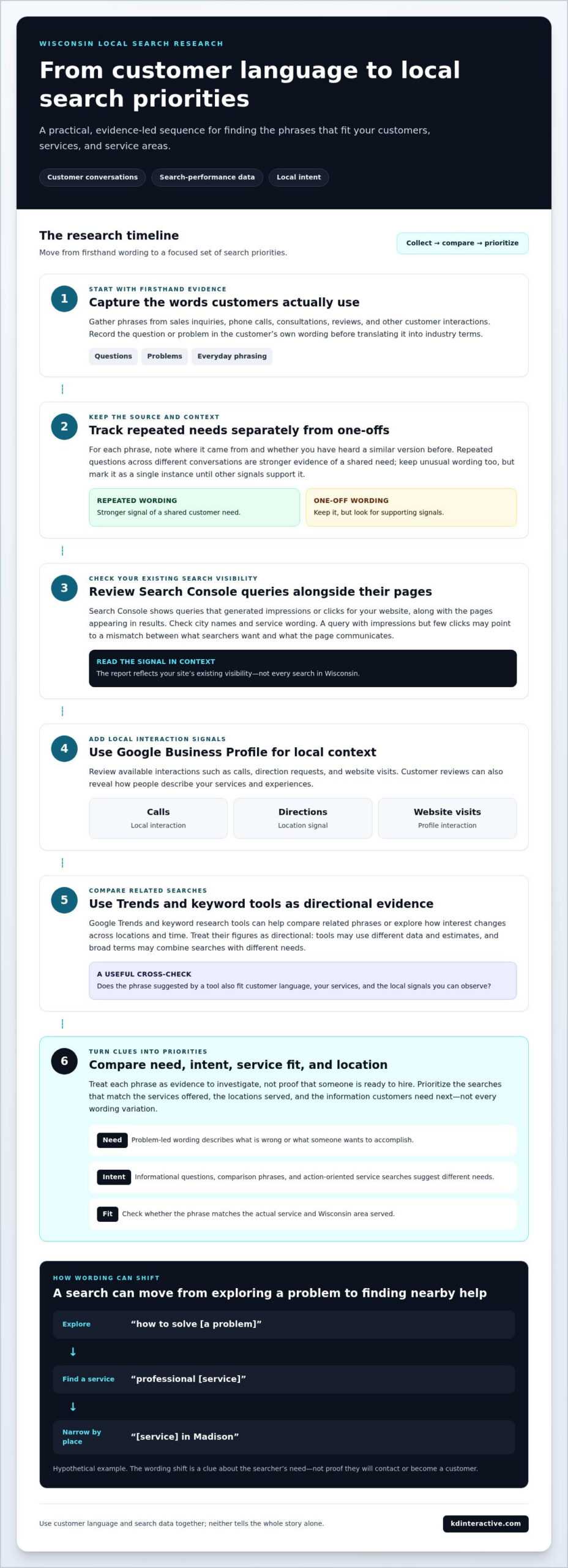
A Practical Workflow for Turning Local Search Research Into Priorities
Research becomes useful when it leads to a clear decision: what to address first, where it belongs, and how you’ll judge its performance. This workflow helps small and multi-location businesses in Wisconsin move from a collection of phrases to a manageable, measurable search plan.
- Collect phrases in one working list. Bring together wording from customer conversations, search-performance reports, Google Business Profile interactions, and keyword research tools. Record the source of each phrase so you can distinguish a customer’s exact language from a tool suggestion.
- Group phrases by shared need. Sort queries by the problem or goal behind them, then note the relevant service and likely intent. Keep close variants together when they express the same need. Creating a separate page for every wording variation can add unnecessary work and make your content less focused.
- Add the Wisconsin geography. Identify whether a phrase names a city, refers to a nearby provider, or has no clear location signal. Check each place against the areas your business serves. For a multi-location business, organize queries by the location they genuinely relate to, rather than adding city names indiscriminately.
- Choose a manageable first group. Prioritize queries that align with an actual service, a relevant Wisconsin audience, and a clear business goal. Give more weight to ideas supported by multiple sources. Mark uncertain phrases for further observation instead of treating every suggestion as a priority.
- Match each priority to a page or content idea. Connect service-selection queries to a relevant service page. Match early research questions with a useful article or other planned content. Before creating a new page, consider whether an existing one can answer the query clearly. A focused local SEO strategy can help align these choices with the locations and services that matter to your business.
- Track separate performance signals. Set a baseline, then review rankings, website traffic, user behavior, and conversions as distinct measures. Rankings show search visibility, traffic shows visits, user behavior helps explain how visitors engage with pages, and conversions track meaningful actions. Together, they offer a more useful picture than any one metric alone.
Keep your working list simple: query group, customer need, service, intent, Wisconsin location, evidence source, target page, and next review. This makes it easier to revisit priorities as customer language and performance data emerge. Learning how to find out what local customers are searching for is an ongoing process, but the first step can be a focused group of well-supported queries, not an attempt to target everything at once.
If you’d like help turning your research into a tailored local SEO plan, request a FREE Consultation with KD Interactive.
How KD Interactive Helps Wisconsin Businesses Find Local Search Opportunities
Finding useful search opportunities takes more than collecting keyword suggestions. Small and multi-location businesses in Wisconsin need research that connects customer language with the services they provide, the areas they serve, and the goals they want their online presence to support. KD Interactive’s Keyword Research is part of a broader, tailored Local SEO Services approach that turns those signals into a practical direction for ongoing work.
What a Tailored Local Keyword Research Partnership Looks Like
KD Interactive starts with the individual business, not a generic list of popular phrases. Customer language, search-performance data, services, business goals, and Wisconsin locations all help shape the research. Local knowledge matters because the right priorities depend on the business and the communities it serves. Clear communication keeps the reasoning visible, so decisions are made collaboratively rather than handed over as an unexplained list of keywords.
Research can inform relevant content creation and on-page optimization. For example, a query group that reflects a specific customer need may point to an opportunity to improve a service page or develop useful supporting content. The aim is to connect each recommendation to a real business offering and local audience, rather than create pages simply to include more keyword variations.
The work continues as performance data and customer behavior provide new context. KD Interactive tracks rankings, website traffic, user behavior, and conversions as separate signals. Rankings indicate search visibility, traffic shows visits, user behavior offers insight into how visitors interact with the site, and conversions measure meaningful actions. Reviewing these together supports informed adjustments without treating any one measure as the whole story.
What Wisconsin Businesses Can Expect From the Next Step
A FREE Consultation gives a small or multi-location business in Wisconsin an opportunity to discuss its services, local search goals, and the questions it wants its research to answer. It’s a practical way to explore how customer-language insights and search data could inform an individualized plan. The conversation can focus on where the business operates, which offerings matter most, and what performance signals are useful to track.
SEO takes time, and results vary by business and its circumstances. KD Interactive’s stated timeline is improvements in 3-6 months and full results in 6-12 months. These timeframes aren’t a promise of a particular ranking or outcome. Ongoing measurement helps show how visibility, visits, behavior, and conversions are changing, and where the strategy may need attention.
Turn what you’ve learned about how to find out what local customers are searching for into a focused Wisconsin plan by discussing your business and its priorities with KD Interactive.
Talk with KD Interactive about local search opportunities
Turn Your Local Search Insights Into a Clear Next Step
Search research can become a practical growth tool when it guides decisions about where to focus next. Start with an opportunity that fits your services and Wisconsin audience, then use what you learn to refine your direction over time. You don’t need to solve every search question at once.
If you’re still weighing how to find out what local customers are searching for, a conversation with a Wisconsin-focused partner can help turn your research into priorities. KD Interactive specializes in tailored local SEO for small businesses in Wisconsin and tracks rankings, website traffic, user behavior, and conversions to understand performance. Client testimonials from Anden Business Systems, Link It Call Center, and Y’s Way Flooring offer additional perspective on working with the agency.
Take the next step with a plan shaped around your business, customers, and service areas. Request a FREE Consultation with KD Interactive, and move forward with greater clarity and confidence.
Frequently Asked Questions
How can I see what people are searching for in my area?
Combine several local clues rather than relying on one report. Check your website’s Search Console queries, review customer questions and feedback, and compare common phrases in Google’s search suggestions for the services you provide. Search a phrase with a Wisconsin city name and note the types of pages that appear. Results are clues about what Google considers relevant, not a complete record of every search in your area.
Can Google Search Console show what local customers are searching for?
Yes. Search Console shows queries that generated impressions or clicks for your website, revealing what searchers already use to find your pages. Review query, page, date, and device data in the Performance report. It doesn’t show every search in your market, and its location reporting isn’t a reliable city-by-city query breakdown. Pair its findings with direct customer feedback and local context.
How do I find local search terms without using paid keyword tools?
Start with sources you already have access to: customer calls, service inquiries, reviews, Search Console, and Google’s search suggestions. Write down phrases customers use and questions they ask, then compare them with searches already associated with your website. A spreadsheet can help you record each phrase’s source and service relevance. This approach won’t estimate total demand, but it can uncover real customer wording worth investigating.
Does “near me” matter when researching local customer searches?
Yes, it’s worth checking, but don’t make it the only phrase you target. A person may search for a service without typing “near me” because Google can use the searcher’s context to show nearby options. Compare “near me” searches with versions that name a Wisconsin city or just the service. Use natural wording in useful page content rather than repeating “near me” unnaturally.
How often should a small business review its local search queries?
A monthly review is a practical starting point for a small business, with a deeper check each quarter to spot patterns and decide whether priorities should change. Review sooner after adding a service, updating a location page, or seeing a noticeable change in inquiries. Compare similar periods where possible, since customer needs can shift with seasonality. Keep a brief record of what changed and why, so each review informs the next one.
Can customer reviews help reveal what people search for?
Reviews can reveal the words customers use to describe a service, a concern, or the result they valued. Repeated mentions of a particular issue may suggest a useful question to research or address in content. But reviews aren’t a report of the exact Google searches customers made. Treat them as qualitative evidence, compare recurring themes with query data, and don’t add keywords to review responses unnaturally.
How long does local SEO take to show improvements?
KD Interactive states that businesses may see improvements in 3-6 months, with full results in 6-12 months. The timeline depends on factors such as competition and industry, and it isn’t a promise of a particular ranking or outcome. Track rankings, website traffic, user behavior, and conversions to understand progress from different angles. A change in one measure alone may not show whether the overall strategy is serving the business well.