
Did you know that 46% of all Google searches now have local intent, and 43% of those queries trigger AI Overviews that pull directly from Google Business Profile data? Managing local seo for multi-location businesses shouldn’t feel like a constant battle against inconsistent data or the stress of managing reviews for five different places at once. It’s exhausting when your Madison branch ranks for the wrong city or your Milwaukee location disappears from the Map Pack because of a verification glitch. You need a strategy that works as hard as you do, without requiring you to manually update every single listing every time a policy changes.
We understand the pressure of scaling a regional brand while trying to maintain that personal, local touch. You’re about to learn how to dominate local search results for every one of your business locations without doubling your workload. This guide provides a unified 2026 strategy that streamlines your operations, improves your visibility across Wisconsin, and delivers measurable lead growth for every branch in your portfolio. From navigating stricter verification processes to mastering the new review policies, we’ll show you how to build a scalable system for long-term success.
Key Takeaways
- Understand the fundamental shift in how search engines treat multi-location brands and why geographic precision is the key to 2026 growth.
- Discover how to structure your website using subfolders or subdomains to maximize crawlability and search visibility for every branch you operate.
- Learn to scale your presence in the Google Map Pack with AI Assistant, a vital tool for mastering local seo for multi-location businesses.
- Identify and fix “Review Silos” to ensure that a single struggling location doesn’t drag down your brand’s overall digital authority.
- Gain a competitive advantage by aligning your strategy with regional market nuances in specific territories like Milwaukee and Watertown.
What is Multi-Location SEO and Why Does It Matter in 2026?
Multi-location SEO is the strategic process of optimizing a single brand to appear in search results across several distinct geographic areas. While Local search engine optimization (local SEO) traditionally focuses on a single storefront, multi-location strategies require a scalable engine that manages dozens or hundreds of digital profiles simultaneously. It’s about ensuring your brand is the first choice whether a customer is searching from a downtown office or a suburban living room. Effective local seo for multi-location businesses ensures that every branch maintains its own identity while benefiting from the authority of the parent brand.
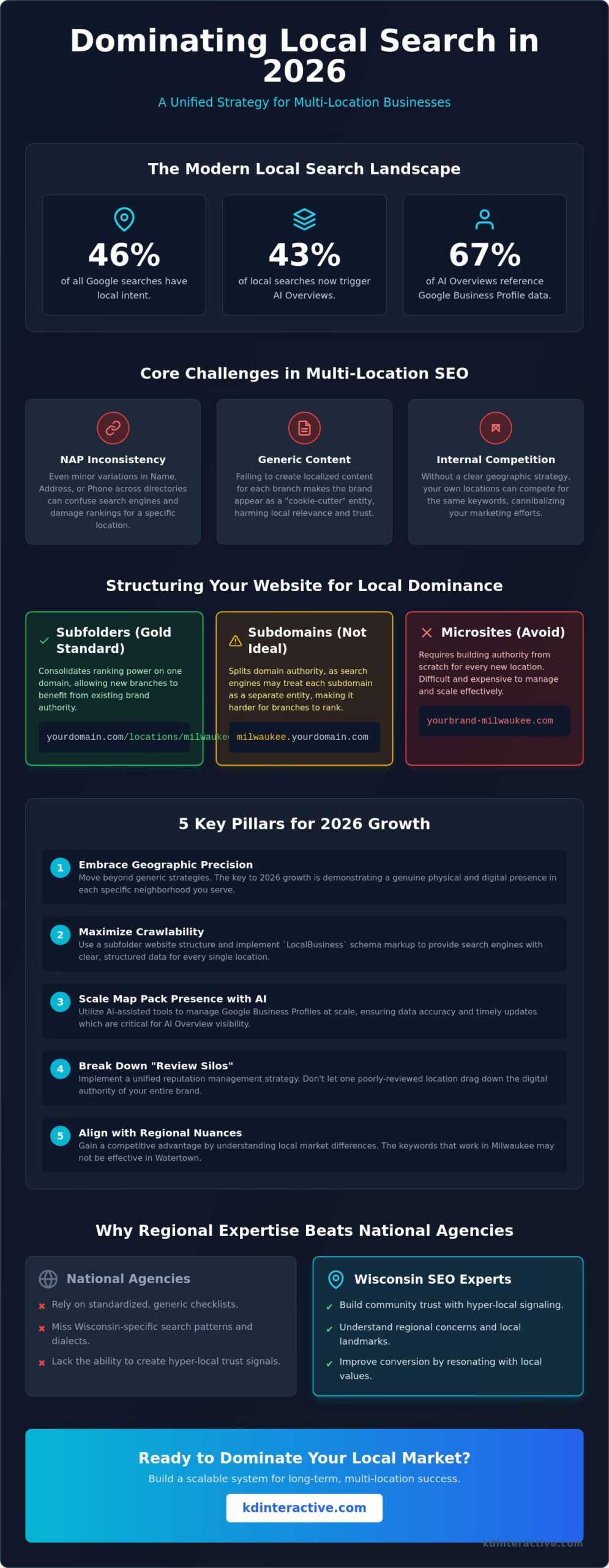
Success in 2026 hinges on two pillars: proximity to the searcher and entity authority. Google’s algorithms have evolved to prioritize businesses that demonstrate a genuine physical and digital presence in a specific neighborhood. With 46% of all Google searches now carrying local intent, the stakes have never been higher. Furthermore, 43% of local searches now trigger AI Overviews, which rely heavily on structured data. These AI summaries reference Google Business Profile data 67% of the time, making your multi-location accuracy a non-negotiable asset. A generic approach fails because it ignores the nuances of different markets. For instance, the keywords that drive traffic in a bustling hub like Milwaukee often differ significantly from the search patterns in a community like Watertown. If you treat every branch the same, you’re essentially invisible to half your audience.
The Core Challenges of Managing Multiple Locations
Why Regional Expertise Beats National Agencies
National agencies often rely on standardized checklists that miss the mark in specific territories. They don’t understand Wisconsin-specific search patterns or the regional dialects that influence how people look for services in our state. Investing in local digital marketing allows you to build community trust through hyper-local signaling. When your content mentions local landmarks, neighborhood events, or regional concerns, it signals to both Google and your customers that you’re a neighbor, not just a vendor. This regional focus improves conversion rates because it resonates with the specific values and expectations of local customers in Milwaukee, Madison, and beyond.
Structuring Your Website for Local Dominance
Your website’s structure acts as the digital blueprint for your expansion. If the foundation is disorganized, search engine bots will struggle to crawl your deeper pages, leaving your individual branches invisible. For local seo for multi-location businesses, you must decide how to organize your location data to maximize this crawlability. Most businesses choose between subdomains, microsites, or subfolders, and this choice determines how easily your authority flows from the main brand to each local storefront.
Subdomains often split your authority, making it harder for individual branches to rank because Google may treat them as separate entities. Microsites are even more difficult to manage; they require you to pay for multiple hosting accounts and build authority from scratch for every new city. Subfolders, such as /locations/milwaukee/, remain the gold standard for small-to-mid-sized brands. This approach consolidates your ranking power onto one domain, allowing a new branch to piggyback off your existing success. These foundational local marketing strategies ensure your brand remains cohesive while targeting specific neighborhoods in Wisconsin.
Schema Markup is the secret weapon for teaching search engines about your physical footprint. By implementing LocalBusiness schema, you provide AI bots with structured data about each location’s address, phone number, and operating hours. This clarity reduces the risk of your Watertown branch ranking for Milwaukee searches. If you aren’t sure if your current site is built for this, you can request a professional site audit to identify technical gaps and performance opportunities.
The Anatomy of a High-Converting Location Page
Internal Linking for Local Authority
Internal linking transfers authority from your high-traffic service pages to your specific location pages. Breadcrumbs provide a clear, hierarchical path that allows both users and AI bots to understand the relationship between a specific location and the broader brand structure. This logical flow is built upon professional web and seo services that prioritize user experience and search performance. By linking your “Plumbing Services” page directly to your “Madison Plumbing” location page, you tell Google which branch is most relevant to a local searcher’s needs.
Scaling the Google Map Pack with AI Assistance
The Google Map Pack remains the most valuable real estate in search results. For brands with multiple branches, appearing in the top three results for every city is a significant logistical challenge. Google Business Profile (GBP) signals now account for 32% of local ranking factors, meaning you can’t afford to let these profiles sit idle. This is where the Google Map Pack with AI Assistant becomes your most valuable asset. It bridges the gap between corporate scale and neighborhood relevance, allowing you to manage a high volume of data with precision.
Engagement signals like Google Posts and photo updates are critical in 2026. Frequent posting signals to Google that your location is active and “open” for business. AI can automate these updates across all your branches, ensuring that a special offer in Milwaukee doesn’t accidentally get promoted in Watertown. It allows you to maintain a high cadence of activity without spending your entire day in the GBP dashboard. This automation is a cornerstone of successful local seo for multi-location businesses, as it ensures consistency across the board while freeing up your team for higher-level strategy.
Managing Multiple Google Business Profiles
Verification is more stringent in 2026. Google often requires video verification to prove you have physical access to the building and equipment. When managing local seo for multi-location businesses, you must verify each site individually without triggering spam flags. Start by following our guide on how to set up a Google Business page to ensure your foundation is solid. Once verified, upload unique, high-quality photos for each branch. Avoid stock images. Customers want to see the actual storefront they’ll visit in Madison or the specific team they’ll meet in Watertown.
Leveraging AI for Local Engagement
AI doesn’t just push content; it listens. Use AI to analyze local search trends and identify location-specific keywords that your competitors are missing. If searchers in Milwaukee are suddenly looking for “emergency furnace repair” while those in Watertown are focused on “preventative maintenance,” your profiles should reflect that shift. AI assistants also help draft responses to common customer questions in the Q&A section. This ensures your brand remains responsive and helpful. The key is to keep the voice pragmatic and results-oriented. You want to provide clear, direct answers that build trust. By automating the routine, you free up your time to handle complex customer interactions that require a truly human touch.
Reputation Management: The Secret to Multi-Location Rankings
Reviews aren’t just feedback; they’re high-octane ranking signals. In 2026, review signals account for 16% of how Google determines local rankings. If your Milwaukee branch maintains a 4.8-star rating while your Watertown location languishes at 3.2, you’re facing a “Review Silo” problem. This inconsistency doesn’t just hurt one branch; it creates a gap in your brand’s overall entity authority. High review velocity and diversity across every single profile are essential for local seo for multi-location businesses to succeed. When 87% of consumers read reviews before visiting a local business, your digital reputation becomes your most effective sales tool.
Many owners worry that managing reviews for five or more locations is too much work. This perspective often leads to neglect, which search engines interpret as a lack of engagement. You don’t need to spend hours every day typing manual responses to see results. By treating reputation management as a centralized engine rather than a series of scattered tasks, you can maintain high standards across all Wisconsin territories. Consistent, positive feedback builds a layer of localized trust that national competitors simply can’t replicate. If you want to see where your brand stands today, you should book a comprehensive reputation audit to identify which locations need immediate attention.
Automating the Review Request Process
Modern reputation management requires a system that triggers review requests at the point of sale. However, you must stay compliant with the April 2026 Google Business Profile updates. You can no longer use on-premises kiosks or shared tablets to solicit reviews while the customer is still at your business. Instead, use automated SMS or email follow-ups that reach the customer shortly after they leave. When responding to negative feedback, be pragmatic and solution-oriented. Address the specific concern to save the relationship. Never copy-paste the same generic response across different locations. Google’s algorithms are sophisticated enough to recognize canned responses, and customers find them insincere.
Building Local Citations at Scale
Citations remain a foundational element of local search, contributing to 7% of ranking factors. The “Big Four” data aggregators still play a massive role in 2026 by distributing your NAP (Name, Address, Phone) data to hundreds of smaller sites. For Wisconsin brands, identifying niche regional directories is equally important for signaling local relevance. Whether it’s a local chamber of commerce or a state-specific industry list, these links prove you’re a legitimate part of the community. A successful local seo services near me strategy must include regular citation cleanup to ensure that old addresses or disconnected phone numbers don’t haunt your rankings. Accuracy at scale is the only way to maintain a dominant digital footprint.
Partnering with a Wisconsin SEO Expert for Growth
Partnering with a Wisconsin SEO expert provides a level of regional insight that national agencies simply cannot match. While a firm in another state might see Milwaukee and Watertown as just two points on a map, we understand the local competitive landscape and the specific search behaviors of Wisconsin consumers. Scaling local seo for multi-location businesses requires more than just a checklist; it demands a partner who is as invested in your branch’s performance as you are. We take a pragmatic, results-oriented approach that prioritizes measurable lead growth and transparent data tracking across every territory you serve.
Our strategy is built on confidence and regional expertise. We don’t just guess which keywords will work for your Madison or Milwaukee branches. We use methodical SEO Keyword Analysis to identify exactly where your opportunities lie. By combining our deep roots in the community with rigorous data tracking, we ensure that every marketing dollar spent contributes to your expansion. Transparent reporting means you’ll see the exact performance of every branch, from your main headquarters to the smallest satellite office.
The KD Interactive Advantage
We’ve helped numerous Wisconsin entrepreneurs grow their brands from a single storefront to a thriving multi-location network. Our Google Map Pack with AI Assistant is specifically designed to handle the heavy lifting of profile management, saving you hours of manual work every week. This tool ensures your data remains accurate and your engagement stays high, even as you scale to new cities. If you’re ready to see how your current digital footprint measures up, you can request a professional assessment of your multi-location presence today. We’ll provide a clear, data-driven look at your visibility and identify the technical gaps holding you back.
Your Roadmap to Multi-Location Dominance
Success doesn’t happen by accident; it requires a structured plan. We guide our clients through a logical progression that turns search visibility into a scalable asset. Our proven process includes:
- The First 90 Days: We focus on a comprehensive audit, citation cleanup, and site structure optimization to fix the technical errors and inconsistent NAP data that hinder rankings.
- Ongoing Optimization: Our team manages localized Content Creation, monitors review velocity, and utilizes AI monitoring to stay ahead of algorithm shifts and competitor moves.
It’s time to stop managing your locations in silos and start building a unified growth engine that dominates the Wisconsin market. This methodical system ensures that your local seo for multi-location businesses remains a competitive advantage rather than an operational burden. Schedule your multi-location SEO consultation today and let’s get to work on your next phase of expansion.
Scale Your Brand Across the Wisconsin Market
Winning in the local market requires a methodical system that scales with your ambition. We’ve explored how a strong subfolder structure and consistent citation management form the backbone of a dominant digital presence. By leveraging tools like our proprietary Google Map Pack with AI Assistant, you can maintain high engagement across all your profiles without sacrificing your valuable time. Mastering local seo for multi-location businesses is about creating a centralized engine that drives neighborhood-level results for every branch you open.
You don’t have to navigate these complex algorithm shifts alone. Our team specializes in the Milwaukee and Watertown markets, providing the pragmatic, data-driven results that regional businesses need to compete with national giants. We’ve spent years helping entrepreneurs grow from single shops to statewide networks by focusing on measurable outcomes and transparent reporting. It’s time to stop guessing and start growing with a partner who understands your roots and your goals.
Ready to dominate the Map Pack? Get your multi-location SEO audit from KD Interactive. We’re ready to help you build a digital legacy that lasts for years to come.
Frequently Asked Questions
How do I rank for multiple cities with just one website?
You rank for multiple cities by building a robust hierarchy of location-specific pages on your primary domain. Each page should target a specific geographic area like Milwaukee or Madison. This approach allows search engines to associate your brand with multiple physical addresses while concentrating your domain authority. It’s a foundational step in local seo for multi-location businesses that ensures you appear in local results without needing separate websites for every branch.
Should I use a different phone number for each business location?
Yes, you should use a unique local phone number for every physical storefront. Local area codes act as a strong geographic signal to search engines and build immediate trust with residents in cities like Watertown. Using a single toll-free number for all branches can dilute your local relevance. Ensure these numbers are consistent across your website, Google Business Profiles, and all third-party directories to maintain perfect NAP data.
Does every location need its own Facebook and Instagram page?
Most brands find success with one primary corporate page supplemented by location-specific posts rather than managing dozens of individual accounts. Managing many individual Instagram pages often leads to neglected profiles and inconsistent branding. Instead, use your main account to highlight specific branches using location tags and neighborhood-specific content. This strategy maintains a high level of engagement while preventing your marketing team from becoming overwhelmed by social media management.
What is the best website structure for a multi-location business in 2026?
Subfolders are the most effective structure for managing multiple locations on a single domain. Organizing your site as yourbrand.com/locations/milwaukee/ keeps all your ranking power in one place. This makes it easier for search bots to crawl your site and understand your geographic footprint. It also simplifies the implementation of Schema Markup, which acts as a critical tool for teaching AI bots about your various physical addresses and service areas.
How do I handle negative reviews for only one of my locations?
Address negative reviews directly on the specific Google Business Profile where they were posted. A single location with poor ratings creates a “Review Silo” that can damage your overall brand reputation if left unaddressed. Be pragmatic in your response; apologize for the specific issue and offer a clear path to resolution. This demonstrates to future customers in that city that your branch is accountable and committed to professional, supportive service.
Can AI really manage my Google Map Pack profiles effectively?
AI can effectively manage the repetitive tasks associated with your Map Pack profiles. Our Google Map Pack with AI Assistant drafts location-specific posts and monitors search trends to keep your profiles active. This technology allows you to maintain a high cadence of engagement across 10 or 50 locations simultaneously. It ensures that your Milwaukee branch and your Watertown branch both receive the attention they need to stay at the top of local search results.
Do I need unique content for every single location page?
Unique content is non-negotiable for every location page you publish. Search engines will often ignore or penalize pages that use “cookie-cutter” text copied from other branches. You must include details about local services, neighborhood landmarks, and specific regional expertise. This level of detail proves to search engines that your business is a legitimate part of the local community. It also provides a better, more personalized experience for customers looking for specific help in their city.
How long does it take to see results for a new business location?
You can typically expect to see measurable growth in local visibility and lead generation within three to six months. The exact timeline depends on the competitive density of your specific market and the current state of your digital footprint. A new location in a high-competition area like Milwaukee might take longer to rank than one in Watertown. Consistent effort in local seo for multi-location businesses ensures these results are sustainable and continue to grow.