
Your competitor down the street just claimed the top spot in Google’s Map Pack, and they’re getting the calls that should be coming to you. If you’ve ever searched for a local service and clicked one of the first three results without scrolling further, you already understand the power of local SEO for small business owners. The frustrating truth is that most small businesses are losing customers to national chains and savvier local competitors, not because their service is worse, but because they’re simply invisible online.
You’re not wrong to feel like the digital marketing world is stacked against you. Between confusing technical jargon, limited time, and the sheer weight of competing against brands with massive advertising budgets, it can feel like an uphill battle before you’ve even started.
This guide cuts through the noise. By the time you finish reading, you’ll understand exactly how local search works in 2026, why AI-verified trust signals have become the new battleground for map dominance, and what practical steps you can take to start driving more calls, more foot traffic, and more real growth to your business.
Key Takeaways
- A winning local seo for small business strategy in 2026 goes far beyond a basic website — it requires a coordinated approach across your Google Business Profile, local keywords, and AI-assisted optimization tools.
- The Google Map Pack captures roughly 40% of all clicks on local search results, making it the single most valuable piece of digital real estate your small business can target.
- Customer reviews are now a primary ranking factor, and businesses with a consistent system for generating authentic feedback hold a measurable edge over competitors who leave this to chance.
- AI-assisted tools like the Google Map Pack with AI Assistant give small businesses the ability to make smarter, real-time optimization decisions that were once reserved for brands with large marketing teams.
- Working with a Wisconsin-based local SEO partner means your strategy is built on genuine community knowledge — the kind of hyper-local insight that national agencies simply cannot replicate.
Understanding Local SEO for Small Business in 2026
Think of local SEO as the digital bridge between someone typing a search query and walking through your front door. It’s a distinct discipline from traditional SEO, built specifically to connect businesses with nearby customers who have immediate intent to buy, visit, or call. When someone searches “best plumber near me” or “coffee shop open now,” they’re not browsing. They’re ready to act. Local SEO positions your business to be the answer they find.
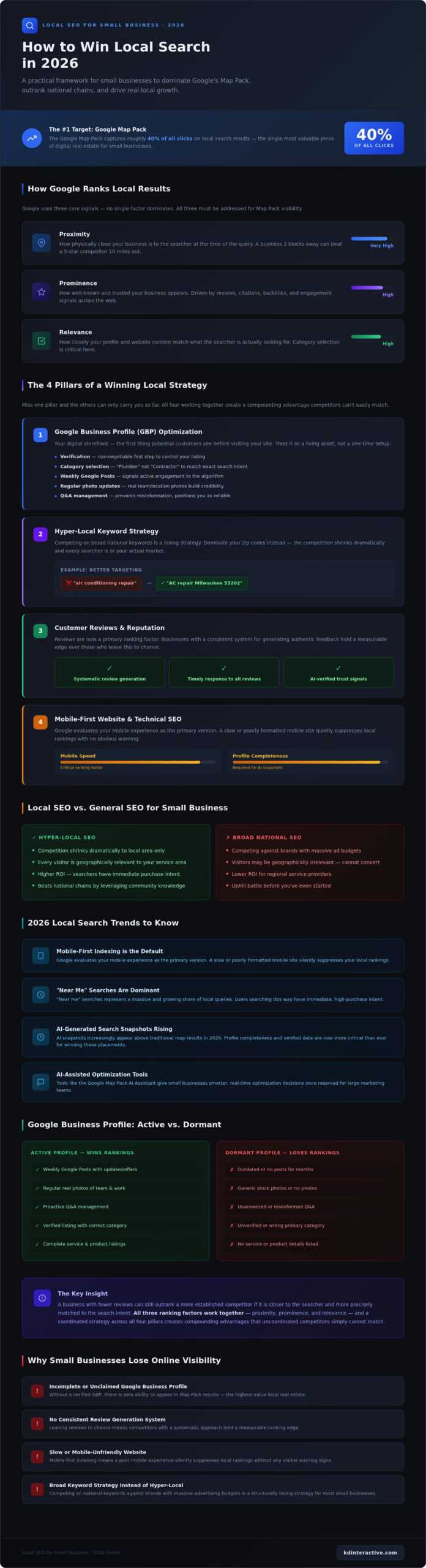
At its core, local SEO for small business operates on three ranking signals that Google uses to determine which businesses appear in location-based results:
- Proximity: How close your business is to the searcher’s physical location at the time of the query.
- Prominence: How well-known and trusted your business appears based on reviews, citations, links, and engagement signals.
- Relevance: How closely your business profile and website content match what the searcher is actually looking for.
No single factor dominates. Google weighs all three together, which is why a business with fewer reviews can still outrank a more established competitor if it’s closer to the searcher and more precisely matched to the search intent.
The Evolution of Local Search Intent
Mobile-first indexing has fundamentally changed how local visibility is determined. Google now evaluates your site’s mobile experience as the primary version, not the desktop version. For small businesses, this means a slow-loading or poorly formatted mobile site can quietly suppress your local rankings without any obvious warning. “Near me” searches have grown into a dominant search pattern, and in 2026, AI-generated search snapshots are increasingly appearing above traditional map results, making profile completeness and verified data more critical than ever. The businesses winning these placements aren’t just listed in directories; they’re maintaining dynamic, interactive profiles that signal active engagement to the algorithm.
Why General SEO Isn’t Enough for Small Businesses
Competing against national brands on broad keywords is a losing strategy for most small businesses. A regional HVAC company in Milwaukee doesn’t need to rank nationally for “air conditioning repair.” It needs to dominate its zip codes. That’s the fundamental advantage of hyper-local SEO: the competition shrinks dramatically, and the intent of every searcher you reach is geographically relevant to your service area. A well-executed local seo for small business strategy consistently delivers a higher return on investment for regional service providers than broad organic campaigns, because every click represents someone in your actual market, not a visitor who can’t convert.
The Core Pillars of a Successful Local Strategy
Local search visibility doesn’t come from one well-placed listing or a single keyword tweak. It’s built on four interconnected pillars that work together to signal trust, relevance, and authority to Google. Miss one, and the others can only carry you so far. Get all four right, and you create a compounding advantage that competitors without a coordinated approach simply can’t match.
Optimizing Your Google Business Profile
Your Google Business Profile is the first thing most potential customers see before they ever visit your website. Think of it as your digital storefront window: if it looks incomplete or outdated, people keep walking. Verification is the non-negotiable first step. Without it, you have no control over your listing and no ability to rank in the Map Pack.
Category selection matters more than most business owners realize. Google uses your primary category as a core relevance signal, so choosing “Plumber” instead of the broader “Contractor” can meaningfully shift which searches you appear in. Beyond the basics, the businesses consistently winning local placements are the ones treating their GBP as a living asset:
- Google Posts: Publishing weekly updates, offers, or service highlights signals active engagement to the algorithm and gives searchers a reason to choose you over a dormant competitor profile.
- Photo updates: Regularly adding real photos of your team, location, and completed work builds credibility that stock images never can.
- Q&A management: Proactively answering common questions prevents misinformation and positions your profile as a reliable resource.
- Service and product listings: Filling out every available field increases your relevance match across a wider range of search queries.
If you’re starting from scratch or want to do this correctly the first time, this step-by-step guide to setting up a Google Business Page walks through the full process in plain language.
Local Keyword Analysis for Niche Markets
Broad keywords are a dead end for most small businesses. The real opportunity sits in high-intent, geographically specific phrases that reflect how your actual customers search. A Milwaukee landscaping company doesn’t need to chase “lawn care.” It needs to own “lawn care service Wauwatosa” or “spring cleanup Brookfield WI.”
The “service plus location” structure is the backbone of effective local seo for small business keyword research. These phrases carry strong purchase intent and face far less competition than their generic counterparts. Practically, this means:
- Mapping keywords to specific service pages rather than trying to rank one page for everything.
- Using neighborhood and suburb-level terms in addition to city-wide targets, especially in dense markets like Milwaukee or Madison.
- Mining your own Google Business Profile insights to see what search terms are already driving views to your listing.
- Informing your blog content calendar with questions and phrases your local audience is actually asking, not just what national keyword tools suggest.
NAP consistency and local link building round out the remaining pillars. Your Name, Address, and Phone number must appear identically across every directory, citation, and social profile. A single discrepancy, like “St.” on your website and “Street” on Yelp, creates conflicting signals that erode Google’s confidence in your business data. Local link building operates on the same trust principle: earning backlinks from Wisconsin chambers of commerce, regional news outlets, or community organizations tells Google you’re a legitimate, embedded part of your local market.
Building all four pillars simultaneously is where most small businesses stall out. If you’d like a clearer picture of where your current strategy stands, connect with the local SEO team at KD Interactive for a practical assessment grounded in the Wisconsin market.
Dominating the Google Map Pack with AI Assistance
Three businesses. That’s all Google shows in the Map Pack for any given local search. Those three listings capture roughly 40% of all clicks on local results, meaning the vast majority of searchers never scroll past them. For a small business owner, earning one of those spots isn’t just a nice-to-have; it’s often the difference between a phone that rings and one that doesn’t.
What’s changed in 2026 is how businesses compete for those positions. The days of set-it-and-forget-it profile optimization are over. Google’s local algorithm now rewards active, data-informed management, and AI-assisted tools have become the practical way for small businesses to keep pace without hiring a full marketing department.
The Role of AI in 2026 Local Search
AI doesn’t replace strategy; it accelerates it. In the context of local seo for small business, AI tools now do three things that used to require significant manual effort:
- Predictive trend analysis: AI can surface emerging local search patterns before they peak, giving you a window to optimize your profile and content ahead of competitors who are still reacting after the fact.
- Automated profile maintenance: Routine tasks like flagging inconsistent business information, monitoring for unauthorized edits to your Google Business Profile, and tracking competitor ranking shifts can all be handled automatically, freeing your time for the work that actually requires human judgment.
- Smarter customer touchpoints: AI-enhanced profiles can surface more relevant answers to searcher queries directly in the Map Pack, improving the experience for potential customers before they even visit your website.
The businesses holding top-three Map Pack positions in competitive Wisconsin markets aren’t guessing at what’s working. They’re using real-time data to make decisions that are two or three steps ahead of competitors still relying on manual audits done once a quarter.
KD Interactive’s Pragmatic Approach to Maps
KD Interactive’s Google Map Pack with AI Assistant is built on a straightforward premise: AI tools are only as useful as the strategy behind them. The approach combines automated ranking gap analysis with hands-on local expertise rooted in the Milwaukee and Madison markets. That combination matters because an AI tool calibrated for national averages won’t catch the neighborhood-level nuances that determine rankings in a market like Wauwatosa or Brookfield.
In practice, this means clients receive regular performance reports that translate data into plain-language action items, not dashboards full of metrics that require a specialist to interpret. Ranking positions, visibility trends, and profile engagement signals are tracked consistently, so strategy adjustments happen before a competitor capitalizes on a gap rather than after you’ve already lost ground.
For small businesses serious about map dominance, the question isn’t whether AI-assisted optimization is worth it. It’s whether you want to be the business using it or the one competing against it.
Reputation Management and Brand Authority
Reviews aren’t just social proof anymore. In 2026, they’re a direct ranking signal that Google weighs when deciding which businesses earn Map Pack placement. The volume, velocity, and diversity of your reviews all feed into the prominence component of Google’s local algorithm, which means a business with 15 fresh, detailed reviews from the past month will consistently outperform a competitor with 200 reviews that stopped coming in two years ago. This is the technical link that most general advice on trust and credibility completely ignores.
The Power of Online Review Management
Waiting for happy customers to leave reviews on their own is a losing strategy. The businesses dominating local search results in Milwaukee and Madison have built what amounts to a review acquisition funnel: a repeatable, low-friction system that turns satisfied customers into public advocates without feeling pushy or scripted.
A practical funnel looks like this:
- Timing your ask: Request a review at the moment of peak satisfaction, right after a job is completed or a service is delivered, not days later when the moment has passed.
- Reducing friction: Send a direct link to your Google review page. Every extra step between a customer and the review form costs you completions.
- Diversifying platforms: Google is the priority, but reviews on Yelp, Facebook, and industry-specific directories contribute to the diversity signals that strengthen your overall local authority.
- Responding to every review: Responding to positive reviews signals engagement. Responding to negative ones professionally demonstrates character, and it’s often the response, not the complaint, that shapes a prospective customer’s impression.
Negative reviews deserve a specific approach. Acknowledge the experience, offer a path to resolution, and keep your response brief and professional. A defensive or dismissive reply does more damage than the original complaint. Done well, a thoughtful response to a one-star review can actually build more trust than a page full of unchallenged five-star ratings.
Understanding how reputation management fits into your broader digital presence is worth exploring in depth. What Is Local Digital Marketing? breaks down how reviews connect to the wider ecosystem of channels that drive local visibility.
Press Releases as an SEO Tool
Most small business owners think press releases are for big corporations announcing mergers. They’re not. For a local seo for small business strategy, a well-distributed press release accomplishes something that no directory listing can: it earns backlinks from authoritative media outlets, which directly signals prominence to Google’s algorithm.
Strategic storytelling is the key. A new service launch, a community partnership, a local award, or a milestone anniversary all qualify as newsworthy when framed correctly. When that story gets picked up by regional news sites, local business journals, or Wisconsin-based publications, each link back to your site carries genuine ranking weight. It’s not about vanity coverage; it’s about building the kind of citation profile that tells Google your business is a recognized, established presence in its community.
KD Interactive’s Press Release Distribution service handles both the writing and the placement, connecting your business story to the outlets that actually move the needle in Wisconsin markets. Talk to the KD Interactive team about building your local brand authority through strategic press coverage.
Partnering with a Wisconsin Local SEO Expert
Everything covered in this guide — your Google Business Profile, local keyword strategy, Map Pack optimization, and review management — only delivers its full potential when it’s executed as a coordinated system by someone who understands your specific market. That’s where the difference between a national agency and a Wisconsin-rooted partner becomes impossible to ignore.
Regional Expertise vs. National Agencies
National agencies sell scalable processes. What they can’t sell is genuine familiarity with why a Brookfield homeowner searches differently than someone in Bay View, or why a Waukesha service business faces a different competitive landscape than its counterpart in Shorewood. Standardized, one-size-fits-all SEO packages are built around national averages and generic keyword models. They’re not wrong exactly; they’re just not built for you.
Wisconsin consumers have distinct search habits shaped by regional seasonality, community loyalty, and a preference for businesses that feel genuinely local rather than corporate. Capturing that requires more than keyword tools. It requires knowing the market from the inside. A local SEO for small business strategy built on that knowledge targets the right neighborhoods, the right search terms, and the right moments in your customers’ buying cycle.
KD Interactive’s work is grounded in the Milwaukee and Madison markets specifically. That means the insights driving your strategy come from real experience in your competitive environment, not templated assumptions borrowed from campaigns in Phoenix or Atlanta. Learn more about what genuinely local SEO services look like in practice.
Starting Your 2026 Growth Strategy
Most small business owners reach a point where DIY SEO stops delivering results proportional to the time it consumes. A professionally managed growth plan doesn’t just take tasks off your plate; it replaces guesswork with a documented roadmap built around your specific goals, your service area, and the competitive gaps that actually exist in your market.
The starting point is a thorough SEO assessment and keyword analysis. This isn’t a generic audit report full of color-coded scores. It’s a clear picture of where your visibility stands today, which opportunities are within reach in the near term, and what a realistic path to Map Pack placement looks like for your business category and location.
From there, the strategy is customized around what growth actually means for you: more calls, more foot traffic, more booked appointments. KD Interactive measures its own success against those outcomes, not against abstract metrics that look good in a report but don’t translate to revenue.
If you’re ready to move from reactive to strategic, consult with a Wisconsin local SEO specialist at KD Interactive and get a clear picture of what’s possible for your business in 2026.
Your Next Step Toward Local Market Dominance
Local search in 2026 rewards businesses that treat their digital presence as an active investment, not a one-time setup. A strong local seo for small business strategy connects every piece of the puzzle: a fully optimized Google Business Profile, hyper-local keyword targeting, a consistent review acquisition system, and the kind of AI-assisted Map Pack management that keeps you ahead of competitors still working from last year’s playbook.
The businesses winning in Milwaukee, Madison, and communities across Wisconsin aren’t bigger or better funded than yours. They’re simply more strategic. That’s an advantage you can close quickly with the right partner in your corner.
KD Interactive brings specialized Wisconsin market expertise, a proven track record of driving real local revenue, and the Google Map Pack with AI Assistant to give your business a genuine competitive edge. The path from invisible to in-demand starts with one conversation.
Dominate your local market with KD Interactive’s expert SEO services and make 2026 the year your phone starts ringing for the right reasons.
Frequently Asked Questions About Local SEO for Small Business
How much does local SEO for small business cost in 2026?
Local SEO pricing varies widely depending on your market, competition level, and the scope of services you need. A basic package covering profile optimization and citation management will cost less than a comprehensive strategy that includes content creation, press release distribution, and AI-assisted Map Pack management. Rather than quoting a number that may not reflect your specific situation, the most useful step is requesting a direct assessment so pricing can be tied to your actual goals and competitive landscape.
How long does it take to see results from local SEO services?
Most businesses begin seeing measurable movement in local rankings within three to six months, though competitive markets can take longer. Quick wins often appear first: improved Google Business Profile visibility, more profile views, and increased direction requests. Sustained Map Pack placement and organic ranking gains build over time as review volume grows, citations strengthen, and content accumulates authority. Businesses that treat local SEO as a continuous investment consistently outperform those expecting overnight results.
Is a Google Business Profile enough, or do I need a website too?
A Google Business Profile alone isn’t sufficient for a complete local SEO for small business strategy. Your profile drives Map Pack visibility, but a website gives Google additional signals about your services, location, and authority. It also gives searchers a destination to learn more before calling. Service pages, location-specific content, and mobile-optimized design all contribute ranking signals that a profile simply can’t replicate on its own. Both work together; neither fully substitutes for the other.
Can I do local SEO myself, or should I hire an agency?
DIY local SEO is possible, and some basics, like claiming your Google Business Profile and asking customers for reviews, are genuinely manageable without professional help. The challenge is that consistent execution across keyword research, citation building, content creation, and AI-assisted ranking analysis takes significant time and expertise. Most small business owners find that DIY efforts plateau quickly. A specialized agency brings tools, market knowledge, and coordinated strategy that typically delivers faster, more durable results than a solo approach.
What is the most important factor for ranking in the Google Map Pack?
There’s no single factor that overrides everything else. Google weighs proximity, prominence, and relevance together, and a weakness in any one area limits how far the others can carry you. That said, review velocity, meaning how consistently fresh reviews are coming in, is often the factor that separates businesses stuck at positions four through ten from those holding the top three spots. A complete, actively managed Google Business Profile paired with a steady review acquisition system is the most reliable foundation for Map Pack dominance.
How do I handle fake or unfair negative reviews on my profile?
Start by flagging the review directly in Google Business Profile using the “Report a problem” option. Google will evaluate whether it violates their policies. For reviews that don’t get removed, respond professionally and briefly: acknowledge the concern, clarify any factual inaccuracies without being defensive, and offer to resolve the issue offline. Prospective customers read your response as closely as the review itself, so a calm, constructive reply often does more to protect your reputation than the removal would.
What is the difference between local SEO and organic SEO?
Organic SEO targets broad, non-location-specific search rankings and is built to compete nationally or globally. Local SEO is specifically designed to connect your business with nearby searchers who have immediate, location-based intent. The tactics overlap in some areas, like quality content and backlinks, but local SEO adds layers that organic SEO doesn’t address: Google Business Profile optimization, NAP consistency across directories, local citation building, and Map Pack ranking strategy. For a small business serving a defined geographic area, local SEO delivers far more relevant traffic per dollar invested.
Does social media impact my local search rankings?
Social media doesn’t directly influence Google’s local ranking algorithm in the way that reviews or citations do. Its impact is indirect but real. Active social profiles can appear in branded search results, reinforcing credibility. Content shared on social platforms can earn links and drive traffic signals that Google notices. Consistent business information across your social profiles also contributes to the NAP consistency that local SEO depends on. Think of social media as a supporting channel that amplifies your local presence rather than a direct ranking lever.