
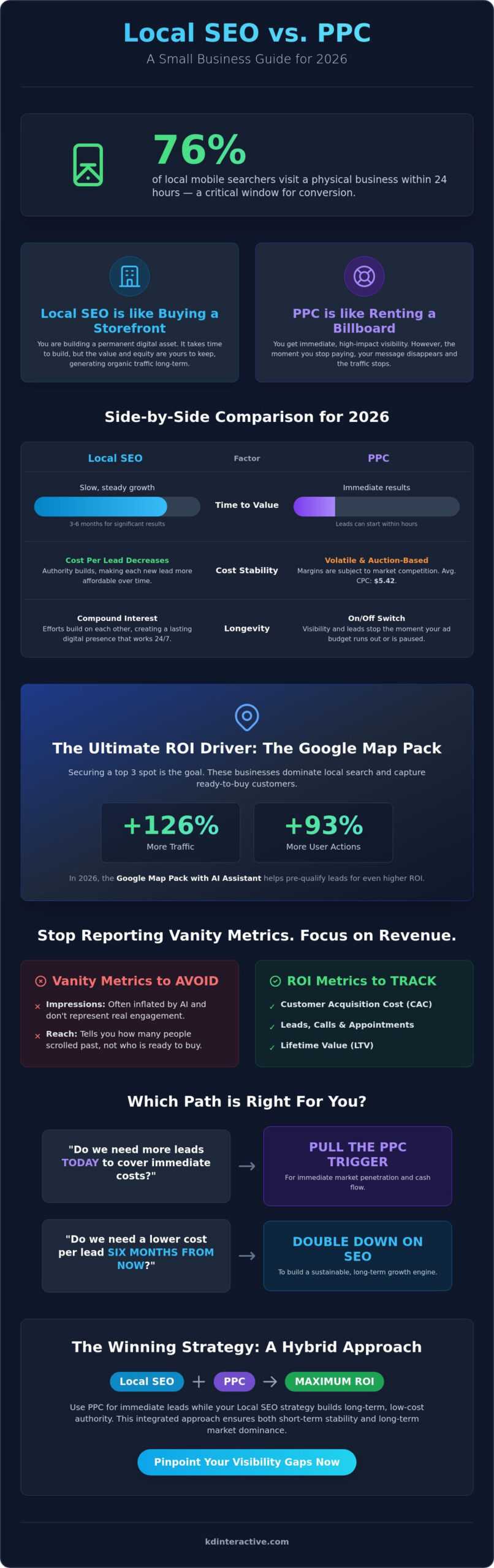
Did you know that 76% of people who conduct a local search on their smartphone visit a physical business within 24 hours? That is an incredible window for conversion, yet many owners still feel like they are throwing money into a digital black hole. You are likely tired of wasting your budget on clicks that don’t lead to calls while leadership demands hard proof of revenue. When weighing local seo vs ppc for small business in 2026, the choice often feels like a gamble between immediate traffic and long-term authority.
We believe your marketing spend should be a predictable engine for growth, not a source of stress. This article will help you discover whether Local SEO or PPC delivers the best return for your specific goals this year. You will learn how to secure a dominant position in the Google Map Pack and move past the confusing jargon used by national agencies. We provide a clear framework for your budget allocation so you can justify your investment to leadership and drive measurable local lead growth.
Key Takeaways
- Learn the fundamental difference between building a permanent search asset and renting temporary space for immediate visibility.
- Understand the critical trade-offs of local seo vs ppc for small business when comparing lead stability and time-to-value in markets like Milwaukee.
- Discover how to calculate Customer Acquisition Cost and Lifetime Value to prove real revenue growth to your leadership.
- Use our decision framework to analyze your current visibility gap and align your marketing spend with your long-term growth goals.
- Explore how specialized tools like our Google Map Pack with AI Assistant help you dominate local search results more effectively than generic national agencies.
The Language of Growth: Why Small Businesses Struggle to Choose
Small business owners in Wisconsin face a constant tug-of-war for their marketing budget. On one side, you have the immediate gratification of paid ads. On the other, the steady build of organic presence. Choosing between local seo vs ppc for small business isn’t just a technical decision; it’s a financial one. Think of Local SEO as buying a storefront in downtown Milwaukee. You own the equity, and while it takes time to renovate, the value stays with you. PPC is more like renting a billboard on I-94. It’s visible immediately, but the moment you stop paying the landlord, your message vanishes.
The 2026 search landscape has made this distinction even sharper. With Google’s May 2026 core update and the heavy integration of AI, the “free vs. paid” debate is outdated. Both paths require a strategic investment. Local search engine optimization (local SEO) demands high-quality content creation and consistent keyword analysis to stay relevant in the Google Map Pack. Meanwhile, PPC costs continue to climb, with the average Google Ads cost-per-click across industries hitting $5.42 this year. To make the right choice, you must move past the “Language Gap” where national agencies talk about clicks while you’re worried about payroll and regional expansion.
The Problem with Vanity Metrics in 2026
Stop reporting on “reach” or “impressions” to your leadership. These are noise metrics that your boss will likely ignore. In 2026, AI-driven search results can inflate your reach without ever touching your bank account. Your leadership wants to know about the Customer Acquisition Cost (CAC), not how many people scrolled past your ad. Over-reporting on data that doesn’t lead to a local sale in Madison or Green Bay creates a false sense of security. Focus on the metrics with a dollar sign: leads generated, calls made, and appointments booked through your Google Business Profile.
Aligning Search Strategy with Business Objectives
Your search strategy must map directly to your quarterly revenue targets. If your Wisconsin business needs cash flow this week to cover a new equipment lease, PPC is your tool. If you’re looking to dominate the Milwaukee market over the next three years, you should double down on Local SEO Services. Ask your leadership this one question: “Do we need more leads today, or do we need a lower cost per lead six months from now?” Their answer dictates your budget. Establishing this baseline of trust through transparent data reporting ensures everyone stays focused on professional achievement, not just digital activity.
Local SEO vs. PPC: A Side-by-Side Comparison for 2026
For a new business owner in Milwaukee, the clock is always ticking. You need to see a return on every dollar yesterday. When evaluating local seo vs ppc for small business, the primary differentiator is the “Time to Value.” PPC offers instant entry into the market. You can launch a campaign this morning and have leads by lunch. Local SEO is a slower build, typically requiring three to six months before you see a significant climb in organic rankings. While PPC acts as a necessary stop-gap, Local SEO functions like compound interest for your digital presence.
Cost per Lead (CPL) stability is another critical factor. In 2026, the average Google Ads cost-per-click has reached $5.42 across 23 industries. If you rely solely on paid traffic, your margins are at the mercy of the auction. Organic leads, conversely, become more affordable over a 12-month period as your authority grows. According to the U.S. Small Business Administration, a balanced approach to marketing and sales is essential for long-term sustainability. Building a foundation of organic search ensures that your business isn’t invisible the moment your ad budget runs dry.
The Map Pack Advantage
Securing a #1 ranking in the local map pack is the ultimate ROI driver for Wisconsin enterprises. Businesses in the top three spots receive 126% more traffic and 93% more user actions than those further down. In 2026, this is enhanced by the Google Map Pack with AI Assistant, which helps pre-qualify leads before they even click through to your site. We track “Click-to-Call” as a primary revenue indicator because it represents a customer ready to buy right now. If you want to see where your business stands in this competitive landscape, our local search analysis can pinpoint your current visibility gaps.
PPC for Immediate Market Penetration
Calculating the Real ROI: Metrics That Matter to Your Boss
Leadership rarely gets excited about click-through rates or impression shares. They want to know how many dollars come back for every dollar spent. To provide a clear answer, you must look at the real math behind local seo vs ppc for small business. Calculating ROI starts with your Customer Acquisition Cost (CAC). For example, if you manage a home services company, the average cost per lead for Google Local Service Ads was $53 in February 2026. While that number is a helpful baseline, it only tells half the story. You also need to track how web and seo services shorten your sales cycle by building trust before the first phone call even happens.
The standard ROI formula is (Revenue – Marketing Cost) / Marketing Cost. However, small businesses in Milwaukee often make the mistake of only counting the first purchase. This overlooks the Customer Lifetime Value (LTV). If a local lead costs $100 to acquire but returns $5,000 in revenue over three years, the initial investment is a bargain. Our methodical approach focuses on these high-impact outcomes, ensuring your marketing spend acts as a growth engine rather than a recurring expense.
The Power of LTV in Wisconsin Niche Markets
In regional markets like Watertown or Oconomowoc, repeat business is the lifeblood of expansion. A single lead generated through local digital marketing often turns into a long-term relationship. When a customer finds you through the Google Map Pack, they are looking for a reliable local partner. This organic trust drives exponential ROI because you aren’t paying for that same customer’s click every time they need your service. LTV justifies a higher initial spend because the long-term profit margins on organic leads are significantly wider than those from “rented” PPC space.
Connecting Content to Local Conversions
Content creation is a pragmatic tool for building local authority, not just a way to fill up a blog. Your leadership needs to see how “Assisted Conversions” work. Often, a customer clicks a PPC ad but visits your site’s articles to verify your competence before they convert. By linking your strategy to broader digital marketing for small business goals, you show that SEO and PPC work together. One provides the speed, while the other provides the professional validation required to close the deal in a competitive Wisconsin market.
Decision Framework: When to Pull the PPC Trigger vs. Double Down on SEO
Deciding where to allocate your marketing budget requires a methodical assessment of your current market position. The debate of local seo vs ppc for small business often comes down to how quickly you need to see a return and how much “equity” you want to build in your Wisconsin territory. We recommend a five-step framework to help you make this decision with confidence.
- Step 1: Analyze your “Visibility Gap.” Use local search tools to see where you rank in the Milwaukee or Madison Map Pack. If you aren’t in the top three, you’re missing out on the 126% traffic boost those positions receive.
- Step 2: Evaluate cash flow vs. growth. If your business needs leads this week to meet quarterly targets, PPC is the answer. If you’re looking for sustainable, lower-cost leads for next year, SEO is the priority.
- Step 3: Audit your conversion readiness. Before spending a dime on ads, ensure your Google Business Page is fully optimized. A poor profile will waste your PPC clicks.
- Step 4: Determine your “Break-Even” point. With the 2026 average Google Ads CPC at $5.42, you must know exactly how many clicks it takes to secure a sale. If your margins can’t support this, SEO is your only viable path.
- Step 5: Present the “Opportunity Cost.” Show leadership what happens if you do nothing. While you wait, competitors are capturing the 900% growth in “near me” searches seen over the last two years.
If you’re unsure which step to take first, our team can provide a professional local search assessment to guide your strategy.
Executive-Friendly Reporting Tools
Busy Wisconsin owners don’t have time for 50-page PDF reports. They need simple dashboards that highlight year-over-year growth and regional seasonal trends. We focus on a “One-Page ROI Summary” that maps marketing spend directly to revenue. This approach builds trust with leadership by proving that your search strategy is a data-driven investment, not a speculative expense. It’s about showing the professional achievement behind the numbers.
Handling Difficult Budget Questions
You will inevitably be asked why you aren’t ranking for a generic, national term yet. Respond by explaining that local focus is more profitable. Defending a budget during Midwest economic shifts requires setting clear performance milestones. Instead of a flat “no” to new spending, use a “not yet” approach. Explain that once your organic visibility reaches a certain baseline, you can scale back PPC spend to maintain a stable Customer Acquisition Cost.
The Hybrid Approach: How KD Interactive Maximizes Local ROI
Choosing between local seo vs ppc for small business doesn’t have to be a zero-sum game. In fact, the most successful Wisconsin enterprises often use a hybrid model to capture both immediate leads and long-term market share. At KD Interactive, we move beyond the technical jargon of national agencies to focus on the metrics that actually move the needle for your bottom line. We understand that a click is only valuable if it turns into a customer walking through your door in Milwaukee or calling your office in Madison. Our approach is designed to bridge the gap between marketing activity and measurable revenue.
Automated national platforms often miss the regional nuances that define your success. A “local expert” perspective allows us to identify specific SEO Keyword Analysis opportunities that generic algorithms overlook. We help you build the exact reports you need to prove your value to leadership, focusing on Customer Acquisition Cost and lead quality rather than vanity metrics. By aligning your search strategy with your quarterly goals, we turn your digital presence into a predictable engine for professional achievement. You shouldn’t have to guess whether your marketing is working; you should see the proof in your monthly revenue growth.
The KD Interactive Difference in Wisconsin
Our commitment to pragmatic, results-oriented reporting sets us apart from competitors who hide behind complex data. We provide Local SEO Services that are grounded in transparency and regional expertise. One of our most effective tools is the Google Map Pack with AI Assistant, which helps local service providers capture leads more efficiently by answering common customer questions instantly. For example, we recently helped a Milwaukee-based service provider increase their user actions by 93% by securing a top-three spot in the local pack. This isn’t just about visibility; it’s about creating a frictionless path for your customers to find and hire you.
Your Next Step Toward Marketing Authority
Stop fighting an uphill battle with fragmented data and confusing reports from agencies that don’t understand the Midwest market. It is time to move from “guessing” to “growing” with a strategy tailored to your specific visibility gap. If you are ready to see how a methodical, data-driven approach can transform your business, choosing the right SEO agency is the most critical decision you will make this year. You have done the hard work of building a great business. Now, let’s show the results to the world. Contact us today for a professional assessment of your local search potential and start dominating your territory.
Take Control of Your Local Growth in 2026
The showdown between local seo vs ppc for small business isn’t about finding a single winner; it’s about aligning your marketing spend with your actual revenue goals. You now have the framework to distinguish between the immediate reach of paid ads and the long-term authority of Local SEO Services. By focusing on Customer Lifetime Value and moving away from vanity metrics, you can finally provide the revenue proof your leadership demands.
Success in the Wisconsin market requires more than just automated national platforms. You need a partner who understands regional search patterns and the power of Google Map Pack optimization with AI integration. As Wisconsin-based local SEO experts, we specialize in providing data-driven reporting that bosses actually understand. This ensures every dollar spent is a methodical investment in your professional achievement.
Ready to prove your impact? Get a professional SEO assessment from KD Interactive today.
You’ve built a reputable business through hard work and dedication. Now, it’s time to ensure your local audience can find you. We are ready to help you dominate your territory and turn search visibility into sustainable growth.
Frequently Asked Questions
What is a good marketing ROI for a local small business in Wisconsin?
A 5:1 ratio is generally considered a strong benchmark for local enterprises. This means earning $5 in revenue for every $1 spent on marketing. In competitive Wisconsin markets, targeting a 20% marketing cost of sales helps maintain healthy margins while supporting professional achievement. We focus on reaching this baseline through methodical tracking and data-driven adjustments.
How do I calculate ROI if my sales happen offline at my physical location?
Use proxy metrics like click-to-call actions, direction requests, and in-person coupon redemptions to bridge the gap. Tracking unique phone numbers or simply asking customers how they found you in person provides the data needed to link your digital spend to physical foot traffic. This approach ensures you can prove the value of your search strategy to leadership without guessing.
Can I prove ROI for awareness-based campaigns like press releases?
Yes, you can measure the impact of Press Release Distribution by tracking branded search volume and referral traffic. While these campaigns build trust and authority, we monitor the increase in organic visibility and local mentions. This shows how awareness translates into measurable lead growth and market leadership in your specific Wisconsin territory.
How often should I present marketing ROI reports to my boss?
Monthly reports are the standard for most small businesses to track progress without getting lost in daily fluctuations. For a busy Wisconsin owner, a high-level quarterly review is also essential. This longer view accounts for seasonal trends and growth patterns that monthly data might miss, providing a more reassuring picture of your long-term expansion.
Should I stop PPC once my Local SEO rankings reach the top 3?
Not necessarily, as running both allows you to dominate search results and capture more real estate. When comparing local seo vs ppc for small business, remember that PPC provides immediate market penetration while SEO builds a permanent asset. A hybrid approach often yields the highest total ROI by capturing different types of search intent simultaneously.
Is Google Business Profile enough to track my entire local marketing ROI?
It is a critical tool, but it doesn’t tell the whole story. You need to integrate data from your website and lead tracking systems to see the full picture. Our Google Map Pack with AI Assistant provides deeper insights, but a comprehensive view requires looking at all conversion points across your entire digital footprint to ensure accuracy.
How do I explain attribution models to a non-technical business owner?
Explain attribution as a team sport where different channels get credit for the assist. If a customer sees a press release, clicks a PPC ad, and finally calls via your organic listing, each step played a role in the win. This helps leadership understand the value of a multi-channel search strategy and justifies the investment across different platforms.
What is the average Customer Acquisition Cost for local services in 2026?
Average CAC varies by industry, but Google Local Service Ads averaged $53 per lead in February 2026 for home services. When weighing local seo vs ppc for small business, your specific CAC will depend on your local competition and the effectiveness of your SEO Keyword Analysis. Tracking this number monthly ensures your marketing remains a profitable engine for growth.